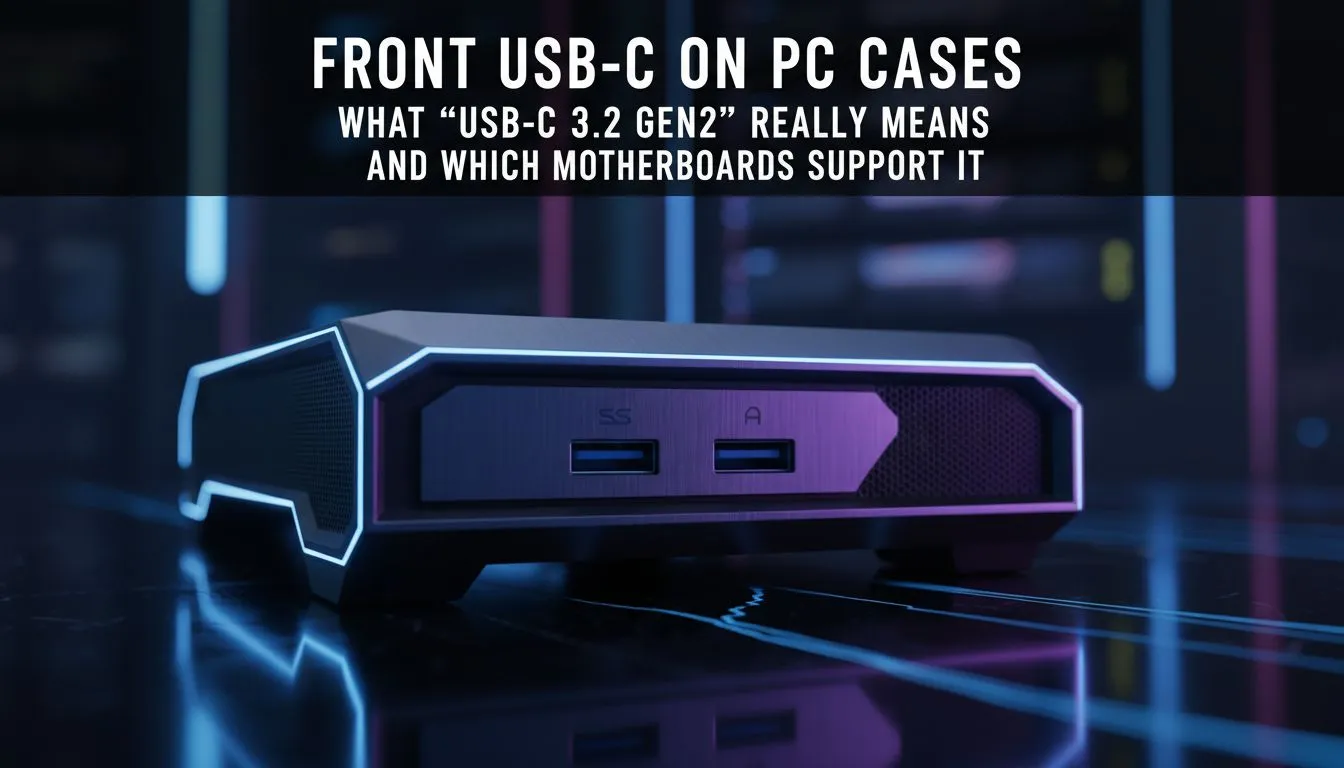
Understanding the Power of Front USB-C 3.2 Gen2
Ever tried fumbling behind your desk just to plug in a fast SSD? It is a mission that most South African gamers know too well. Front USB-C 3.2 Gen2 changes that by bringing 10Gbps speeds to your chassis I/O. If you want to optimise your setup for modern peripherals, knowing which motherboards and cases support this standard is essential for a future-proof build. ⚡
Why Speed Matters for Your Front Panel
The leap from USB 3.0 (now called 3.2 Gen1) to Front USB-C 3.2 Gen2 is significant. We are talking about doubling the theoretical bandwidth from 5Gbps to 10Gbps. For creators in Jo'burg or Cape Town handling massive video files, this means less time waiting and more time rendering.
When browsing the massive variety of computer cases on the market, look specifically for a Type-C port on the top or front panel. However, having the port on the case is only half the battle. Your motherboard must have the specific internal header to feed that port the data it needs.
Matching Your Motherboard to Your Chassis
Most modern mid-range and high-end motherboards, like the B650 or Z790 series, now include a dedicated Type-E (Key-A) 20-pin header. This is what powers the Front USB-C 3.2 Gen2 connection. If you are eyeing the sleek, premium aesthetics of Fractal Design PC cases, you will find that almost all their modern towers require this specific motherboard support to keep your desk clutter-free.
Hardware Sync Tip 🔧
Always check the "Internal I O" section of your motherboard specs. You are looking for a "USB 3.2 Gen 2 Front Panel Connector". If your motherboard is an older budget model, it might only have the wider 19-pin USB 3.0 header... in that case, your front Type-C port will stay dead unless you use a third-party PCIe expansion card.
High Performance Without Breaking the Bank
You do not always need to spend a fortune to get modern connectivity. Many airflow-focused Gamdias gaming cases now include Type-C support as a standard feature. This allows for rapid charging of your smartphone or seamless connection of VR headsets right from the front of your rig. 🚀
If you are building on a tighter budget, there are still options. Even some Gamdias gaming cases under R1500 offer impressive value while maintaining compatibility with the Front USB-C 3.2 Gen2 standard. Just ensure your motherboard choice aligns with the case I/O to avoid leaving a "dead" port on your beautiful new build.
Future-Proofing Your South African Gaming Rig
As we move toward a world where Type-A ports slowly disappear, having a functional Front USB-C 3.2 Gen2 port is a smart move. It ensures your PC remains relevant as new peripherals arrive. Whether you are a competitive gamer or a professional editor, the convenience of high-speed front access is a luxury that quickly becomes a necessity. ✨
Ready to Upgrade Your Connectivity?
Don't let slow transfer speeds hold your build back. Whether you need a high-end motherboard or a chassis with the latest I/O, we have the gear to get you up to speed. Explore our latest range of motherboards and components and build your dream PC today.