A capable laptop will run Fusion 360 for sketching and small parts, but the moment you load a complex assembly with hundreds of components, the difference between the minimum spec and the recommended spec stops being academic. Autodesk publishes both, and the gap between them is where most slowdowns, lag and crashes live.
Quick Answer
Fusion 360 needs a minimum of 8GB RAM, 40GB free storage and a DirectX 11 GPU with at least 1GB of dedicated VRAM. Autodesk recommends 16GB RAM or more for working comfortably with assemblies, a dedicated GPU with 4GB VRAM, and an SSD. The minimum runs the software, the recommended spec is what makes it pleasant to use on real projects.
The official minimum requirements
The minimum is what gets Fusion 360 to launch and run small jobs. It calls for a 64-bit Windows 10 or 11 install (or macOS on the Mac build), 8GB of system RAM, and a graphics card that supports DirectX 11 with 1GB of dedicated VRAM. You need roughly 40GB of free storage for the install plus working files, and a CPU of at least four cores running around 1.7GHz or faster.
On this spec, Fusion 360 works for single-part modelling, light sketching and simple parametric work. Where it falls down is assemblies, rendering and simulation. With only 8GB of RAM and integrated graphics, larger files swap to disk, the viewport stutters when you orbit, and cloud renders take noticeably longer.
The recommended requirements, and why they matter
Autodesk's recommended configuration is the realistic target for anyone doing CAD work daily. It calls for 16GB of RAM or more, a dedicated GPU with 4GB of VRAM, an SSD rather than a mechanical hard drive, and a modern multi-core processor running 3GHz or above.
Why RAM is the first thing to upgrade
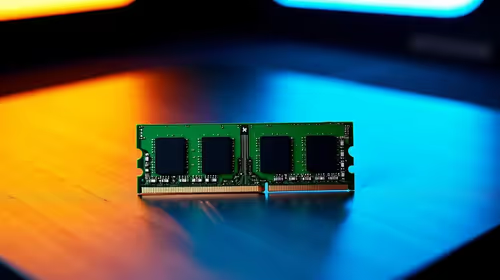
Fusion 360 holds the entire active assembly in memory. A part or two fits comfortably in 8GB, but an assembly with hundreds of bodies, joints and references can easily exceed it. Once you run out of physical RAM, Windows pages data to disk, and orbiting or editing the model becomes choppy. Moving from 8GB to 16GB is the single upgrade most users feel immediately, and 32GB is sensible if you regularly open large assemblies or run simulations.
Why the GPU is more about VRAM than raw speed
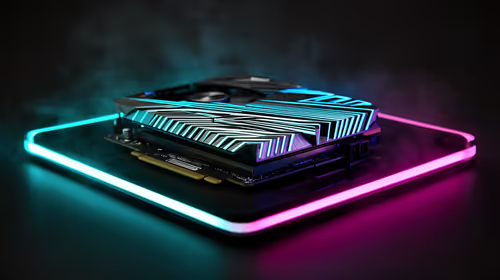
Fusion 360 is not as GPU-heavy as a game, but it leans on the graphics card for viewport rendering and for accelerated local renders. The 1GB minimum VRAM keeps the viewport functional, but 4GB or more lets you rotate dense models smoothly and shortens the time the local render engine takes. A dedicated GPU also frees system RAM that integrated graphics would otherwise borrow.
Why an SSD is effectively required
Autodesk lists an SSD under recommended rather than minimum, but in practice it should be non-negotiable. Fusion 360 streams files to and from Autodesk's cloud and reads large local caches constantly. A mechanical drive turns every save, open and sync into a wait. An NVMe SSD removes that bottleneck and is one of the cheapest meaningful upgrades you can make.
CPU: cores versus clock speed
Fusion 360's modelling engine still leans heavily on single-thread performance, so a high clock speed helps with sketching, constraints and feature regeneration. Simulation and rendering, by contrast, scale across multiple cores. The practical sweet spot is a modern six- to eight-core CPU with a strong single-core clock, which covers both the responsive modelling you do all day and the occasional heavy compute job. Chasing core count alone, with a weak per-core clock, leaves the interactive parts of the workflow feeling sluggish.
Desktop or laptop for Fusion 360?
Both work, and the choice comes down to whether you need to model on the move. A desktop gives you more thermal headroom and easier upgrades for the same money. A laptop wins on portability for students moving between res, campus labs and home. If you go the laptop route, prioritise a model with a dedicated GPU and at least 16GB of RAM rather than a thin-and-light with integrated graphics. For the desktop side, the workstation and creator components in the 3D printing and maker range at Evetech pair naturally with a CAD build. Students kitting out a mobile setup will find the cooling pads, external drives and peripherals that round out a workstation among the most-bought accessories at Evetech.
Who needs the recommended spec, and who can save
If your work is occasional, single parts, light sketching, a 3D-printable bracket here and there, the minimum spec genuinely covers you and there is no need to overspend. If Fusion 360 is part of your daily workflow, you design assemblies, or you run renders and simulations, the recommended 16GB RAM, 4GB-VRAM dedicated GPU and SSD configuration pays for itself in time saved. The common mistake is buying to the minimum, then fighting lag on every assembly for the life of the machine.
Frequently Asked Questions
Can Fusion 360 run on 8GB of RAM?
Yes, it launches and runs on 8GB, which is the official minimum. You will feel the limit on assemblies and renders, where the software runs out of memory and pages to disk. For comfortable daily use, 16GB or more is the target.
Does Fusion 360 need a dedicated graphics card?
The minimum only requires a DirectX 11 GPU with 1GB VRAM, which integrated graphics can sometimes meet. For smooth viewport performance and faster local rendering, Autodesk recommends a dedicated card with at least 4GB of VRAM.
Is Fusion 360 better with a faster CPU clock or more cores?
Both matter for different tasks. Interactive modelling, sketching and feature regeneration favour single-thread clock speed, while simulation and rendering scale across cores. A modern six- to eight-core chip with a strong per-core clock covers both.
How much storage does Fusion 360 need?
Plan for at least 40GB of free space for the install and working files. An SSD is strongly recommended because Fusion 360 reads and writes local caches and syncs to the cloud constantly, and a mechanical drive slows every save and open.
Will Fusion 360 run well on a laptop?
It will, provided the laptop has a dedicated GPU and at least 16GB of RAM. Avoid thin-and-light machines with integrated graphics for assembly work, and prioritise cooling, since sustained CAD loads heat a laptop quickly.
Building or buying a machine for CAD? Compare workstation-class hardware and dedicated GPUs in the components range at Evetech and spec a system that runs Fusion 360 the way Autodesk intends.