Got a powerful Nvidia GPU but staring at a FreeSync monitor, wondering if you've made a costly mistake? Relax. For years, silky-smooth, tear-free gaming meant shelling out for a pricey G-SYNC monitor. But times have changed. Thanks to Nvidia's G-SYNC Compatible program, you can unlock buttery variable refresh rate (VRR) performance on many FreeSync screens.
Let's break down how this tech works and how you can get it running in minutes. 🚀
What Exactly is G-SYNC Compatible?
At its core, G-SYNC Compatible is Nvidia's way of validating FreeSync monitors that deliver a solid baseline VRR experience with their GeForce GPUs.
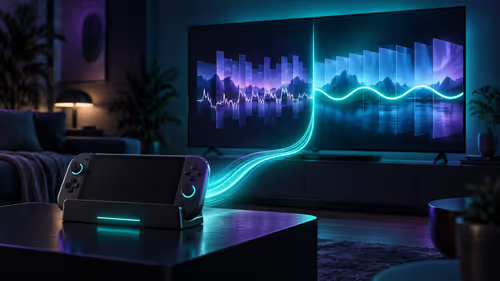
So, what’s VRR? It allows your monitor's refresh rate to dynamically match the frames-per-second (FPS) your graphics card is pushing out. This eliminates ugly screen tearing and stuttering, especially when your frame rate fluctuates.
Previously, this required a special G-SYNC hardware module inside the monitor, which added to the cost. FreeSync, an open standard from AMD, offered a more affordable alternative but was locked to AMD GPUs. Now, the G-SYNC Compatible program bridges that gap, using the VESA Adaptive-Sync standard (which FreeSync is built on) to bring VRR to Team Green users on a wider, more affordable range of PC monitors.
How to Enable G-SYNC on Your FreeSync Monitor
Ready to give it a try? The process is surprisingly simple, provided you meet a few requirements: an Nvidia GeForce 10-series GPU or newer, and the latest Nvidia drivers.
Here’s the step-by-step:
- Connect via DisplayPort: This is crucial. Ensure your monitor is connected to your GPU using a DisplayPort cable.
- Enable FreeSync on Your Monitor: Dive into your monitor's on-screen display (OSD) menu. Find the setting for Adaptive-Sync or FreeSync and make sure it's turned on.
- Open Nvidia Control Panel: Right-click your desktop and select "NVIDIA Control Panel".
- Set Up G-SYNC: In the left-hand menu, navigate to "Display" > "Set up G-SYNC".
- Enable and Apply: Check the box for "Enable G-SYNC, G-SYNC Compatible". Choose whether you want it for full-screen mode only or for windowed and full-screen mode. Click "Apply".
Your screen might flicker for a moment, and that's it! You're now using your FreeSync monitor with an Nvidia GPU. ✨
Cable is Key 🔧
monitor might support VRR, but are you using the right connection? G-SYNC Compatible requires a DisplayPort cable. While some newer monitors and GPUs support HDMI 2.1 VRR, DisplayPort is the guaranteed method for this feature. Make sure you're using a quality DP 1.2a or newer cable, which you can find with other essential [monitor accessories](https: www.evetech.co.za buy-monitor-accessories-368.aspx) to optimise your setup.
Does Official Certification Matter?
Nvidia maintains an official list of certified G-SYNC Compatible monitors. These are screens they have personally tested to ensure they provide a flawless VRR experience without flickering, blanking, or other artifacts. Choosing a certified monitor from our list of all gaming monitors is the safest bet for guaranteed performance.
But what if your monitor isn't on the list? You can still manually enable the feature using the steps above. Many unlisted FreeSync monitors work perfectly fine. However, performance isn't guaranteed, and you might encounter issues. It's a bit of a lottery, but one that often pays off.
Choosing the Right Panel for Your Setup
The beauty of the G-SYNC Compatible program is the explosion of choice it gives South African gamers. You're no longer locked into a small ecosystem.
- For Immersion: The wraparound view of curved monitors combined with smooth VRR is a potent combination for racing sims and epic RPGs.
- For Detail: If you're running a top-tier RTX card, pairing it with one of the latest high-resolution 5K and 4K monitors delivers breathtaking visual fidelity, and G-SYNC Compatible ensures it stays smooth even if your FPS dips below that native 4K target.
- For Flexibility: Even the niche world of portable monitors is seeing more high-refresh-rate options, perfect for a LAN party or a powerful on-the-go laptop setup.
Ultimately, using a FreeSync monitor with your Nvidia GPU is one of the best value-for-money upgrades you can make. You get a premium gaming feature without the premium price tag.
Ready to Eliminate Screen Tearing for Good?
The world of adaptive sync is now wide open. Whether you're after a certified G-SYNC Compatible screen or a high-refresh-rate beast, we've got the panel for you. Explore our massive range of gaming monitors and find the perfect display to match your Nvidia GPU.