Quick Answer
In South African rooms reaching 28 to 35 degrees Celsius in summer, GPU cooling design matters more than in cooler climates. A card running at 75 degrees at 20 degrees ambient can hit 90 degrees in a hot room, approaching thermal throttle thresholds. Choose a card with a larger heatsink and higher TDP thermal margin for SA conditions.
Why Ambient Temperature Changes Everything 🌡️
Every degree of ambient temperature increase adds roughly 0.7 to 1 degree to the GPU's load temperature because the heatsink rejects heat into the surrounding air, and that air is warmer. In Pretoria, Durban, and Johannesburg during January and February, room temperatures without air conditioning frequently reach 30 to 35 degrees Celsius.
A GPU that benchmarked at 78 degrees in a controlled environment might run at 88 to 90 degrees under those conditions. At 90 degrees, most NVIDIA and AMD GPUs approach their firmware-defined throttle point, reducing clock speeds and producing inconsistent frame rates during intense scenes.
Cooler Designs That Handle SA Heat Best 🔧
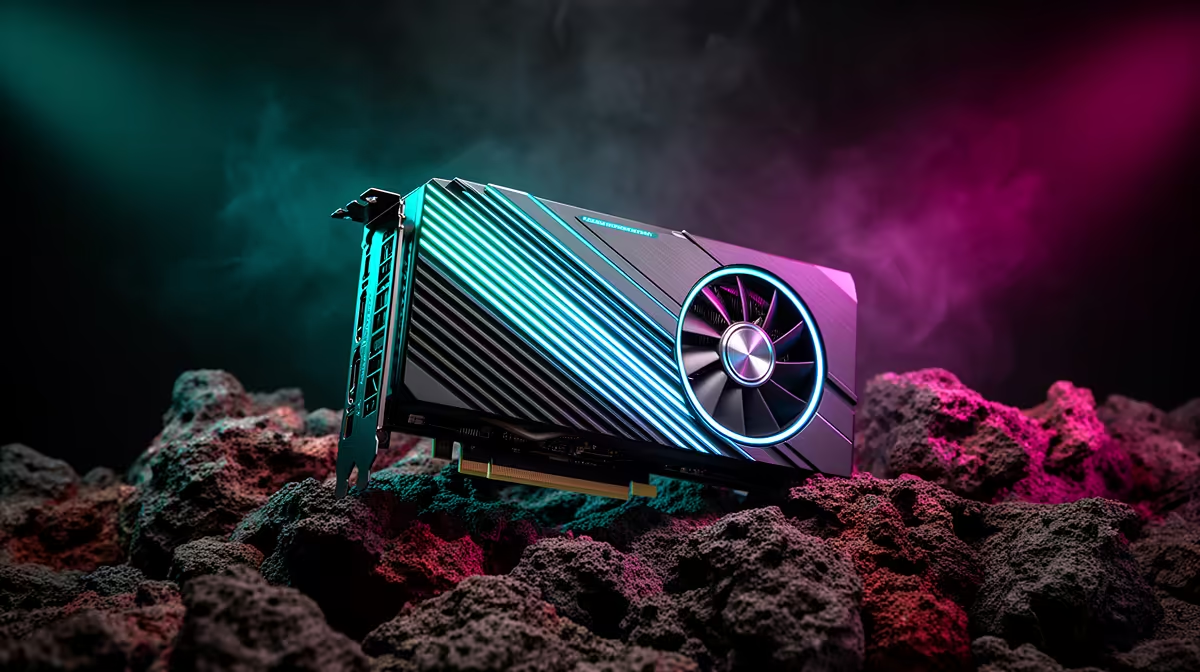
Triple-fan vapor chamber cards handle high ambient temperatures best because the vapor chamber spreads heat across the full fin array instantly. Cards from the ASUS ROG Strix, MSI Gaming X Trio, and Gigabyte Aorus lineups use vapor chambers and maintain lower delta temperatures than dual-fan alternatives under sustained gaming load.
For mid-range budgets, dual-fan cards with copper base plates and multiple heat pipes are the next best option. The Palit RTX 5060 Dual 8GB uses a copper base plate that handles moderate ambient temperatures well in the R8,000 to R12,000 price range. Single-fan blower-style cards are the worst choice for hot SA gaming rooms.
Case Airflow Modifications for Hot SA Environments 💡
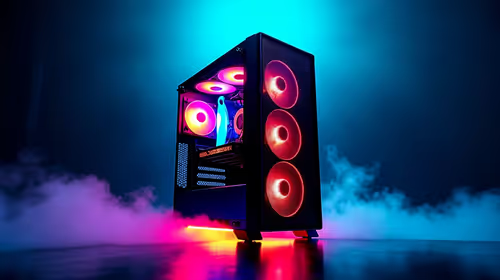
Mesh front panel cases significantly outperform solid-front designs in hot conditions. A Phanteks Eclipse P400A Mesh or Fractal Design Meshify 2 passes substantially more air, reducing GPU temperatures by 5 to 10 degrees Celsius inside the case under gaming load compared to solid-front equivalents.
Mount two or three intake fans at the front, with exhaust at the rear and top. In very hot rooms, elevating the case off the floor reduces intake air temperature by 2 to 3 degrees Celsius.
Remove Your Side Panel During Extreme SA Heatwaves ⚡
Removing the side panel during gaming in very hot weather immediately drops GPU temperatures by 5 to 8 degrees Celsius. The open case allows ambient air to flow directly over the heatsink without restriction. It is not a permanent solution but works well during the hottest weeks of Gauteng and KZN summer.
FAQ
Does GPU thermal throttling damage the card permanently?
Throttling is a protection mechanism. The card reduces clock speed to stay within safe temperature limits. Occasional throttling during heatwaves is not harmful. The risk is only significant if the card throttles constantly during normal-temperature conditions, indicating an underlying cooling problem.
Will air conditioning in the gaming room make a noticeable difference?
Yes, significantly. Dropping ambient room temperature from 32 to 22 degrees Celsius reduces GPU gaming temperature by approximately 7 to 10 degrees Celsius, often taking a throttling GPU into comfortable non-throttling territory entirely.
Are liquid-cooled GPUs worth considering for consistently hot SA environments?
Liquid-cooled GPUs deliver the lowest temperatures possible and are the definitive solution for hot ambient conditions. The cost premium typically adds R2,000 to R6,000 over an air-cooled card and requires an all-in-one cooler compatible with your GPU model.
Gaming through a SA summer in a hot room?
Evetech stocks GPUs with some of the best thermal designs available, from dual-fan compact cards to triple-fan vapor chamber models. Browse the graphics card category and check the cooling specs to find a card built for SA heat.