Quick Answer
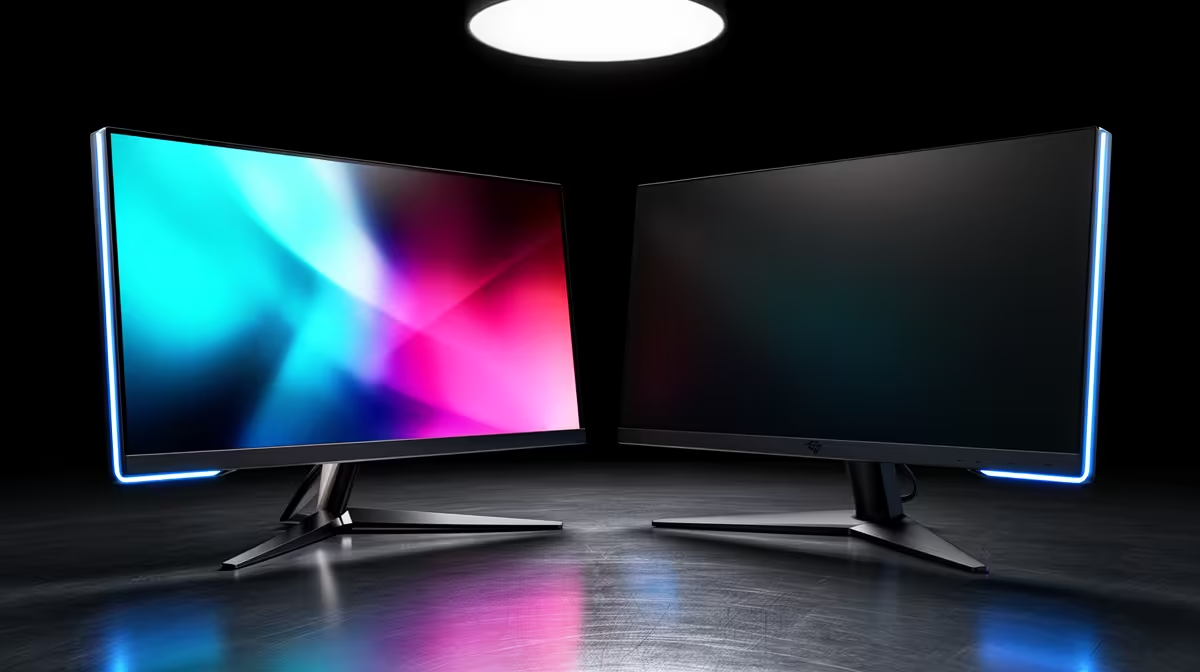
Glossy OLED delivers richer blacks, higher perceived contrast, and more vibrant colour because the surface has no anti-glare coating to scatter light. Matte gaming monitors reduce reflections significantly but add a subtle haze that softens colours and raises the apparent black floor. Glossy suits dim rooms; matte suits bright South African rooms with windows opposite the desk.
What the Surface Treatment Changes Optically 🖥️
A glossy panel has a clear coating over the OLED substrate that passes light with minimal scattering. Black pixels appear near-perfectly black because no coating diffuses ambient light hitting them, and colours look saturated. The drawback: any light source behind you reflects directly off the screen as a sharp mirror image. In a bright South African lounge with windows during daytime, a glossy OLED can be difficult to use without repositioning or blackout curtains. Matte monitors apply a micro-textured anti-glare coating that scatters reflections into a diffuse glow, making them usable in bright ambient light at the cost of slight colour softening and a higher apparent black floor.
Contrast and Colour Differences in Practice 🎨
On a glossy OLED, measured black levels approach 0.0001 nits, producing contrast ratios beyond standard measurement. In a dark room this makes space games, horror titles, and cinematic cutscenes look dramatically more striking than on any matte LCD. The DCI-P3 colour volume is fully visible with no coating-induced desaturation. Matte OLED panels currently stocked at Evetech still deliver far better contrast than any IPS or VA LCD, but a luminance floor slightly above pure black due to coating scatter lifts perceived black levels by a small margin. For colour-critical creative work, glossy OLED is preferred by most professionals who control their room lighting.
Choosing Based on Your South African Room Setup 🏠
Assess where your primary light sources are relative to your monitor. If your desk faces a window or sits under downlights behind your position, a glossy OLED will show constant reflections during daylight. A matte or semi-glossy OLED handles these conditions far better. If you game primarily in the evening in a dim room, glossy OLED's visual quality advantage is fully accessible. Many SA gamers use blackout blinds specifically to access glossy OLED quality during the day.
Bias Lighting for Glossy OLED ⚡
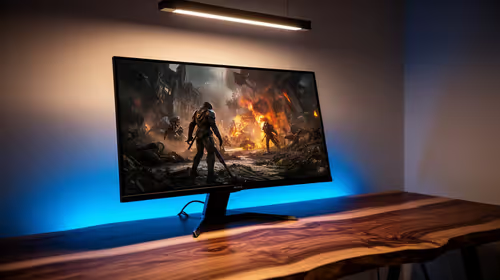
Place an LED bias light strip behind the glossy OLED monitor set to 6500K at about 10% to 15% of the panel's peak brightness. This raises ambient light enough to reduce perceived contrast between screen reflections and surroundings, significantly reducing eyestrain during long dark-room gaming sessions.
FAQ
Can you add a matte screen protector to a glossy OLED gaming monitor?
Yes, but the adhesive film adds a slight haze similar to a matte coating and can introduce Newton's rings at the edges if not applied perfectly. It is simpler to choose a matte OLED from the outset if reflections will be a persistent problem.
Do glossy OLED monitors scratch more easily than matte panels?
Both are glass-surfaced on current OLED gaming monitors. Use a dry microfibre cloth for either surface and avoid any chemical cleaners. Matte coatings are slightly more susceptible to micro-scratching from abrasive cloths.
Is the colour difference between glossy and matte OLED visible in screen photos?
Yes. Glossy panels photograph with more punch and saturation. Matte panels look slightly softer in photos even when the in-person experience is good. This matters for content creators who capture their screen as part of their workflow.
Deciding between glossy and matte OLED for your gaming setup?
Evetech stocks OLED gaming monitors in both surface treatments so you can choose based on your room, lighting and gaming style.