Whether reverb lives in a dedicated chip on the mixer or inside a plugin running on the computer is not just a technical distinction. It determines when you hear the effect, how much computing overhead the effect consumes, and whether you can adjust the sound freely in a later editing pass or are committing to a shape at the moment of recording. Hardware reverb controls compared to software-based audio processing involve a genuine set of trade-offs, and the better choice depends heavily on what you are actually trying to do with the sound.
Quick Answer
Hardware reverb runs on a dedicated DSP chip in the mixer, adding under 5ms of processing delay so you hear the effect in real time. Software reverb runs inside a plugin on your computer, which produces more variety and deeper control but adds buffer latency of 30 to 60ms and draws CPU resources during live sessions.
⚡ Hardware Reverb: Real-Time Processing Without the Tax
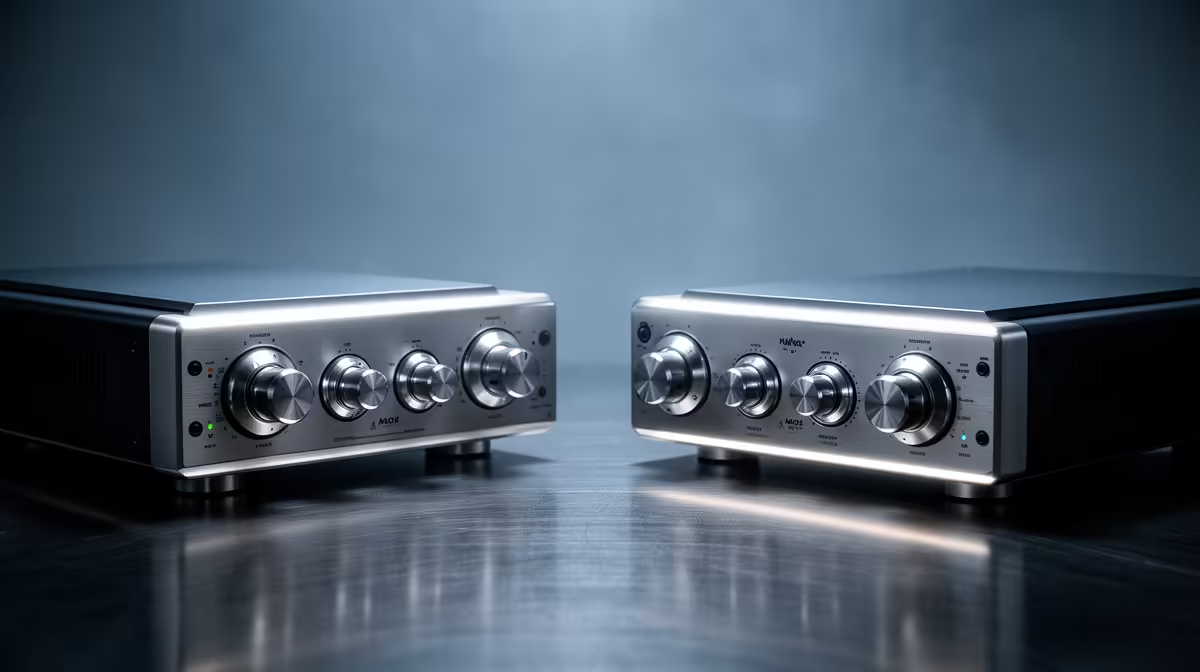
The reverb circuit on a compact audio mixer is a dedicated digital signal processing stage that works independently of the computer. It takes the input signal, applies a mathematical model of a reflective space, and outputs the wet signal to the mix bus, all within a few milliseconds.
That processing speed is the core advantage. A vocal monitored through hardware reverb sounds exactly as it will be recorded, with no perceptible gap between the dry input and the processed output. For a live podcasting session, a vocal stream, or a two-host recording where both presenters are monitoring in real time, that immediate response is not a luxury. Monitoring with a 50ms delay between speaking and hearing your own reverbed voice is genuinely disorienting and causes presenters to adjust their delivery unconsciously.
The trade-off is parameter depth. A mixer typically ships with four to eight reverb modes, often labelled by acoustic environment: small room, hall, plate, spring, and a few variations. The controls are usually a single wet-dry knob or a send level, sometimes with a decay time adjustment. What you cannot do is reshape the early reflection pattern, alter the diffusion character, or sculpt the frequency response of the tail. The reverb is preconfigured and you work within its options.
Dry Recording for Later Re-Processing
Many modern compact mixers include a separate USB send bus that outputs a dry, unprocessed version of the vocal signal alongside the main mix. When this option is available, you get the best of both worlds: the performer monitors through hardware reverb during the session, hearing the effect in real time, while the recorded track is clean and ready for a software reverb to be applied freely in post-production. This combination removes the argument that hardware reverb locks you in to a choice you might regret.
🧠 Software Reverb: Depth, Variety, and CPU Cost
A reverb plugin running inside a digital audio workstation draws on the full computing power of the host CPU. That allows fundamentally different algorithms. Convolution reverb, which mathematically multiplies the input signal against an impulse response captured from a real space, can reproduce the acoustic character of a concert hall, a cathedral, or a specific recording room with considerable accuracy. The complexity this requires is measured in processing threads rather than a chip designed for one task.
The result is a much wider palette. A single convolution plugin typically ships with dozens or hundreds of impulse responses covering spaces and acoustic environments no hardware DSP chip could hold simultaneously. Alongside convolution options, software suites include algorithmic reverbs with detailed parameter control: pre-delay in milliseconds, diffusion curves, frequency-dependent decay times, and separate controls for early reflections and the main tail.
That depth comes with a resource cost. A high-quality convolution reverb on a single vocal channel can consume between 8 and 15 percent of one CPU core during a live session. Stack multiple plugin instances across a multi-channel recording and the overhead becomes meaningful. On a capable desktop PC running a modern DAW this is manageable. On a budget laptop being used simultaneously for streaming and recording, the processing demand can cause buffer underruns that produce clicks and pops in the output.
🔧 Latency: Where the Practical Difference Shows Most
Hardware DSP reverb processes in under 5ms, which falls below the threshold of perception for the human auditory system. The wet signal feels simultaneous with the dry input.
Software reverb processes within the audio engine's buffer cycle. At a buffer size of 512 samples at 48kHz, the round-trip latency is roughly 21ms before any plugin processing is included. A computationally intensive reverb adds to that figure. In practice, software reverb monitored in real time through a standard interface can introduce between 30 and 60ms of total delay depending on buffer size and plugin load.
For mixing after recording, this latency is irrelevant because the performer is not monitoring live. For a session where a presenter or vocalist monitors through the reverb while performing, the hardware option is clearly preferable on latency alone.
Pro Tip ⚡
If you use hardware reverb for monitoring during a session, set the decay time shorter than you think you need. A 0.6 to 0.9 second decay adds subtle warmth and presence without smearing consonants. Longer tails sound impressive in isolation but obscure the clarity of spoken word in a mix, especially when two voices overlap.
🎯 Which Approach Suits Which Workflow
A live podcast or vocal stream benefits from hardware reverb because the presenter hears the mix in real time and the DSP creates no CPU demand on the streaming machine. A short-room preset adds warmth to the vocal without affecting the dry recording captured on a separate bus.
A post-production workflow, whether editing a podcast episode or mixing a music vocal, benefits from software reverb because variety and fine control matter at that stage. The latency is irrelevant and CPU headroom is available for plugin processing.
Beginners benefit from hardware reverb as a starting point because it requires no setup. A single send-level knob produces an audible improvement with no plugin installation and no parameter decisions, which is a useful foundation before plugin chains enter the picture.
Frequently Asked Questions
Does hardware reverb add latency the way software plugins do?
Hardware DSP reverb processes in under 5ms, which is below the threshold where a human ear perceives it as a delay. Software reverb adds buffer-cycle latency that typically falls between 30 and 60ms during live monitoring, which is audibly perceptible when the presenter is wearing headphones and speaking.
Can I record a dry vocal even while monitoring hardware reverb?
Yes, on mixers that include a separate dry USB send bus. The monitoring signal carries the reverb for the presenter while the recording bus captures the clean signal. You can then apply any software reverb during post-production without being constrained by the hardware shape.
Why does a software reverb tax my CPU during streams?
Convolution algorithms calculate the interaction between the input signal and a sampled impulse response at every sample point. On a demanding preset that convolution load can occupy 8 to 15 percent of a single CPU core. Multiple instances across a recording session accumulate that demand considerably.
Which delivers more variety, hardware or software?
Software reverb by a wide margin. A plugin suite commonly ships with over a hundred room types and parameter sets, plus the ability to load custom impulse responses. A hardware mixer typically provides four to eight fixed reverb modes with limited adjustment.
Is hardware reverb suitable for a live podcast with two hosts?
Yes. A short room or studio preset at 0.8 seconds decay gives the vocal tracks a professional warmth without smearing speech clarity. Both hosts hear the effect during recording and the mixer handles it without any processing load on the streaming computer.
Should a newcomer start with hardware or software reverb?
Hardware. A single wet-dry knob produces a usable result immediately with no configuration. Understanding what reverb does to a voice at different settings is a useful foundation before adding the parameter depth that software plugins offer.
Ready to add reverb to your setup without the processing headache?
Browse the audio mixer range at Evetech for hardware DSP reverb built into compact units, and find the configuration that fits your recording and streaming workflow.