

Complete Gaming Setup Guide for the SA Esports Athlete in SA 2026
Complete Gaming Setup Guide for the Esports. Clear setup instructions with SA-specific considerations, troubleshooting tips & recommended components.
Read moreStruggling with HDMI vs DisplayPort 240Hz for your high-refresh-rate monitor? Don't let the wrong cable bottleneck your performance. We break down the technical differences, bandwidth capabilities, and which standard is best for ultra-smooth gameplay. Get the clear answer now! ⚡️🎮
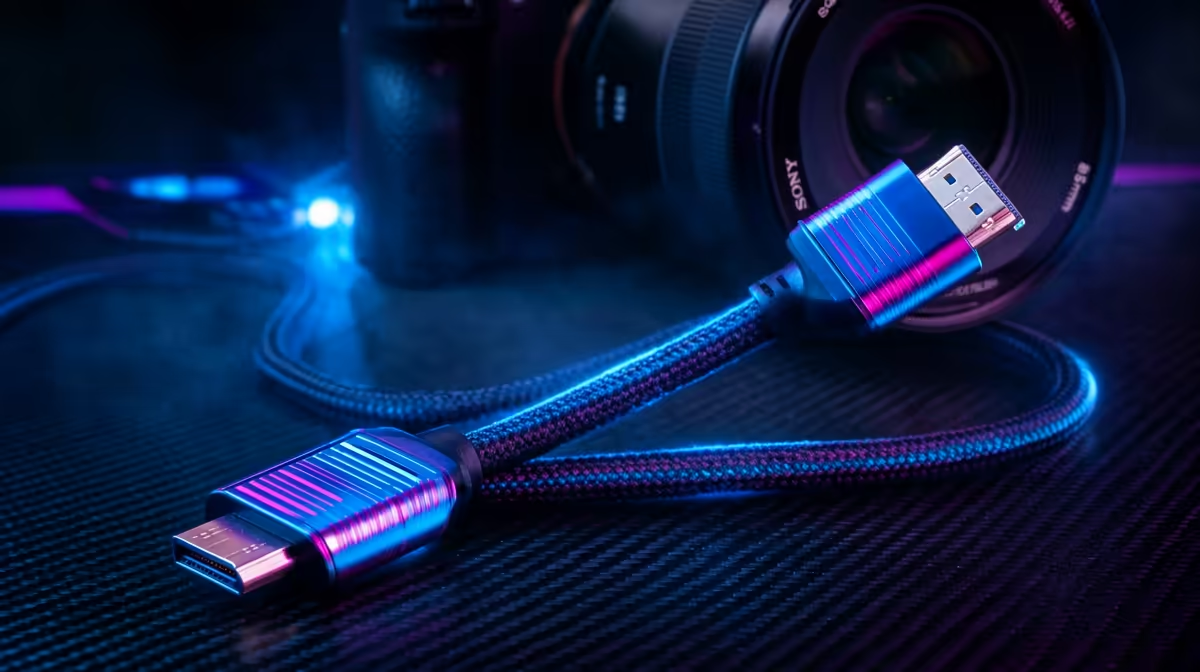
So, you've just dropped some serious ZAR on a lightning-fast 240Hz monitor, ready to dominate in Apex Legends or Valorant. But your gameplay still feels… off. Before you blame your GPU, look at that little cable connecting them. Getting the HDMI vs DisplayPort 240Hz choice right is crucial for unlocking the buttery-smooth performance you paid for. Let's plug in and find the clear winner for your South African gaming setup. 🚀
At a glance, these two cables look pretty similar, but they were built for different worlds. HDMI (High-Definition Multimedia Interface) was designed for home theatre systems—TVs, Blu-ray players, and consoles. DisplayPort, on the other hand, was created from the ground up for computers, with a focus on high resolutions and refresh rates.
While modern versions of both can handle intense gaming demands, their PC-centric roots give DisplayPort an inherent advantage that we'll explore. The key isn't just the cable, but the version number on it.
When you're pushing 240 frames per second, you're sending a massive amount of data from your graphics card to your monitor. The real question in the HDMI vs DisplayPort 240Hz debate is about bandwidth—which connection can handle that firehose of information without compromise?
For years, HDMI lagged behind for high-refresh PC gaming.
DisplayPort has long been the go-to for PC enthusiasts, and for good reason.
You'll find DisplayPort 1.4 across our entire range of gaming monitors, making it the safest bet for immediate performance.
Before buying a new cable, physically check the ports on your graphics card and monitor. Most GPUs have more DisplayPort outputs (usually 3) than HDMI (usually 1). Your monitor might also only support its maximum 240Hz refresh rate over a specific input. A quick 10-second check can save you a lot of frustration.
The debate isn't just about raw speed. A few other features can influence your decision.
For the vast majority of South African PC gamers today, the answer is clear: DisplayPort 1.4 is the winner for 240Hz gaming.
It offers the most reliable, uncompressed performance on the widest range of hardware available right now. If you're building a new rig or upgrading, ensuring your components have DisplayPort 1.4 is your ticket to silky-smooth frames.
HDMI 2.1 is an excellent, future-proof alternative, and it's absolutely essential if you're also a console gamer. But for a dedicated PC setup, DisplayPort still holds the crown. To find the perfect screen with the right ports, check out our full selection of PC monitors and match it to your graphics card.
Ready to Unleash True 240Hz? The right cable makes all the difference between winning and watching a replay. Explore our massive range of high-refresh-rate gaming monitors and get the performance that leaves lag in the dust.
DisplayPort 1.4 is generally the best cable for 240Hz gaming, especially at 1440p or higher resolutions. It offers more consistent support and features like G-Sync.
Yes, HDMI 2.1 has enough bandwidth to support 240Hz, even at 4K resolution. However, you must ensure both your graphics card and monitor have HDMI 2.1 ports to use it.
HDMI 2.0 can support 240Hz, but typically only at a 1080p resolution. For higher resolutions like 1440p, you will need DisplayPort 1.4 or HDMI 2.1 for a stable connection.
For a 240Hz monitor, you should use a DisplayPort 1.4 cable for the most reliable performance and feature support. An HDMI 2.1 cable is also an excellent choice if supported.
At the same resolution and refresh rate, there is no visual quality difference. The main difference lies in the bandwidth capabilities and support for adaptive sync technologies.
You should use a cable certified for DisplayPort 1.4 (HBR3) to guarantee enough bandwidth for 240Hz at 1440p or higher. Older, uncertified cables might not work reliably.
Complete Gaming Setup Guide for the Esports. Clear setup instructions with SA-specific considerations, troubleshooting tips & recommended components.
Read more
AIO Liquid 360mm Installation Guide for Your PC. Clear setup instructions with SA-specific considerations, troubleshooting tips & recommended components.
Read more
MacBook Display Colour Looks Wrong? Calibration. Everything you need to know with SA pricing, step-by-step instructions & expert recommendations.
Read more
Printer Terminology Guide. Everything you need to know with SA pricing, step-by-step instructions & expert recommendations.
Read more
Git on Mac: Complete Setup Guide for Beginners. Clear setup instructions with SA-specific considerations, troubleshooting tips & recommended components.
Read more
Ryzen 9 9900X Thermal Paste Dry: Reapplication. Everything you need to know with SA pricing, step-by-step instructions & expert recommendations.
Read more
AMD RX 9050 XT: Rumoured Specs, Price & Release. SA-focused analysis with local pricing data, real-world insights & actionable buying advice.
Can RTX 4080 Super Run AI Workloads for SA Developers Detailed answer with SA data, expert analysis & practical recommendations for local buyers.
Can RTX 4090 Run AI Workloads for SA Developers Detailed answer with SA data, expert analysis & practical recommendations for local buyers.
Top Settings for Intel Arc B580 at Ultrawide 1440p picks evaluated on performance, value & SA availability with current Rand pricing from Evetech.
RTX 4060 CS2 Low Settings at 1080p: FPS Results. Real-world benchmark data, FPS numbers & performance analysis. What SA gamers can actually expect.
Visual Artifacts: Possible GPU Issue Issue #1. Diagnosis steps, proven fixes & when to seek professional help. SA-specific support info included.
Can the RTX 4090 Handle 1440p 144Hz Gaming. Performance testing verdict with real data & practical recommendations for SA buyers.
Top ASUS GPU Under R15000 picks evaluated on performance, value & SA availability with current Rand pricing from Evetech.
GTA 6 Max Settings on RTX 5070. Tested & verified settings for best FPS and visual quality on SA hardware budgets.
Cyberpunk 2077 Max Settings on RTX 5080. Tested & verified settings for best FPS and visual quality on SA hardware budgets.
Starfield Max Settings on RTX 5070 Ti. Tested & verified settings for best FPS and visual quality on SA hardware budgets.
Top RTX 5090 Under R5000 picks evaluated on performance, value & SA availability with current Rand pricing from Evetech.