Quick Answer
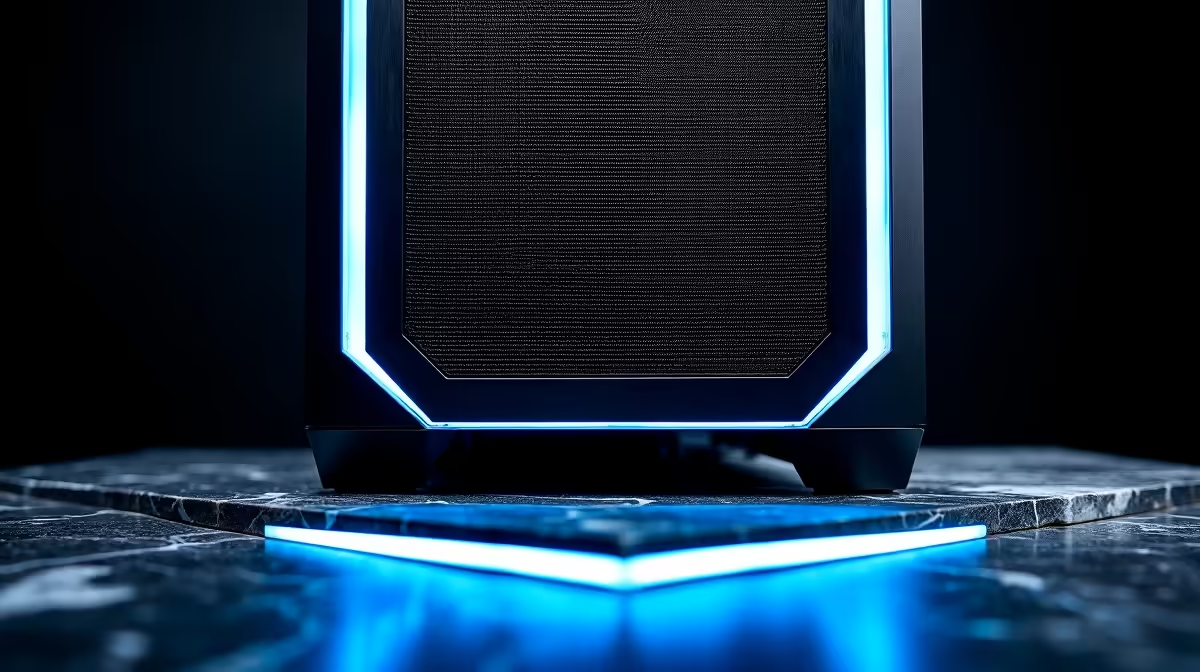
A high-porosity mesh front grill reduces intake restriction, lowering CPU and GPU temps by 3C to 8C compared to a closed front panel at equivalent fan speeds. The trade-off is that mesh fronts let in more dust and require more frequent filter cleaning, particularly in SA environments where ambient dust levels vary by season and region.
Airflow Performance: Mesh vs Closed Front 🌀
A closed front panel with side intake vents restricts airflow significantly because air must travel around the panel edges rather than entering directly through the front. This restriction raises the static pressure demand on front intake fans and reduces effective CFM delivered to the GPU and CPU cooler. A high-porosity mesh front, where 40 to 70 percent of the panel face is open area, lets intake fans operate close to their rated free-air CFM specs. In real-world builds, switching from a closed to mesh front can drop GPU junction temperature by 4C to 7C under load and CPU temps by 3C to 6C, depending on case depth and fan quality.
Dust Ingress: The Mesh Front Trade-Off 🧹
A mesh front without a fine dust filter allows more particulate matter into the case than a closed panel, which routes air through small side slots that act as natural baffles. The solution is a removable magnetic dust filter behind the front mesh. Most quality mesh-front cases include one. Cleaning frequency depends on local conditions: in Cape Town's relatively clean coastal air, monthly cleaning is adequate. In Gauteng during the dry winter months, bi-weekly cleaning of the front filter keeps dust accumulation in check. A closed front panel requires less frequent cleaning but compromises cooling performance year-round. For a dedicated gaming PC, the thermal advantage of mesh is generally worth the extra maintenance step.
Acoustic Differences Between Panel Types 🔇
Closed front panels provide a modest acoustic benefit by shielding fan noise from propagating forward. The difference is 2 to 4 dB(A) in a quiet room, which is noticeable but not transformative. Mesh fronts transmit fan noise more directly into the room. If the build is in a home studio or bedroom where noise matters, a closed front panel with well-tuned PWM fan curves (keeping fans at 30 to 40 percent duty cycle during light tasks) can maintain acceptable acoustics without sacrificing as much cooling as a fully closed design. Some cases offer a compromise: a perforated steel front that is less open than full mesh but more open than a solid panel, landing between the two extremes on both airflow and acoustics.
Add a Magnetic Dust Filter to Any Mesh Front ⚡
If your mesh-front case does not include a dust filter, cut a piece of filtration foam or magnetic filter material to the front dimensions and attach it with adhesive magnetic strips. This costs under R50 at most hardware or fabric stores and significantly reduces dust ingress without meaningfully restricting airflow. Clean it under running water every two to four weeks.
FAQ
Does a mesh front make a case significantly louder?
By 2 to 4 dB(A) in practice. At normal fan speeds this is audible in a quiet room but not intrusive. PWM curves that keep fans below 50 percent during most use reduce this difference further.
Is a closed front panel ever better for cooling?
Rarely. The only scenario is a case with bottom-mounted intake fans where a closed front is irrelevant to airflow. In all front-fan configurations, mesh outperforms closed panels for cooling.
Do mesh fronts void airflow warranties?
No. Mesh and panel type are design choices at the case level. The only consideration is matching fan static pressure to the mesh density as discussed in fan selection guides.
Looking for a case with better airflow?
Evetech stocks mesh-front and panel-front PC cases in a range of sizes and price points. Check the current selection to find a design that suits your thermal and aesthetic priorities.