Trying to frame a speaker from the back of a large conference hall or event venue reveals exactly what consumer video hardware cannot do. The subject shrinks to a tiny figure, details disappear into digital mush, and the footage that comes back from a supposedly live event looks like it was captured from a parking lot. Choosing high-zoom hardware for large SA venue streaming means thinking seriously about optics before anything else, because the camera's lens determines how much of that distance you can actually close.
Quick Answer
For venues where the stage or speaker is 20 metres or more away, target a camera with at least 20x optical zoom and built-in stabilisation. Optical reach gives clean magnification without quality loss. Hybrid or digital extension adds extra range at the cost of some softness, and a fluid-head tripod rated above 3kg keeps the framing locked at full zoom.
🔆 Why Optical Zoom Is the Non-Negotiable Baseline
Zoom ratings are not all the same, and the distinction matters far more in event work than in any casual photography context. Optical zoom is the only kind that moves glass inside the lens to close the distance without touching the original pixel data. The image quality at 20x optical is essentially the same as at 1x because all that has changed is the focal length of the lens itself.
Digital zoom is something different entirely. It takes a portion of the sensor's output and enlarges it in software, which is the same process as cropping a photo and then blowing it up. Every step of digital zoom trades resolution for reach, and at the magnifications needed for a large venue, digital extension produces footage that looks visibly degraded. For a stream watched on a large screen at 1080p, soft and mushy close-ups read as unprofessional immediately.
Hybrid zoom sits between the two, using computational processing to push reach past the optical limit with less quality cost than pure digital. A camera rated at 20x optical and 40x hybrid can cover the far end of a large hall, but the hybrid range will show some softness that pure optical does not. Keep critical close-ups within the clean optical range and treat hybrid as a reserve for establishing shots at greater distances.
Reading Zoom Specifications Without Being Misled
Camera packaging often lists the highest available zoom figure, which is typically the digital or hybrid maximum. The optical figure is buried in the specifications. Always locate the optical number specifically and treat digital extension as a reserve rather than part of the working range. For a stage 30 metres away, 20x optical is the minimum; deeper venues or elevated balcony positions may need 30x optical or more.
⚡ Stabilisation at High Zoom Magnification
Stabilisation is one of those specifications that sounds like a nice-to-have but becomes structurally essential once you push past 10x magnification. At 20x zoom, the angular movement that becomes visible in the frame is tiny. A perfectly still hand will introduce perceptible shake. The natural vibration of a heavy tripod sitting on a resonant floor in a crowded venue is easily enough to make footage at maximum zoom look unstable.
Optical image stabilisation, where a floating element inside the lens counteracts movement mechanically, handles the high-frequency micro-vibrations that cause the worst visual noise. Electronic stabilisation uses sensor cropping and digital correction, which introduces its own quality cost similar to digital zoom. For event work at high focal lengths, optical stabilisation is substantially better.
Tripod Quality at Long Focal Lengths
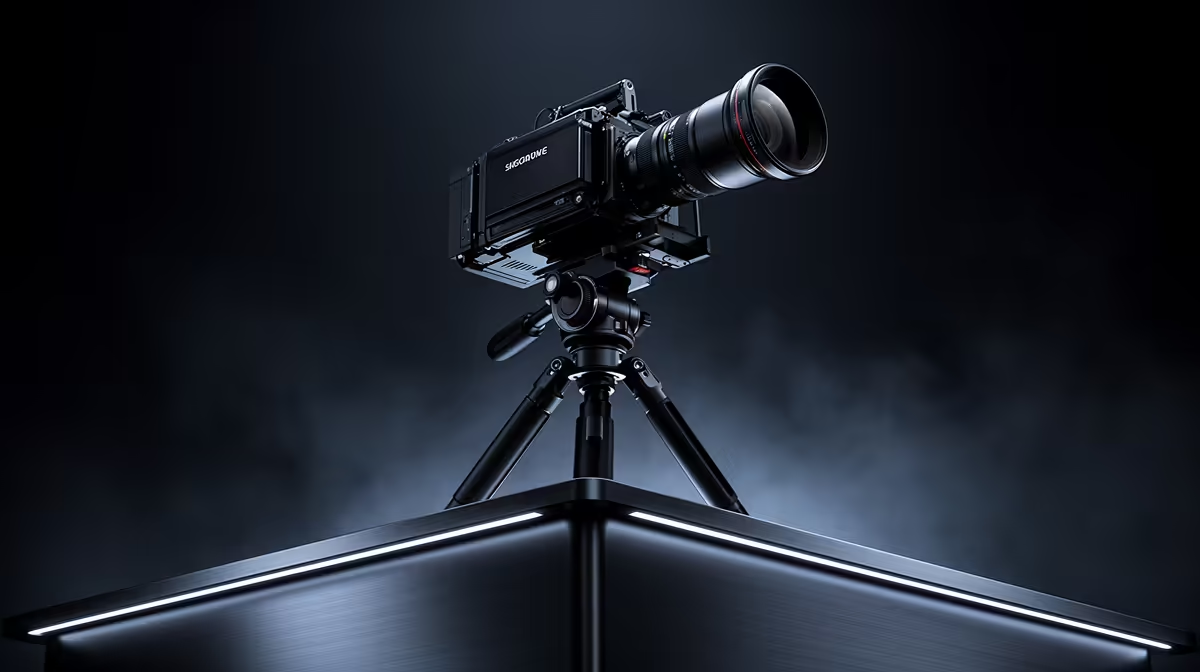
A video tripod with a fluid drag head is not optional for long-zoom event streams. The fluid mechanism creates resistance as you pan or tilt, so movements across a wide stage are smooth rather than jerky, and the head stays where you leave it between movements without creeping under the weight of a heavier camera body.
Check the weight rating of any tripod head against the combined weight of the camera body, zoom lens, and any mounted accessories. A head rated for a maximum payload of 3kg with a 2.5kg rig has no spare capacity and will behave poorly at the extremes. Giving the head meaningful headroom below its rated limit produces noticeably smoother operation.
🌐 Connectivity for Large Venue Event Streaming
Clean footage at the camera means nothing if the signal cannot reach the encoder reliably across a large, crowded venue.
Wireless video transmission in a crowded venue is vulnerable to interference from smartphones, Bluetooth devices, and personal hotspots competing for the same 2.4GHz spectrum. A 5GHz transmission system operates in a less contested band and holds up better in those conditions, though it is more sensitive to physical obstructions.
A hardwired connection eliminates interference entirely. SDI cable from the camera to a floor-level encoder is standard in broadcast work because it carries a professional signal over long runs without the degradation that consumer HDMI shows at distance. For fixed positions, an RJ45-equipped camera streaming over the venue's ethernet network is increasingly practical, since a single network cable handles both video and power together.
Pro Tip ⚡
Arrive at any large SA venue at least an hour before the event and walk the room with the camera on a tripod. Frame the stage from your actual operating position at maximum optical zoom and check that stabilisation keeps the shot clean. Discovering that a pillar or rigging truss obstructs your line of sight during soundcheck is far less stressful than during a live broadcast.
🎯 Matching Zoom Hardware to Venue Size
A framework for matching optical zoom to venue depth helps avoid both overspending on capability you will never use and underspending on reach you will constantly need.
For smaller conference rooms and boardrooms where the speaker is within 8 to 10 metres, a mid-range PTZ camera with 12x optical covers the space comfortably and adds remote pan and tilt control that is useful for switching angles without a dedicated camera operator.
For medium halls of 15 to 25 metres depth, 20x optical with stabilisation is the practical benchmark. This covers the back row cleanly and leaves hybrid extension as a reserve for unusually deep seating configurations.
For large theatres, arenas, and outdoor stadiums where the stage may be 40 metres or more away, a dedicated broadcast camcorder or PTZ with 30x optical or a separate long-range zoom lens becomes worth the investment. At these distances, the optical quality difference between adequate and excellent zoom hardware is clearly visible in the broadcast output, not just in side-by-side comparisons.
Frequently Asked Questions
How much optical zoom is needed for a 30-metre venue?
A 20x optical lens frames a speaker clearly from 30 metres with hybrid range held in reserve. At 30x optical the subject fills the frame more comfortably. Below 15x, you are relying on digital extension at that distance and the image softens noticeably on a broadcast-quality feed.
Why does camera shake look so much worse at high zoom?
When a lens is magnifying the subject 20 times, it is magnifying every movement by the same factor. A tremor of 0.1 degrees that would be invisible at 1x becomes the equivalent of 2 degrees at 20x, which is clearly visible in the frame. This is why stabilisation and a heavy, well-rated tripod head are both needed simultaneously rather than as alternatives to each other.
Does hybrid zoom affect all footage, or only beyond the optical limit?
Only beyond the optical limit. Within the optical range, image quality is determined entirely by the glass. Past the optical maximum, hybrid processing takes over and softness increases with distance beyond that point. Mark the transition point on your zoom control so you know when you have crossed it.
Why stream wired rather than over Wi-Fi at a venue?
Venue Wi-Fi becomes unpredictable under the load of hundreds of connected devices. Even strong signal can suffer dropped packets during an event, causing frame drops or brief disconnections. A wired ethernet or SDI connection delivers a stable feed regardless of crowd density.
Ready to cover your next large SA venue event without losing the shot?
Browse the streaming cameras, PTZ cameras, and tripod systems at Evetech to find the long-zoom setup that frames every moment cleanly from the back of the hall.