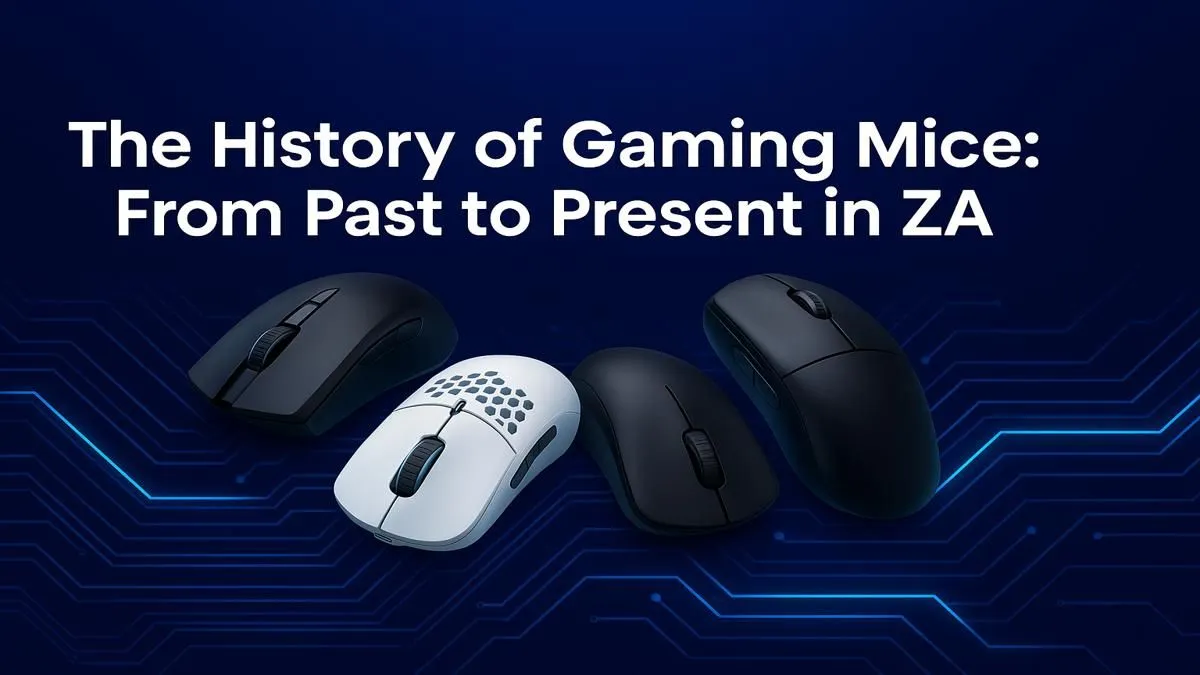
Remember the dark ages? When you had to pause your game of Quake not because of lag, but because your mouse was full of... gunk? That little grey ball of dust you’d scrape from the rollers was a rite of passage for every 90s PC gamer in South Africa. The history of gaming mice is a wild ride from those clunky mechanical beasts to the feather-light, hyper-accurate tools esports champions use today. 🚀
The Dawn of Point-and-Click: The Humble Ball Mouse
Before pinpoint accuracy was a thing, there was the ball mouse. Inside its beige plastic shell, a heavy, rubber-coated steel ball rolled across your desk (or your textbook, let's be honest). This ball spun two perpendicular rollers that translated your physical movements into on-screen motion.
It worked... most of the time. But it was heavy, imprecise, and a magnet for every crumb and piece of lint in a five-metre radius. Cleaning it was a mandatory, and slightly gross, ritual. The idea of this device being used for competitive gaming was laughable; it was a tool for navigating Windows, not landing headshots.
The Optical Revolution: A Beam of Light
The first major leap in the history of gaming mice came with the optical sensor. The ball and rollers were gone, replaced by a small LED that lit up the surface and a tiny sensor that effectively took thousands of pictures per second to track movement.
Suddenly, everything changed.
- No Moving Parts: No more cleaning out fluff-balls!
- Greater Precision: Tracking was smoother and far more reliable.
- Surface Versatility: It worked on almost any surface without a dedicated mousepad.
This innovation laid the foundation for all of today's incredible gaming mice, turning a simple peripheral into a tool capable of pixel-perfect accuracy.
From Office Tool to Weapon of Choice 🖱️
With optical technology sorted, companies started asking: what if we designed a mouse specifically for gamers? This was the true beginning of the gaming mouse as we know it. Early legends like the Razer Boomslang and Logitech MX518 weren't just office mice painted a different colour; they were purpose-built.
This part of gaming mouse history introduced features that are now standard:
- Higher DPI: Allowing for faster and more sensitive cursor movement.
- Programmable Buttons: For macros and keybinds.
- Ergonomic Shapes: Designed for comfort during marathon gaming sessions.
For competitive players, the flawless connection of a classic wired mouse was non-negotiable, ensuring zero input lag when every millisecond counted.
DPI vs. Polling Rate: What's the Difference? 🔧
DPI (Dots Per Inch) is sensitivity—how far your cursor moves on screen for every inch you move the mouse. Higher isn't always better; pros often use 400-1600 DPI. Polling Rate (measured in Hz) is how often the mouse reports its position to your PC. 1000Hz (1ms response time) is the standard for competitive gaming, ensuring your movements are registered instantly.
Cutting the Cord Without Compromise
For years, "wireless" was a dirty word in gaming circles. Early wireless mice were plagued by noticeable input lag, signal drops, and a constant hunger for AA batteries. They were fine for browsing, but a death sentence in a competitive match.
Thankfully, the evolution of the gaming mouse didn't stop there. Brands invested heavily in R&D, creating proprietary 2.4GHz wireless technologies that finally solved the latency problem. Today's top-tier modern wireless mouse options are indistinguishable from their wired counterparts in terms of performance, offering esports-grade reliability with total freedom of movement.
Finding Your Perfect Gaming Mouse in SA ✨
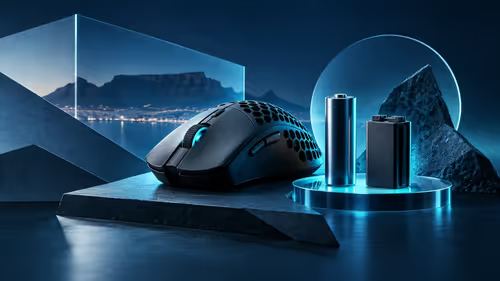
The long history of gaming mice has brought us to an era of incredible choice. From ultra-lightweight honeycomb designs to ergonomic powerhouses with a dozen buttons, there’s a perfect mouse out there for every gamer and every budget. When choosing, consider your grip style (palm, claw, or fingertip), the types of games you play, and how much you want to invest.
Here in South Africa, you don't have to break the bank to get a competitive edge. You can find great budget-friendly options under R1000 that are a massive upgrade from any standard office mouse. If you're ready to get serious, the mid-range mice under R2000 offer fantastic sensors and build quality. For those who demand the absolute best, the premium performers above R2000 pack in the latest technology.
No matter your budget, you can always check out the best gaming mouse deals to find exceptional value on your next upgrade.
Ready to Upgrade Your Aim?
The history of gaming mice shows how far we've come. Ditch the lag, forget about cleaning fluff-balls, and find the perfect tool for your victory. Explore our massive range of gaming mouse deals and find your next competitive edge.