Quick Answer
ATX 3.1 PSUs improve modern PC compatibility in three concrete ways: they introduce the 16-pin 12V-2x6 connector that delivers up to 600W to PCIe 5.1 GPUs without adapter cables, they specify transient power handling up to 200% of rated capacity to prevent voltage droops during GPU boost spikes, and they update cable and safety specifications that reduce fire risk from overloaded connectors under sustained high-draw conditions.
The 12V-2x6 Connector and Why It Matters 🔌
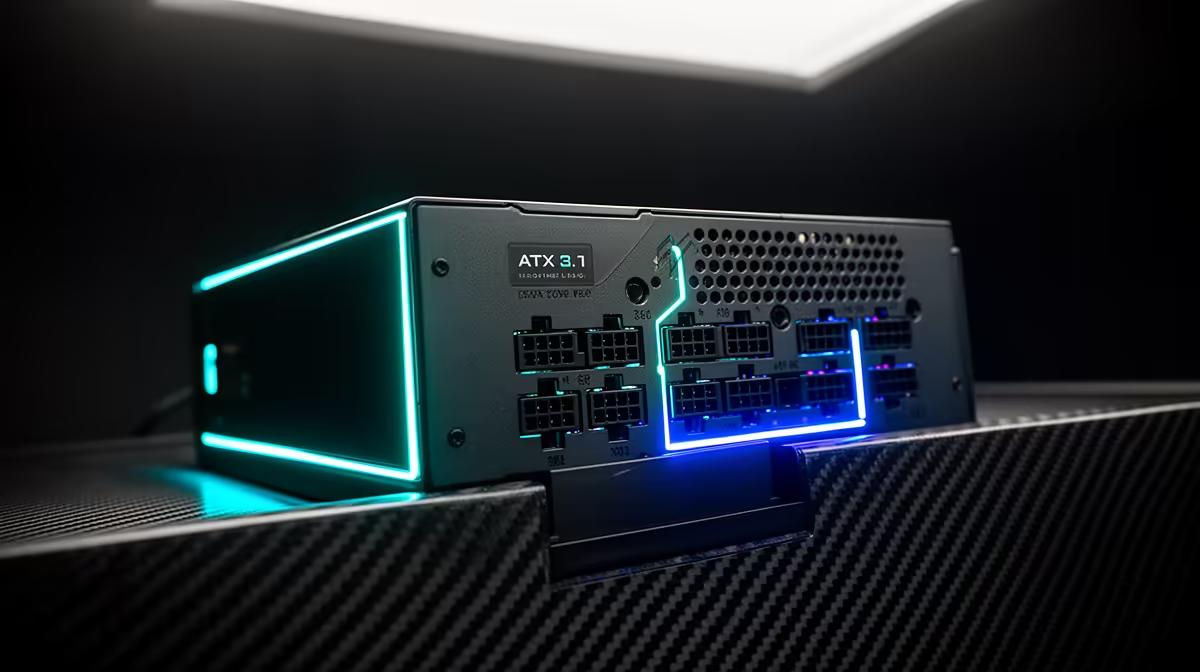
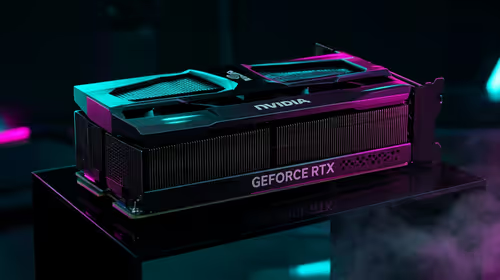
The 16-pin 12V-2x6 connector in ATX 3.1 replaces the 12VHPWR connector from ATX 3.0 PSUs. The 12V-2x6 has improved contact retention, shorter pin protrusion to prevent over-insertion, and reinforced housing for sustained 600W delivery. RTX 5090 and RTX 5080 cards use this connector natively. Legacy PSUs require an adapter combining multiple 8-pin PCIe cables, introducing resistance at multiple junction points and a thermal risk under high-draw operation. An ATX 3.1 PSU with a native 12V-2x6 cable eliminates this risk entirely.
Transient Power Handling: The Spec That Prevents Throttling 🖥️
Modern GPUs from the RTX 50-series and RX 9000-series spike power draw dramatically during rapid scene transitions and shader compilation bursts. An RTX 5090 can momentarily demand 700W or above for milliseconds at a time even with a 575W rated TGP. ATX 3.1 specifies that the PSU must handle 200% of rated capacity in transients lasting up to 100 microseconds and 150% for up to 10 milliseconds. This prevents the momentary voltage sag that causes the GPU to reduce its boost clock state to protect itself, which manifests as micro-stuttering in demanding scenes. Older ATX 2.x and even ATX 3.0 PSUs may not meet the full ATX 3.1 transient specification, making ATX 3.1 the correct baseline for RTX 5080 and 5090 builds.
Practical Upgrade Considerations for SA Builders 🔧
For SA builders upgrading a 2022 or 2023 build to include an RTX 5080 or 5090, the PSU is frequently the overlooked component that needs replacing alongside the GPU. A quality ATX 3.1 compliant 850W to 1000W Gold or Platinum PSU from Corsair, Seasonic or be quiet! sits in the R2,800 to R4,500 range at Evetech. Pairing this with the new GPU purchase at the same time avoids the frustration of discovering compatibility issues after the GPU is installed. The prior PSU may not be worthless: a quality 750W Gold unit from 2022 can continue powering a secondary build or be sold locally, reducing the effective upgrade cost.
Check for ATX 3.1 Logo, Not Just 3.0 ⚡
ATX 3.0 and ATX 3.1 are different specifications with key connector and transient handling improvements in 3.1. When purchasing a PSU for an RTX 50-series build, look explicitly for ATX 3.1 certification, not just PCIe 5.0 or high-wattage marketing language. The ATX 3.1 logo on the product page or box is the definitive confirmation.
FAQ
Can I use an ATX 3.1 PSU with an older GPU that uses 8-pin connectors?
Yes. ATX 3.1 PSUs are fully backward compatible with older PCIe connectors and GPU generations. The new 12V-2x6 cable is simply an additional cable type; all other connector types remain available on modular units.
Is ATX 3.1 the same as PCIe 5.1?
No. ATX 3.1 is the PSU specification that defines the power supply design and connector standards. PCIe 5.1 is the GPU slot and power delivery specification on the motherboard and GPU side. ATX 3.1 PSUs implement the PCIe 5.1 power connector natively, but the two are separate specifications that work together.
Will an ATX 3.0 PSU work with an RTX 5090 in SA?
An ATX 3.0 PSU can power an RTX 5090 via a compatible adapter cable, but this is not ideal for a flagship GPU. The adapter introduces additional connection points under high current, and ATX 3.0 transient handling specifications are less robust than ATX 3.1. For an RTX 5090 build, an ATX 3.1 compliant unit is the correct choice.
Upgrading to an RTX 50-series GPU?
Browse Evetech's ATX 3.1 compliant power supplies from 850W through 1200W, ready for PCIe 5.1 GPUs with native 12V-2x6 connectors.