Quick Answer
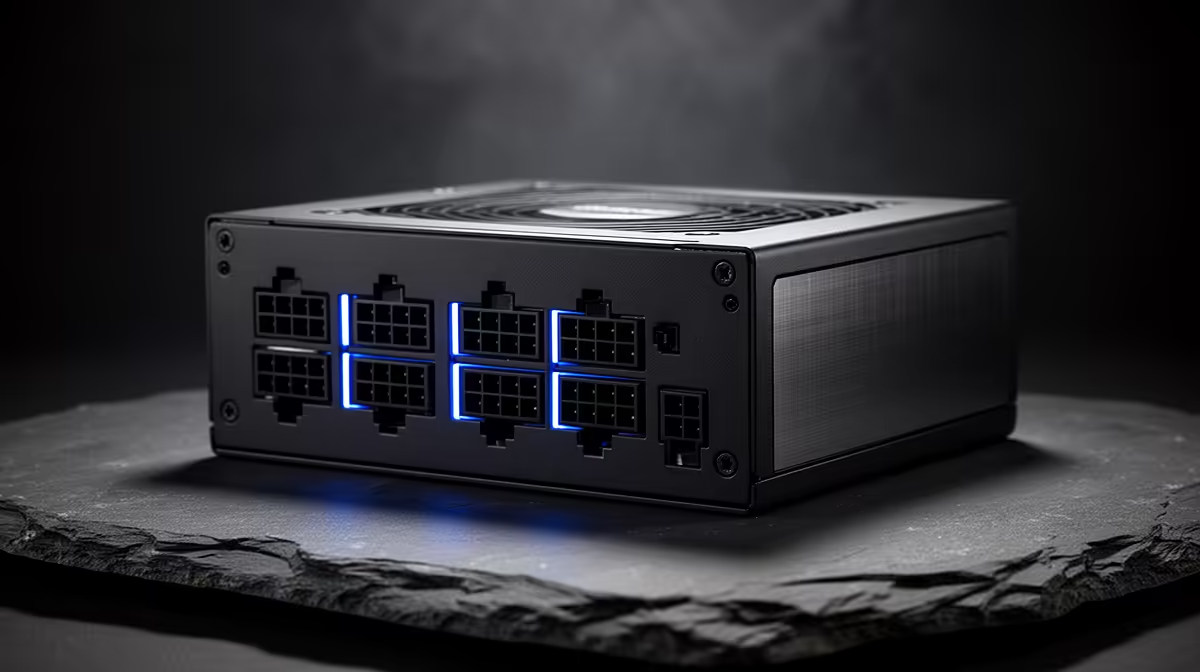
Fully modular PSUs let you attach only the cables your build actually needs, eliminating the bundle of unused wires that would otherwise sit coiled behind the motherboard tray. The result is cleaner airflow through the case, easier GPU and drive upgrades, and a build that photographs cleanly through a tempered-glass side panel.
How Fully Modular Differs From Semi-Modular and Fixed 🔧
Fixed PSUs have every cable permanently soldered to the PSU output board, whether you need it or not. Semi-modular units attach the essential 24-pin motherboard and CPU EPS cables permanently but make GPU and peripheral cables detachable. Fully modular units have zero permanently attached cables. For a typical gaming build using one GPU, one NVMe SSD, and an ATX motherboard, the needed cables are: 24-pin ATX, one or two 8-pin CPU EPS, one 12V-2x6 or 8-pin GPU, and one SATA for a fan hub. That is four to five cables versus the eight to twelve permanently attached on a fixed PSU. The unused cables on a fixed PSU have nowhere to go cleanly.
Airflow Impact Inside the Case 🌡️
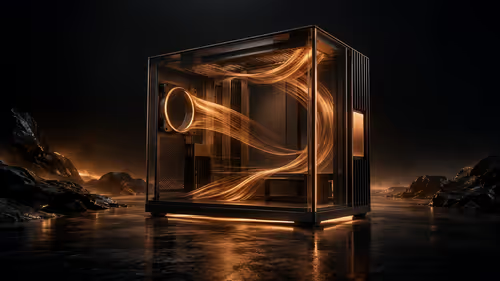
Cable bundles behind the motherboard tray restrict the return airflow path from front intake fans to rear and top exhaust. In a mid-tower with a 360mm front radiator pulling cool air inward, excess cables behind the tray can reduce effective airflow area by 20 to 35 percent. This directly raises GPU and CPU temperatures at steady state. With a fully modular PSU and careful routing of only the required cables, this obstruction is nearly eliminated. The impact is most visible on high-end SA builds using RTX 5080 or RTX 5090 cards that benefit from every degree Celsius of improved ambient air reaching the GPU heatsink.
Upgrade Flexibility and Long-Term Value 💡
When you upgrade from an RTX 5070 to an RTX 5090, the GPU cable requirement changes from a single 8-pin to a 12V-2x6 connector. With a fully modular PSU, you simply swap the GPU cable. With a fixed PSU, the cable is permanently attached and you are adding an adapter, which introduces connector resistance and reduces safety margins at high wattage. Fully modular PSUs at 850W to 1000W in South Africa carry a R200 to R500 premium over non-modular equivalents, which is negligible in the context of a high-end build where they protect significantly more valuable components.
Label Your Spare Modular Cables for Future Upgrades ⚡
Store unused modular PSU cables in a small zip-lock bag labelled with the PSU model. Modular connectors from different PSU brands are NOT cross-compatible, and mixing them can cause short circuits. When you upgrade a component and need an additional cable, using the correct cables from your original PSU set is the only safe approach.
FAQ
Can I use aftermarket sleeved cables on a fully modular PSU?
Yes, provided the cables are listed as compatible with your specific PSU model by the cable manufacturer. Reputable aftermarket cable brands publish compatibility lists. Using incompatible cables voids the safety of the PSU and can damage components.
Does cable routing affect GPU cooling temperatures measurably?
Yes in high-performance builds. For open-air coolers like those on RTX 5080 and RTX 5090 triple-fan designs, improved ambient airflow from clean cable routing can reduce GPU temperature by 3 to 6 degrees Celsius under sustained gaming.
Are flat ribbon cables worth the premium over standard modular cables in SA?
Flat ribbon cables are easier to route tightly against case surfaces and through grommets, making cable management noticeably cleaner. The R200 to R500 premium for a quality flat cable set is worthwhile for builds with a show-quality side-panel aesthetic.
Building a clean, high-airflow gaming PC?
Browse Evetech's range of fully modular power supplies and cable accessories, with local warranty coverage and fast delivery across South Africa.