Quick Answer
An infinity mirror ARGB pump head creates a deep tunnel of layered LED reflections behind a one-way mirror panel, making a single ring of LEDs appear to recede into a seemingly infinite distance. In a windowed PC build, this transforms a flat RGB logo into a centrepiece focal point visible from across a room, without adding heat or requiring wiring beyond the standard ARGB header.
The Optics Behind Infinity Mirrors 🌟
The infinity mirror effect uses two layers: a standard mirror at the back and a half-silvered one-way mirror at the front. LEDs placed between these layers reflect back and forth repeatedly, each reflection appearing slightly fainter and smaller, creating a visual tunnel with perceived depth despite the physical chamber being only 15 to 25mm deep.
On AIO pump heads like the ASUS Prime LC 360 ARGB, the LED ring sits inside this mirrored chamber. When lit against a dark background, the reflections create a three-dimensional appearance that changes character as ARGB colour cycles progress. A slow fade from deep blue to violet through the infinity chamber looks fundamentally different from the same transition on a flat LED ring because the reflections add perceived motion and depth to every lighting state.
Impact on SA Gaming Build Aesthetics 🎮
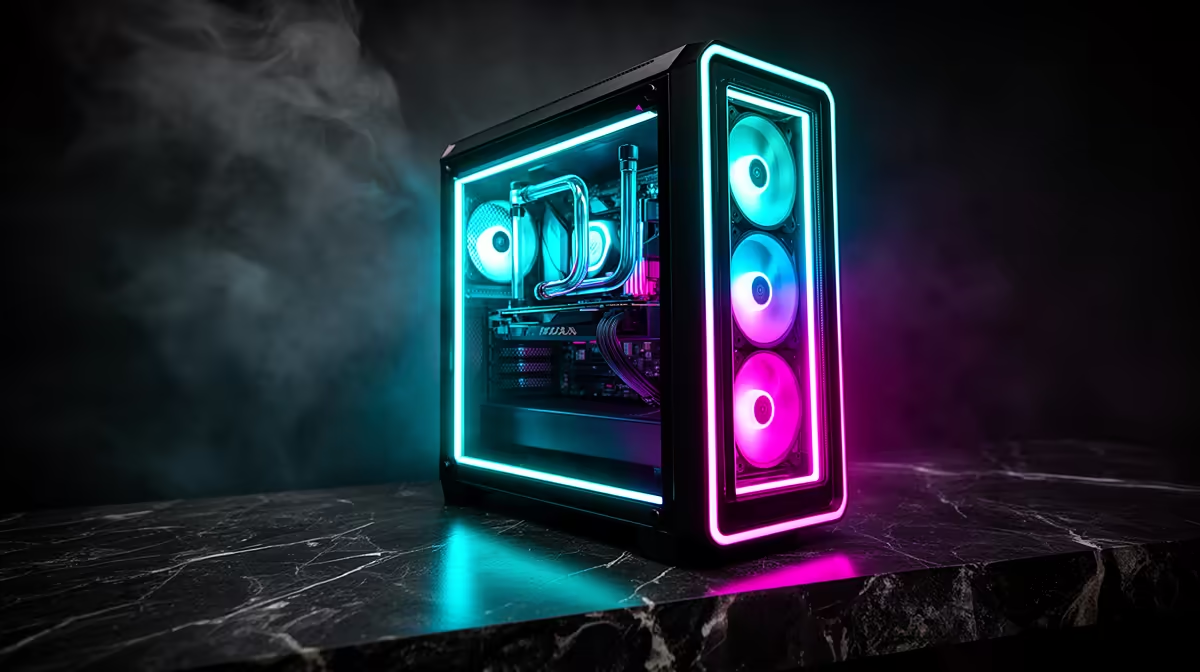
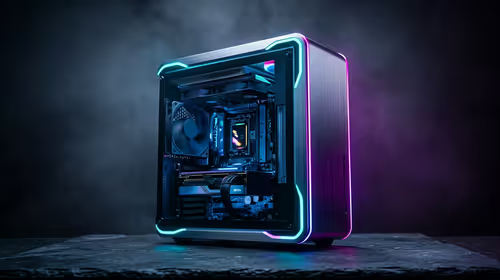
South African gaming setups increasingly feature windowed mid-towers displayed prominently on desks, particularly in Joburg and Cape Town gaming dens where dedicated gaming rooms are common among students and young professionals. In these setups the pump head is often the first component a visitor notices.
An infinity mirror pump head elevates a build's aesthetic from RGB-lit to showcase tier without custom loop plumbing or significantly larger budgets. The price premium over an equivalent-performance AIO with a flat ARGB pump head is typically R300 to R600 at Evetech, modest for the visual impact delivered. AIOs with infinity mirror designs are available in the R2,800 to R4,500 range locally.
Syncing Infinity Mirror Lighting Across Your Build 🌈
For a cohesive build, synchronise the infinity mirror pump head colour profile with case fans, GPU shroud lighting, and RAM ARGB through your motherboard's native RGB software or SignalRGB as a universal controller. The deep colour saturation of infinity mirror designs pairs best with a single-colour theme or slow gradient rather than rapid rainbow cycling, which can appear busy given the added visual complexity of the reflection effect.
Use Static Colours for Maximum Mirror Depth Visibility ⚡
The infinity mirror depth effect is most pronounced with a static or slowly breathing single colour rather than fast colour cycling. At 50 to 70 percent brightness with a deep colour like cobalt blue or emerald, layered reflections are individually distinguishable, creating the strongest perceived depth effect.
FAQ
Does an infinity mirror pump head require extra power or headers?
No. The infinity mirror is a passive optical effect requiring no additional power. The LEDs connect to the same standard 5V 3-pin ARGB header that any ARGB device uses, with no additional cable or power connector.
Can I use an infinity mirror AIO in a case without a side window?
Yes, but the effect is only visible with an open panel or a window. In a solid-panel case the infinity mirror is entirely hidden. A standard ARGB pump head performs identically and saves R300 to R600 on the AIO cost for windowless builds.
Do infinity mirror designs scratch or cloud over time?
The one-way mirror panel on quality AIO pump heads is a hard-coated acrylic that resists minor scratches. Wipe it with a microfibre cloth when cleaning your build. Avoid paper towels or dry cloths which can cause micro-scratches that gradually reduce mirror clarity.
Want a build that looks as good as it performs?
Browse Evetech's range of ARGB AIO coolers including models with infinity mirror pump head designs, available for AMD AM5 and Intel LGA 1851 platforms.