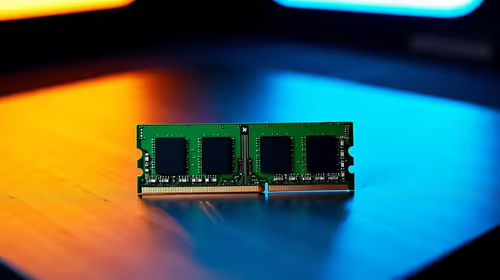
The amount of RAM you need for 3D work is not a single number, it is a ladder, and where you sit on it depends entirely on what the software is holding in memory at once. A student running parametric CAD and a studio artist rendering a 40-million-polygon scene are doing jobs that differ by an order of magnitude, and buying the wrong tier either wastes money or, worse, turns every save and render into a waiting game. The honest split breaks into three tiers: 16GB, 32GB and 64GB, each tied to a real workload rather than a marketing label.
Quick Answer
16GB comfortably covers CAD modelling and slicing for 3D printing. 32GB is the practical floor for sculpting in ZBrush and GPU rendering in Blender. 64GB becomes necessary for high-polygon scenes, large texture sets and FEA simulation. Buy for the heaviest task you do regularly, not your average one.
What Actually Eats RAM in 3D
Three things fill memory in 3D work: scene geometry, textures, and the application's own working overhead. A CAD assembly is mostly maths, lightweight on RAM but heavy on single-core speed. A sculpt is millions of polygons held live so you can push and pull them. A render holds the entire scene, every texture, and the frame buffer at once. Simulation is the most brutal: finite element analysis builds a mesh of the whole part and solves equations across every node, and the solver wants all of it resident at the same time. Understanding which of these you do most often tells you exactly which tier to target.
The 16GB Tier: CAD and Slicing
For Fusion 360, SolidWorks on modest assemblies, SketchUp and slicing software like Cura or PrusaSlicer, 16GB is genuinely enough. These tools lean on the CPU and a competent GPU more than on raw memory. A student designing parts to print, an engineer drafting brackets, or a hobbyist preparing models for a printer will rarely touch the ceiling. The moment you load a 200-part assembly or open a dozen reference tabs, you will feel the edges, but for focused single-project work 16GB holds up.
When 16GB Stops Coping
The warning signs are predictable: the application stutters when you rotate the viewport, saves take noticeably longer, and Windows starts swapping to disk. If you see your system pushing past 14GB used in Task Manager during normal work, you have outgrown the tier and every session is being throttled by paging.
The 32GB Tier: Sculpting and GPU Rendering
This is where most serious 3D artists should land. ZBrush sculpting at high subdivision levels, Blender scenes with several detailed assets, and GPU rendering in Cycles or a similar engine all sit comfortably in 32GB. GPU rendering is worth a note here: the render itself runs in the graphics card's VRAM, but the scene is assembled, textures are decoded, and the viewport is driven from system RAM first. Skimp on system memory and you bottleneck the card before it even starts. For anyone earning from 3D, or studying toward it, 32GB is the sensible default that leaves room to grow.
The Multitasking Reality
Real 3D work is rarely one app. You sculpt in one window, reference a browser with a dozen tabs, keep a texture editor open and maybe a render previewing in the background. That stack alone can claim 20GB before your main scene loads. 32GB absorbs this without forcing you to close everything each time you switch tasks.
The 64GB Tier: Heavy Scenes and Simulation
64GB stops being overkill once you work with high-polygon production scenes, 4K and 8K texture sets, dense particle systems, or any kind of physics simulation. FEA in particular is memory-hungry: stress, thermal and fluid simulations build huge node meshes and the solver needs the lot in memory to converge. Architectural visualisation with full furniture and foliage, film-grade assets, and CPU rendering of complex scenes all benefit too. If your render times or simulation runs are measured in hours, the last thing you want is the job failing because it ran out of memory at the final pass.
Matching RAM to the Rest of the Build
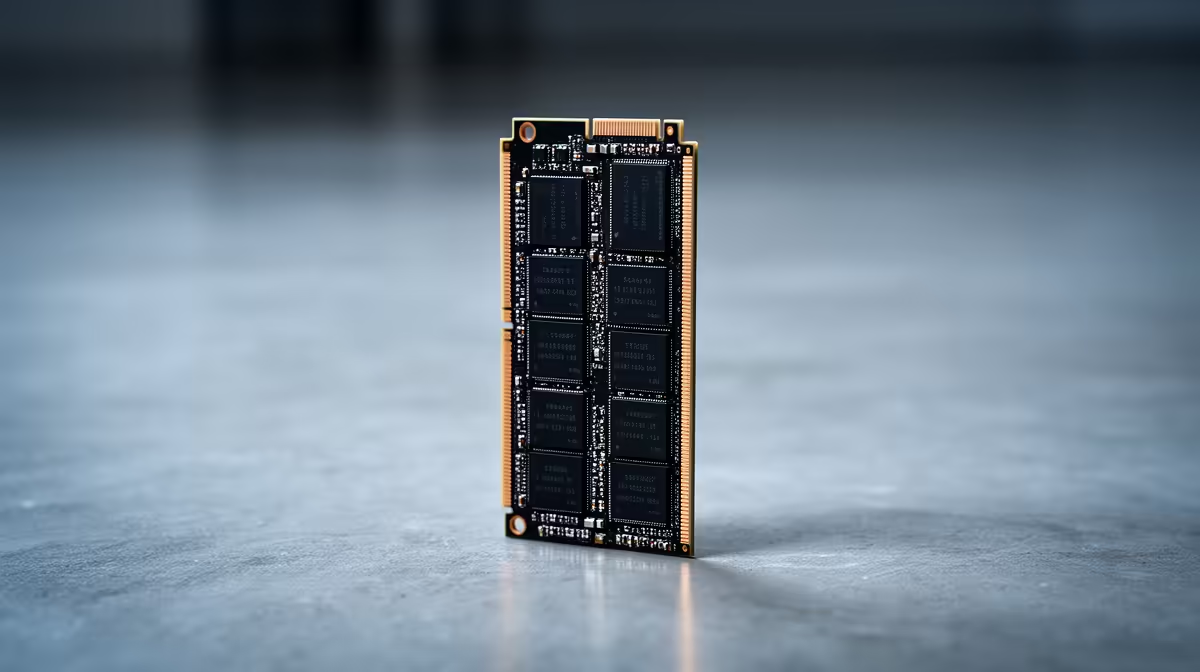
RAM does not work in isolation. Pair generous memory with a fast NVMe drive so swapping, when it happens, is less painful, and with a CPU that has the core count your renderer can actually use. For GPU rendering the card's VRAM matters as much as system RAM, so balance the two rather than over-spending on one. The current desktop kits in the DDR5 memory range at Evetech make it straightforward to start at a tier and add a second kit later. If your 3D work flows into printing, the 3D printers and related hardware on the shelves at Evetech round out a workstation built for the full pipeline. For the peripherals, cables, and accessories that complete a dedicated 3D workstation, the Evetech accessories best sellers are a practical first stop.
Frequently Asked Questions
Is 16GB enough for Blender?
For light scenes and learning, yes. For production rendering, dense scenes or heavy texture work, 32GB is the realistic floor and you will hit the limit of 16GB quickly once projects grow.
Does RAM speed matter for 3D work, or just capacity?
Capacity matters far more. Running out of RAM forces slow disk swapping that wrecks performance, while faster RAM offers only marginal gains. Buy enough capacity first, then chase speed.
Will more RAM make my renders faster?
Only up to a point. Once you have enough RAM to hold the scene without swapping, adding more does not speed up the render itself. GPU rendering speed depends on the graphics card; CPU rendering on core count.
How much RAM do I need for FEA simulation?
64GB is a sensible minimum for serious finite element analysis. Large or fine-mesh simulations can demand 128GB or more, since the solver holds the entire node mesh in memory at once.
Can I start with 32GB and upgrade later?
Yes, provided your motherboard has spare slots and you buy a kit that leaves room. Matching the new modules to the existing ones in speed and timing keeps the system stable.
Does GPU rendering reduce the system RAM I need?
No. The render runs in VRAM, but the scene is built, textures decoded and the viewport driven from system RAM first. You still want 32GB or more even when the heavy lifting happens on the card.
Building a workstation for CAD, sculpting or simulation? Explore the DDR5 memory kits at Evetech and choose the tier that matches your heaviest workload, with room to expand when your projects grow.