Quick Answer
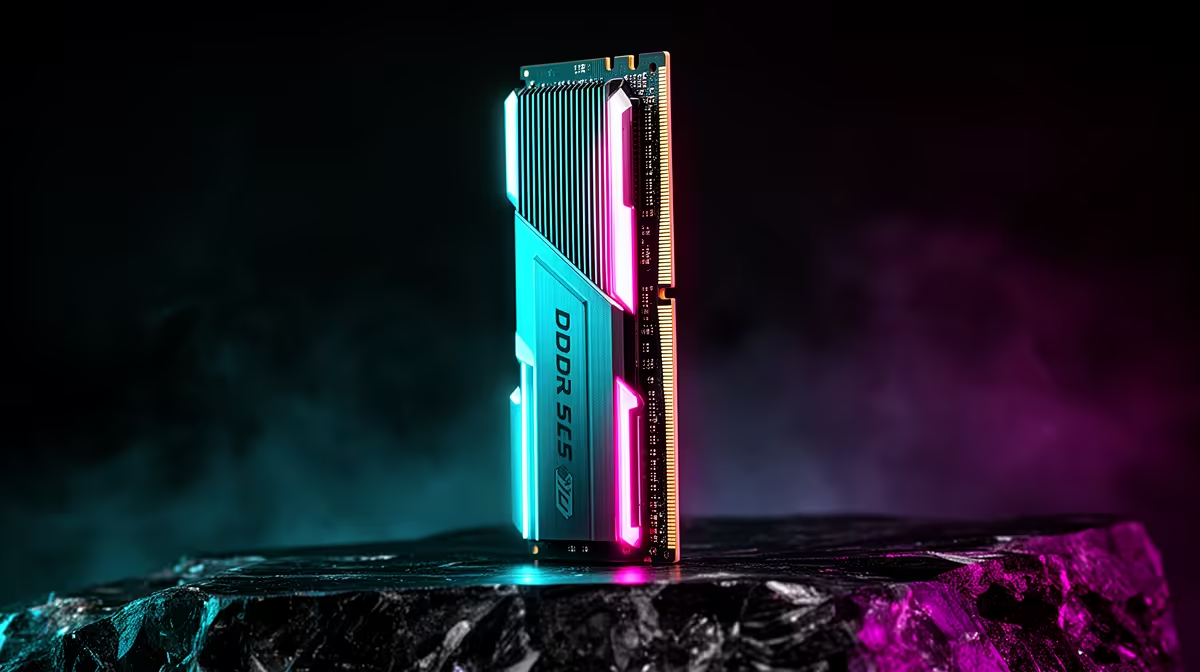
32GB of DDR5 RAM is the recommended amount for an RTX 5060 gaming PC in 2026. It prevents system RAM from becoming the bottleneck in demanding titles, supports smooth multitasking alongside gaming, and is priced accessibly enough that skipping it makes little sense when building at this GPU tier.
Why RAM Capacity Matters More Than It Used To 💾
Modern games are steadily increasing their RAM footprints. Titles like Hogwarts Legacy, Alan Wake 2, and Black Myth: Wukong routinely allocate 12GB to 16GB of system RAM alongside GPU VRAM usage. With only 16GB installed, Windows and background applications compete directly with the game for that same pool, which can cause stutters and longer level-load times even when your GPU and CPU are otherwise idle. The RTX 5060 already brings 8GB of fast GDDR7 VRAM to the table; pairing it with only 16GB of system RAM creates an imbalance that limits the overall experience. Going to 32GB removes that ceiling for most gaming scenarios in 2026.
DDR4 vs DDR5: Which Should You Pair With an RTX 5060? 🔧
If you are building around a Ryzen 7 8700F or any other AM5 processor, you are on DDR5 by default since AM5 only supports DDR5. A 32GB DDR5 kit running at DDR5-6000 CL30 is the current sweet spot for gaming on AM5, delivering meaningful bandwidth improvements over slower DDR5 base speeds. Intel's LGA1851 platform also supports DDR5. For older LGA1700 builds with an RTX 5060 upgrade, DDR4 at 3200MHz or faster in a dual-channel configuration is still perfectly capable, though you will not see the same bandwidth ceiling as DDR5. The priority in either case is always dual-channel: two sticks of 16GB each rather than one stick of 32GB.
Speed, Capacity, and Dual Channel: Getting It Right 🖥️
Dual-channel configuration doubles the memory bandwidth available to both the CPU and the iGPU path, and it matters at every tier. A 2x16GB kit at DDR5-5600 outperforms a 1x32GB stick at DDR5-6400 in real-world gaming tests. Beyond 32GB, the returns for gaming alone are minimal. 64GB is relevant for content creators running DaVinci Resolve or After Effects alongside games, but for pure gaming with an RTX 5060 it is overkill. South African DDR5 32GB kits are currently available in the R1,500 to R2,500 range depending on speed and brand, making them an easy inclusion in a mid-range build budget.
Enable EXPO or XMP After Installing RAM ⚡
New DDR5 kits default to the JEDEC base frequency at first boot, which is often 4800MHz rather than the kit's rated 6000MHz or higher. Enter your BIOS after installing RAM, find the EXPO or XMP profile, and enable it. This single step can add five to ten frames per second in CPU-sensitive titles and costs nothing.
FAQ
Is 16GB enough for an RTX 5060 gaming PC if I only game?
16GB is still functional for most games in 2026, but it is increasingly tight. Newer titles and Windows 11 background services eat into that headroom, and you may notice stuttering in open-world games. 32GB is a stronger foundation if you are spending R18,000 or more on a system.
Does RAM speed affect the RTX 5060's gaming performance?
On AMD AM5 platforms, faster RAM has a measurable effect on gaming frame rates because Ryzen processors use an Infinity Fabric that scales with memory speed up to around DDR5-6000. On Intel platforms the gains are smaller but still present in CPU-limited scenarios.
Can I upgrade RAM later if I start with 16GB?
Yes, provided your motherboard has two or more free DIMM slots and your existing kit is not soldered. Most desktop ATX and mATX boards offer four slots. When upgrading, match the speed and timings of your existing sticks or replace both sticks as a matched pair for guaranteed stability.
Building or upgrading an RTX 5060 gaming PC?
Evetech stocks pre-built RTX 5060 systems with 32GB configurations as well as individual DDR5 RAM kits. Visit the gaming PC section to compare what is currently available.