Quick Answer
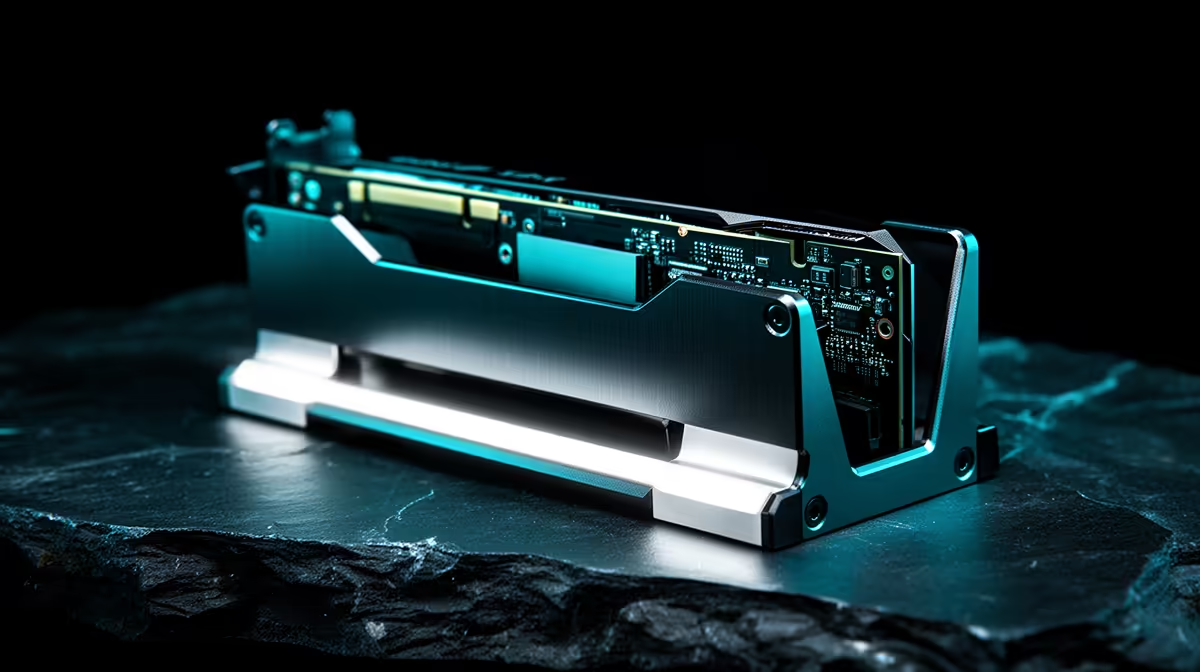
For a premium build, budget R250 to R450 for a GPU holder. That range covers rigid aluminium or steel brackets with rated load capacities above 1.5 kg, adjustable height posts, and silicone contact pads. Going below R150 risks a flimsy bracket that flexes under a heavy card; going above R500 buys mainly cosmetic finishes that do not add structural benefit.
What the Price Tiers Actually Get You 💰
In the South African accessory market, GPU holders broadly fall into three tiers. At R80 to R180, you get basic single-post plastic or lightweight aluminium brackets, often with a fixed height or a simple screw-adjust mechanism. These are adequate for dual-slot mid-range cards like an RX 7600 or RTX 4060 but marginal for anything heavier. The R180 to R350 mid-tier brings heavier-gauge aluminium or steel construction, notched height adjustment, and rubber contact pads. This tier handles most builds correctly, including three-slot cards in the RTX 4070 Ti range. The R350 to R500 premium tier adds aesthetic touches like ARGB lighting, machined aluminium in white or black anodised finishes, dual-post designs, and rated load capacities of 2 kg or more. For a flagship build centred around an RTX 5080 or RX 9070 XT, the premium tier is appropriate because the structural integrity matches what those cards demand.
Scaling the Budget to Your Build Value 🖥️
A useful heuristic is to spend roughly 1% to 2% of your GPU's cost on its holder. A R20,000 RTX 5080 justifies a R200 to R400 bracket without hesitation. A R9,000 RTX 4060 Ti is adequately served by a R150 to R250 mid-tier option. The logic is straightforward: a holder that costs 1.5% of your GPU is cheap insurance against connector stress that could require an expensive warranty claim or out-of-warranty repair. Keep in mind that local warranty service on high-end graphics cards in SA can take two to four weeks, meaning the card is out of your hands for that duration if something goes wrong.
Where You Should Not Cut Corners 🔧
Avoid buying a holder without a stated load rating, especially for three-slot cards above 1.5 kg. A bracket that flexes under load provides psychological comfort but no real structural support. Similarly, do not buy a bracket purely for its ARGB lighting if the underlying post is thin stamped steel. Lighting is a bonus; the post rigidity is the product. If the listing shows no weight capacity and the post looks undersized in the product photos, pass on it regardless of price.
Factor In Matching Colour Upfront ⚡
In a white or full-colour-themed build, sourcing a matching GPU holder at build time costs the same as at any other point, but hunting for a specific colour after the fact can lead to compatibility surprises. Add the holder to your initial parts list alongside your case and fans so you shop for everything together.
FAQ
Is R450 too much to spend on a GPU holder for a mid-range build?
Yes. A mid-range build with a dual-slot GPU around R8,000 to R12,000 is better served by a R150 to R250 holder. Save the R450-tier options for flagship three-slot cards that genuinely need the rated load capacity and heavier construction.
Do more expensive GPU holders look noticeably better inside a case?
Often, yes. Premium holders with machined aluminium and ARGB accents look significantly cleaner inside a window panel case compared to bare black stamped-steel options. Whether that matters depends on your build theme and how much you care about the interior appearance.
Can I use a DIY solution instead of buying a holder?
Builders use folded aluminium strips, wooden dowels, and 3D-printed posts as DIY solutions. These can work but rarely apply force as evenly as a purpose-built bracket, and they look far worse inside a clean build. For a premium build, the R250 to R450 spend is the correct choice.
Building a premium rig and need the right GPU bracket for your budget?
Evetech stocks GPU holders across all price tiers. Browse the accessories section to match the right bracket to your card and build value.