Quick Answer
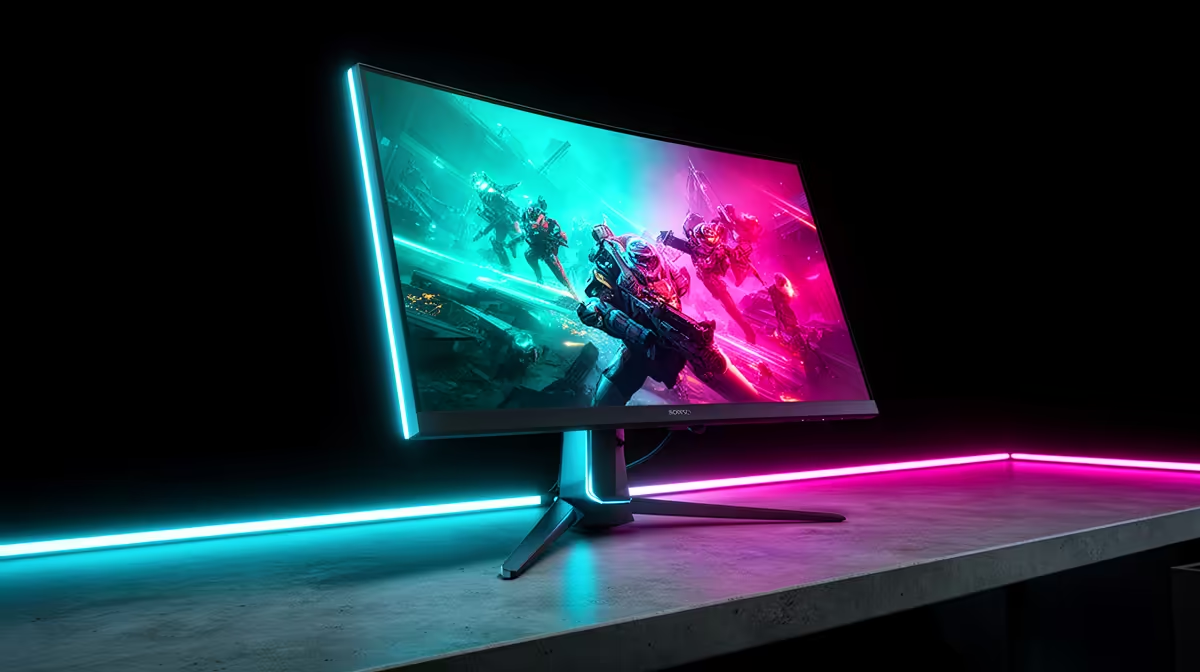
For a quality 300Hz gaming monitor in South Africa, budget R7,000 to R14,000. Panels under R6,000 at this refresh rate typically cut corners on response time consistency or colour accuracy. The R9,000 to R12,000 range offers the best balance of verified performance and local warranty support.
What the Price Tiers Actually Deliver 💰
Below R6,000, 300Hz monitors exist but generally use panel revisions with less consistent overdrive tuning. Independent reviews of panels in this range often reveal measured GTG averages of 3ms to 5ms rather than the advertised 0.5ms, and factory colour calibration is less reliable.
At R7,000 to R10,000, you access panels from brands like LG, Gigabyte, and AOC that use proven fast IPS technology with VRR certification tested under G-Sync Compatible or FreeSync Premium Pro standards. Factory calibration reports accompany some models in this range, and the overdrive presets are usually well-tuned at the medium setting.
At R10,000 to R14,000, you reach ASUS ROG Swift, Samsung Odyssey, and MSI MPG-tier panels with full ergonomic adjustment, built-in backlight strobing compatible with VRR, and broader warranty terms. For competitive players who treat the monitor as a long-term investment, this tier represents the ceiling of sensible spending on a 300Hz LCD panel.
Matching Monitor Cost to Your GPU Investment 🎮
A 300Hz monitor only makes full sense if your GPU produces enough frames to populate most of those refreshes. An RTX 5070 Ti or RX 9070 XT, priced at R18,000 to R28,000 locally, can sustain 200 to 300 fps in esports titles at 1440p.
If your GPU is a previous-generation mid-range like an RTX 3060 or RX 6700 XT, it typically hits 100 to 150 fps at 1440p in esports titles. A 165Hz or 240Hz monitor at R4,000 to R7,000 is a more proportional match in this scenario, leaving budget for a future GPU upgrade.
Hidden Costs to Factor Into Your Budget 🔧
A DisplayPort 1.4 cable is required for 1440p 300Hz on most monitors. Some manufacturers include one in the box; others provide only an HDMI cable that may cap at 240Hz on older HDMI 2.0 ports. Budget R80 to R200 for a quality DP 1.4 cable if your monitor does not include one.
A VESA mount arm, if your desk layout requires it, costs R400 to R1,200 locally for a decent single-arm option. The monitor's included stand is usually adequate for most setups, but a centre-column arm frees desk space and allows finer height and angle control for ergonomic benefit during long sessions.
Buy From a SA Retailer With Physical Warranty Backing ⚡
A 300Hz gaming monitor is a precision device where panel defects, backlight bleed, or dead pixels can appear early in the product's life. Buying from a retailer with a physical South African service centre means you can get a replacement assessment without shipping the monitor internationally. Always confirm the local warranty terms cover dead pixels above a minimum threshold before purchasing.
FAQ
Are 300Hz monitors available in South Africa from stock, or are they import orders?
Several 300Hz models from LG, ASUS, Gigabyte, and Samsung are stocked locally and available for same-week delivery. Import-only models exist but carry currency risk in pricing and longer delivery times. Buying locally stocked inventory is preferable for both warranty and delivery reliability.
Does spending more than R14,000 on a 300Hz monitor make sense?
Above R14,000, you are typically stepping into OLED 240Hz or 480Hz territory rather than LCD 300Hz. OLED monitors offer superior response times and contrast but at a burn-in risk with static game HUD elements.
Is a 300Hz 1080p monitor cheaper than a 300Hz 1440p monitor?
Yes, significantly. A 1080p 300Hz panel typically costs R3,500 to R6,000, compared to R7,000 to R14,000 for 1440p at the same refresh rate.
Ready to invest in a 300Hz competitive monitor?
Evetech stocks 300Hz gaming monitors across multiple price points, with local warranty and delivery to major SA cities. Visit the monitors section to see what is currently available at your budget.