Quick Answer
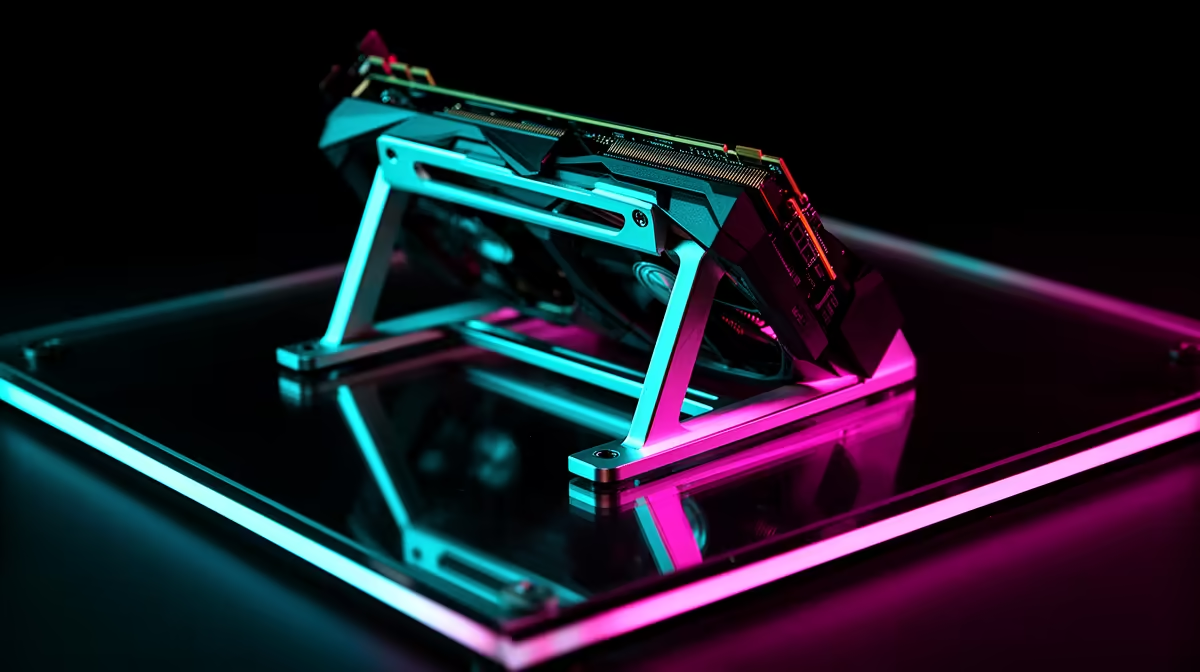
For most gaming builds in South Africa, a GPU support bracket costing R100 to R200 is entirely sufficient. ARGB and premium aluminium variants run R250 to R450 and are worth the extra cost only if aesthetics matter to your build. Spending above R450 is rarely justified for a component whose sole functional job is stopping a card from sagging.
What the Different Price Tiers Actually Deliver 💰
The R80 to R150 range covers basic adjustable brackets with a plastic or steel post, threaded or friction-lock adjustment, and a rubber or silicone tip. These are functionally adequate for every current GPU including the RTX 5090 at 2.1 kg. Build quality differs: cheaper brackets use thinner base plates that may rock on uneven case floors, while better options in this range use flat aluminium bases with non-slip rubber feet. The R150 to R250 range adds quality aluminium construction throughout, wider adjustment ranges (60 mm to 140 mm versus 72 mm to 128 mm), and often a cleaner logo or finish. This tier suits builders who want a neat appearance through the side panel without spending on ARGB.
ARGB and Feature Brackets: When to Spend More 🎮
The R250 to R450 range is where ARGB light bars, built-in spirit levels, dual-post designs for extra-heavy GPUs, and premium colour finishes (white, silver, black anodised) are available. An ARGB bracket in this range connects via a standard 5 V 3-pin header and syncs with Aura Sync, Mystic Light, RGB Fusion, and Polychrome Sync. For a white-theme build containing an ASUS ROG Strix White GPU and white AIO at a combined cost of R18,000 to R30,000, spending R350 on a white ARGB bracket is proportionately trivial and closes the last unlit zone in the build.
Cost-to-Build Ratio: Framing the Decision for SA Buyers 🏆
A budget gaming build around a Ryzen 5 9600X and RTX 5060 Ti totals approximately R12,000 to R16,000 in SA. A R100 basic bracket represents 0.6 to 0.8 percent of that budget. A premium high-end build around a Ryzen 9 9950X and RTX 5090 at R40,000 to R60,000 makes even a R400 ARGB spirit level bracket feel negligible at under one percent. The decision is not really about the bracket cost in absolute terms; it is about what level of finish and function matches the build tier. As a rule, budget builds get basic R100 to R150 brackets, mid-range builds get clean aluminium R150 to R250 brackets, and premium builds with ARGB themes get R250 to R450 feature brackets. All of these are available at Evetech with local stock.
Buy the Bracket When You Buy the Case ⚡
GPU support brackets are easy to forget until you finish a build and see the card sagging. Add the bracket to your cart when you order the case, before the build starts. This avoids a second delivery or a trip to collect a single small item after the rest of the build is complete. The few rand in delivery cost savings is a practical reason to bundle it with the case order.
FAQ
Is a R400 ARGB GPU bracket worth it over a R100 basic bracket in South Africa?
For purely functional sag prevention, no: both stop sag equally well. For ARGB theme builds where every illuminated element matters, yes: the visual contribution justifies the cost if the rest of the build already uses ARGB fans, RAM, and CPU cooler.
Do cheap GPU brackets from unknown brands protect the GPU adequately?
If the bracket is made of aluminium or steel with a rubber tip and a secure locking mechanism, yes. Avoid all-plastic brackets for cards above 1.2 kg, as plastic posts can flex under sustained load and gradually lose height, reducing support over months.
Can I use a GPU support bracket with a vertical GPU mount riser?
No. Vertical GPU mounts change the card's orientation so sag no longer occurs. A support bracket is unnecessary in a vertical mount configuration and would have no surface to contact.
Need a GPU support bracket in South Africa?
Evetech stocks GPU support brackets across all price points in ZAR, from basic adjustable models to ARGB and spirit level variants, with local delivery nationwide.