Quick Answer
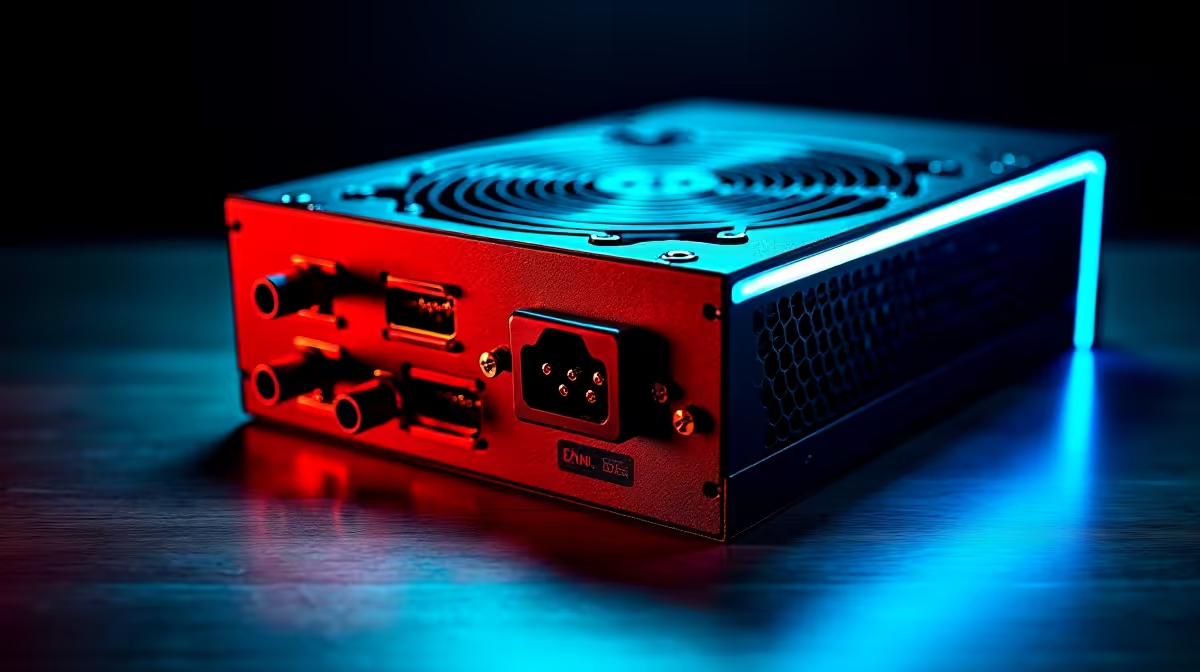
For a R50,000-plus gaming build, budget R4,000 to R8,000 for the PSU. That corresponds to an 80 Plus Platinum or Titanium unit rated between 1,000W and 1,600W with ATX 3.1 compliance, a 10-year warranty, and full modularity. Spending under R2,500 on a PSU for a R50,000 build is a false economy that puts every other component at risk.
Why PSU Budget Matters at This Tier 💰
At R50,000 and above, a South African gaming build typically includes an RTX 5090 (around R22,000 to R28,000), a Ryzen 9 9950X or Core Ultra 9 285K CPU (around R10,000 to R13,000), a premium Z890 or X870E motherboard (R6,000 to R10,000), and 64GB DDR5 RAM. The PSU protects all of this. A quality 80 Plus Titanium unit with proper overcurrent, overvoltage, and short-circuit protection limits the potential damage radius if something does go wrong. A budget PSU on a flagship build is like fitting entry-level brakes on a high-performance car: the rest of the build's capability is only as safe as its most critical failure point.
Choosing Between 1,000W, 1,200W, and 1,600W 🔧
For a single-GPU R50,000 build with an RTX 5090 and a Ryzen 9 9950X, peak system draw sits around 850W to 950W. A 1,200W ATX 3.1 Titanium unit runs this at 70% to 80% load: the sweet spot for efficiency and longevity. Stepping to 1,600W is only necessary if you plan to add a second GPU, extreme overclocking, or hardware expansion (capture cards, multiple NVMe drives in a RAID array). At the R50,000 price tier, a 1,200W Platinum or Titanium unit in the R4,500 to R6,000 range is usually the right call. A 1,600W unit at R7,000 to R9,000 is the right choice if the build is specifically designed for content creation alongside gaming.
Brand and Warranty Considerations 🖥️
The difference between a quality PSU at this tier and a budget unit is not just efficiency: it is the type and quality of internal components. Premium units use Japanese brand 105-degree-C capacitors, LLC resonant converters with synchronous rectification, and digital feedback controllers. These characteristics translate to tighter voltage regulation, lower ripple, and longer service life. At this investment level, look for a PSU carrying at least a 7-year warranty, ideally 10 years. The ASUS ROG Thor 1000W Titanium, Corsair HX1200i, and Seasonic Prime TX-1300 are representative units currently stocked at Evetech with warranties matching the calibre of the build.
Don't Skip the PSU Calculator Step ⚡
Before finalising your R50,000 build, run all components through a PSU wattage calculator and add 25% headroom to the result. Then match that number to an 80 Plus Titanium or Platinum rated unit. This 10-minute step ensures the PSU does not become the bottleneck or failure point in a premium system you have invested heavily in.
FAQ
Is there a noticeable performance difference between a cheap and expensive PSU?
Under normal conditions, no. Performance difference shows up in stability: a budget PSU may allow voltage sag during transient GPU loads, which causes stutters or crashes in demanding scenes. High-quality PSUs maintain rail voltages within 0.5% across the load range.
Should I buy a PSU from the same brand as my GPU for a warranty benefit?
No, PSU and GPU warranties are handled separately in South Africa, regardless of brand. Choose the PSU based on its own specifications, warranty terms, and the local support infrastructure of its distributor.
What is the PSU fan noise like at R50,000-tier builds?
Premium PSUs in this price range use 0dB hybrid fan modes that keep the fan off at loads below 40% to 50% of rated wattage. A 1,200W unit in a R50,000 gaming system will run silently during most gaming sessions, with the fan activating only during extended high-load periods.
Putting together a flagship South African gaming build?
Evetech carries the Titanium and Platinum PSU range to match R50,000-plus builds, with full local warranty support and knowledgeable staff to help you pick the right wattage and feature set.