Quick Answer
SA fibre speeds from Vumatel, Openserve, or Frogfoot eliminate download bottlenecks, meaning the monitor, GPU, and frame rate become the true performance ceiling for SA gamers. Esports players benefit from 240Hz or higher panels at 1080p, while creator-gamers need wide-gamut colour accuracy at QHD or 4K. These are genuinely different hardware choices, not minor variations.
SA Fibre and Online Gaming: What the Connection Changes 🌐
With 100Mbps to 1Gbps fibre now accessible across Johannesburg, Cape Town, and Durban metro areas, SA gamers connect to local Riot, Valve, and EA servers with 10ms to 25ms ping. At these latencies, the monitor's response time and input lag become measurable factors in competitive play, while connection speed is no longer the bottleneck. This elevates the relevance of a 240Hz or 360Hz monitor for local esports players in a way that was less meaningful when SA internet lagged by 80ms or more. The Telkom and Vumatel FTTH rollout reaching secondary cities means this shift affects a growing proportion of the SA gaming population, not just Gauteng residents.
What Esports Players in South Africa Actually Need 🎮
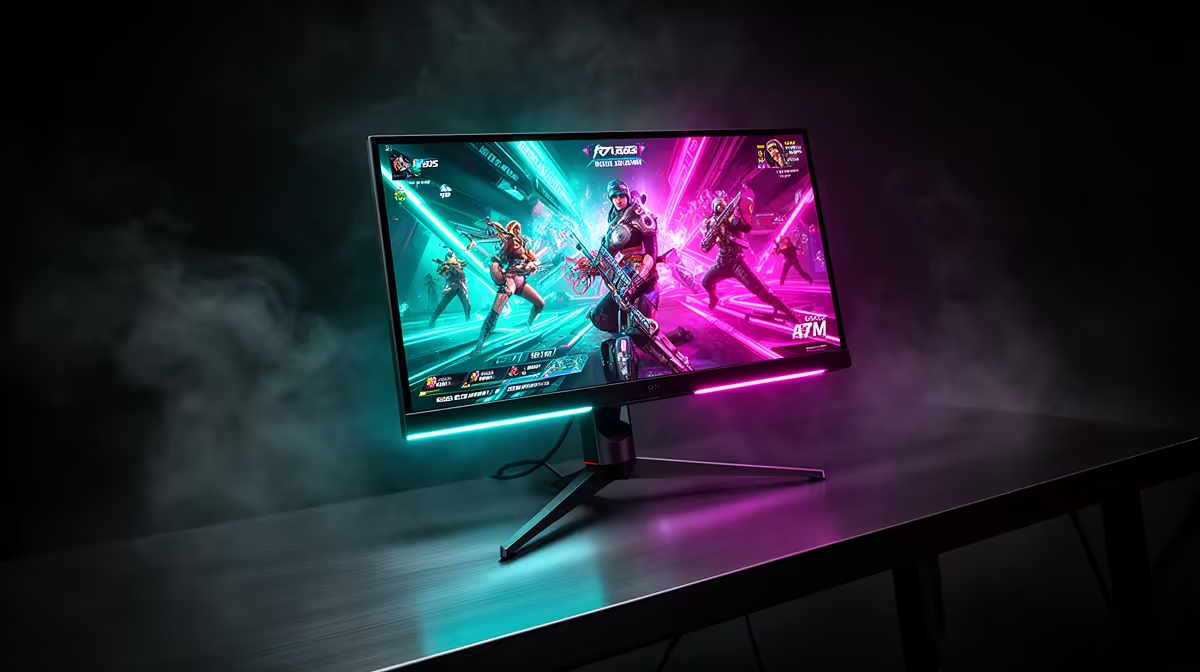
Competitive FPS players in CS2, Valorant, or Apex Legends on local SA servers prioritise: lowest possible input lag, sub-1ms pixel response time, and 240Hz or higher refresh. At these refresh rates, 1080p resolution is standard because GPUs can sustain 240 fps at 1080p far more easily than at QHD. An RTX 5060 Ti drives 240 fps in Valorant at 1080p without difficulty. The SA esports scene, including the ESL Africa leagues and local LAN events, uses 240Hz 1080p monitors as the competitive standard. For this use case, spending more on a 4K 144Hz panel is the wrong trade, as it reduces both fps ceiling and visual latency simultaneously.
Creator Workflows: Where the Monitor Requirements Diverge 🎨
SA content creators producing YouTube tech reviews, Twitch stream overlays, or commercial photography for local brands need different monitor traits. A video editor on DaVinci Resolve wants accurate colour (95% DCI-P3 minimum), sufficient brightness for HDR grading preview (600 nits or higher), and enough pixels to view 4K footage at near-native resolution on a 27-inch screen. QHD at 27 inches covers 4K footage at 56% of native scale, which is adequate for cut work. A 32-inch 4K monitor at R9,000 to R14,000 is the practical creator choice, combining colour accuracy with resolution for tight editing decisions without a secondary reference monitor.
Match Monitor to Your Primary Activity ⚡
If you split time 70 30 between competitive gaming and casual creation, buy the esports monitor and use a calibrated phone or tablet for colour reference checks. If the split is 50 50 or more toward creation, the wide-gamut QHD or 4K panel earns its premium every working day.
FAQ
Does SA server infrastructure support competitive esports at a professional level?
Yes. The Johannesburg data centre cluster hosts servers for most major titles, delivering 10ms to 20ms ping for Gauteng players and 20ms to 40ms for Cape Town. This is well within competitive play thresholds and is sufficient for top-tier ranked performance.
Is 1080p at 240Hz still a viable esports monitor choice in 2026?
Absolutely. The SA and global competitive scene uses 240Hz 1080p as a benchmark. Pixel density at 27 inches is lower than QHD, but the frame rate and response time advantages outweigh this for pure competitive play.
Can one monitor serve both esports and creator needs adequately?
A 27-inch QHD 165Hz IPS with 95% DCI-P3 is the best compromise: fast enough for ranked play, accurate enough for content review. Dedicated esports players and professional creators will each find it short of their ideal, but for a combined workflow it performs well.
Not sure whether to optimise for esports or creation?
Browse Evetech's gaming monitor range to compare refresh rates, colour coverage specs, and sizes for your specific SA workflow.