


PCIe 5.0 vs PCIe 4.0 for Video editing in 4k in SA
PCIe 5.0 vs PCIe 4.0 for video editing in 4k is mainly about fit, features, compatibility, cost, and upgrade path, not one automatic winner. SA buyers should match the choice to the setup.
Read moreRoute 24-pin and EPS cables through the rear cutout, group fan and ARGB cables on a single hub, and use Velcro straps every 80mm behind the tray to keep a large E-ATX build looking clean. Match specs to your build and use case before you commit to the upgrade.

Avoid cable clutter in a large E-ATX case by routing every cable behind the motherboard tray before the tray slides in, using velcro straps every 80 to 100mm along cable runs, and grouping cables by destination (power, data, RGB) rather than by connector type. A tidy E-ATX build takes two to three hours of dedicated management but pays off every time you open the side panel.
The largest mistake in E-ATX builds is routing cables reactively after all components are installed. Before any component touches the tray, identify where each cable enters and exits the main chamber: the 24-pin ATX routes through the grommet closest to the bottom-right of the board, the CPU 8-pin runs up the right side behind the tray, and GPU power cables route from the PSU through the bottom grommet and up the PSU shroud channel. Drawing this on paper before assembly saves significant time and prevents having to disassemble partially built sections.
A fully modular PSU is non-negotiable in an E-ATX build. Use flat or ribbon-style modular cables rather than the standard sleeved cables included with most PSUs: flat cables conform to the narrow channel behind the motherboard tray without creating thick bundles. Extension cables in a matching colour (R150 to R400 per cable set locally) replace short PSU cables with the exact length needed for a particular route, eliminating loops and coils hidden behind the tray.
Each fan produces a 4-pin PWM cable and a 3-pin ARGB cable, so 10 fans generate 20 cables from fans alone. A daisy-chain ARGB hub and a PWM fan hub, each mounted behind the tray with 3M adhesive tape, reduce these 20 cables to two header connections at the motherboard. Bundle fan cables in groups of three or four with velcro straps before routing them to the hub so individual cables do not fray outward through grommets.
Black velcro straps for power cables and white or coloured straps for data and RGB cables make it faster to trace a specific cable during upgrades. When you need to disconnect a fan ARGB cable six months after building, a colour-coded strap tells you immediately which bundle to open. Velcro strap packs are available locally for R50 to R100 for a pack of 50.
A minimum of 25mm of clearance allows standard modular PSU cables to route without compressing. Premium E-ATX cases provide 30 to 40mm, enough for thick cable bundles from a high-wattage modular PSU plus fan and RGB cables.
Cable combs separate parallel cables in the 24-pin and GPU power bundles into evenly spaced rows, creating a professional loom appearance visible through the glass panel. They are purely aesthetic but very effective for display builds. Combs are available locally for R80 to R200 per set.
Yes, meaningfully. Cables routed across the main chamber block airflow between intake fans and heatsinks. Moving cables behind the tray can reduce GPU temperature by 3 to 5 degrees Celsius in an otherwise identical build.
Building in a large E-ATX case and want it to look as good as it performs? Browse Evetech's PC case range for models with deep cable management channels that make clean builds straightforward.
PCIe 5.0 vs PCIe 4.0 for video editing in 4k is mainly about fit, features, compatibility, cost, and upgrade path, not one automatic winner. SA buyers should match the choice to the setup.
Read more
Wi-Fi 7 vs Wi-Fi 6e for competitive esports comes down to router support, latency goals, device compatibility, and coverage. SA buyers should match the choice to the real network setup.
Read more
ATX 3.1 vs ATX 3.0 for mMO and live-service games buyers - what changes is mostly about compatibility, budget, upgrade path, and setup fit. SA buyers should check device support and real needs before expecting a clear win from either option.
Read more
LGA 1851 vs LGA 1700 can affect Twitch and YouTube streaming when gaming and encoding share CPU resources. For SA creators, the real-world difference depends on encoder choice, memory support, motherboard cost, thermals, and upgrade plans.
Read more
X870E vs X670E for aaa single-player gaming is mainly about fit, features, compatibility, cost, and upgrade path, not one automatic winner. SA buyers should match the choice to the setup.
Read more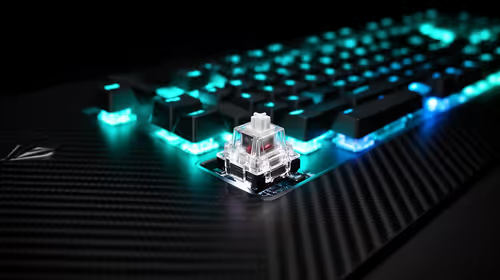
Hall Effect switches vs Mechanical switches for mMO and live-service games is mostly about compatibility, budget, upgrade path, and setup fit. SA buyers should check device support and real needs before expecting a clear win from either option.
Read more
A fake 113GB GTA VI ISO reportedly used empty padding around a small malware payload. SA gamers should delete unofficial builds, keep Windows security active and wait for official channels.

Wi-Fi 6E vs Wi-Fi 6 matters for 4K video editing when files move across a network. The real-world difference between Wi-Fi 6E and Wi-Fi 6 for video editing in 4K depends on NAS access, cloud uploads, router range, and SA creator workflows.

The difference between PCIe 5.0 and PCIe 4.0 for SA gamers is mostly bandwidth headroom. Compare GPU slot needs, NVMe speed, motherboard support, and upgrade timing before paying extra for a newer platform.

Gaming PC stuck pixel checks in South Africa should confirm the monitor fault first. Use colour tests, screenshot comparison, cable swaps, display menu checks, and clear photos before deciding on support.

Shokz OpenFit Air 2 earbuds weigh 7.2g each and use a redesigned dual-driver open-ear layout. SA buyers should choose them for comfort and awareness, not maximum isolation.

AMD's current driver now lists a Radeon RX 9050 4GB, while product coverage details a narrowed memory system. SA buyers should weigh the low VRAM ceiling against current local Radeon options.

Samsung Display has demonstrated a 16-inch 2.5K OLED laptop panel running at 300Hz. SA buyers should wait for a named notebook, full panel specifications and a local price before planning an upgrade.

Microsoft says some Windows 11 game crashes after recent updates are linked to RGB-related drivers. Affected SA gamers should confirm the update and driver before using the published registry workaround.
Shokz OpenFit Air 2 earbuds weigh 7.2g each and use a redesigned dual-driver open-ear layout. SA buyers should choose them for comfort and awareness, not maximum isolation.
A fake 113GB GTA VI ISO reportedly used empty padding around a small malware payload. SA gamers should delete unofficial builds, keep Windows security active and wait for official channels.

The ROG Flux Charger Dock combines 260W total output, 140W laptop charging and HDMI 2.1. SA buyers should check laptop USB-C limits, display needs and local warranty first.

ASRock's Rock 360 Digital AIO adds a 1.05-inch CPU temperature display, 360mm radiator and simplified wiring. SA builders should check case fit, socket support and local warranty.