Quick Answer
To avoid GPU fitment issues in a 420mm clearance case, measure your specific GPU model's length from the manufacturer spec sheet (not the box retail dimensions), confirm whether the case's 420mm figure is measured with or without front fans installed, and check PCIe power connector clearance independently since tall right-angle connectors can add 20 to 30mm beyond the card's stated length.
The Three Measurements You Must Verify 📐
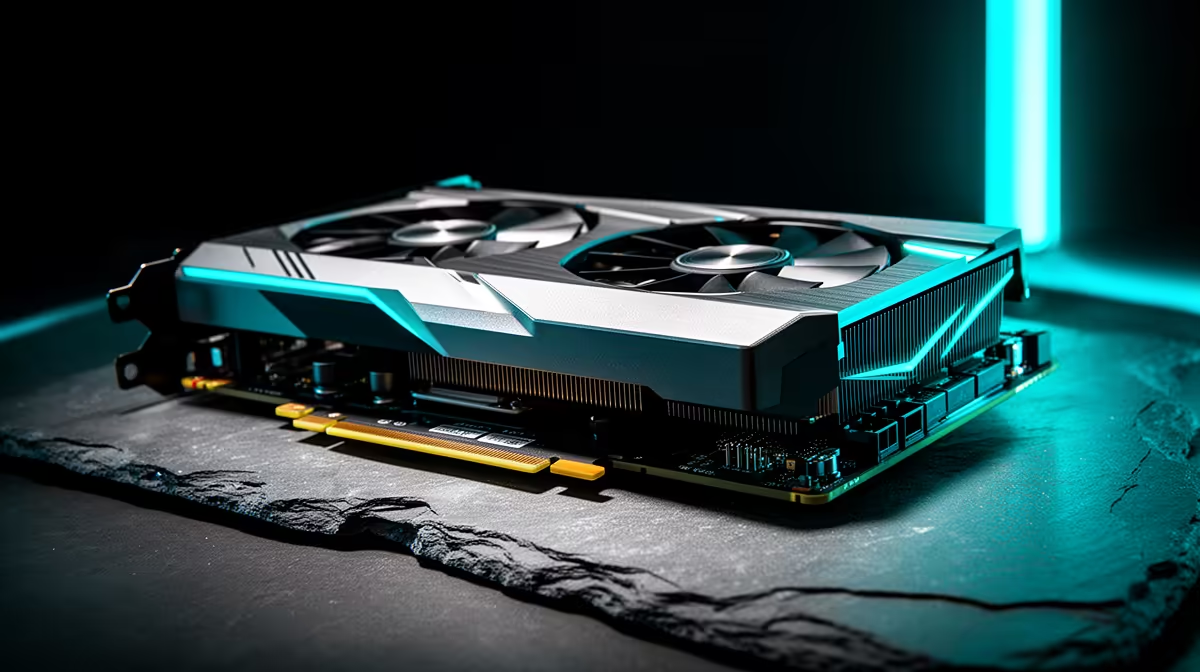
GPU fitment in an ATX case depends on three independent measurements: card length (from bracket to the far end of the PCB or shroud), card thickness in slot heights (two or three-slot), and PCIe power connector depth. Card length gets all the attention, but the power connector is frequently overlooked. Straight-entry 16-pin connectors on current RTX 5000-series cards add a narrow profile, but some third-party cables and adapters use right-angle connectors that protrude 25 to 35mm beyond the card's rated length. In a case where the 420mm clearance is calculated to the front fan frame, a 360mm GPU with a 30mm right-angle connector occupies 390mm of that clearance, leaving only 30mm of buffer.
How Case Clearance Specs Are Measured (and Misread) 🔍
Case manufacturers measure GPU clearance from the rear PCI-E bracket slot to the nearest obstruction at the other end, which is usually the front fan frame. Some manufacturers measure with fans removed and state the maximum bare clearance. Others measure with fans installed and give the practical clearance. A 420mm bare clearance becomes approximately 395mm with a standard 25mm fan and 365mm if a 30mm radiator is also in the path. The case spec sheet should state the configuration used for measurement. If it does not, contact the retailer for clarification or search for builder logs from other South African builders who have used the same case and GPU combination.
Width and Slot Height: The Other Fitment Checks 🔧
Beyond length, GPU thickness matters in dense builds. Current triple-fan GPUs are almost universally three slots thick, occupying 57 to 60mm of vertical space. This is fine in a standard ATX case with ample PCIe slot spacing, but matters if you are running a PCIe riser for a vertical GPU mount. Vertical GPU mounts, increasingly popular in showcase builds, position the GPU facing the side glass panel for display. In this orientation, ensure the case's vertical mount position still provides at least 15 to 20mm of clearance between the GPU fans and the glass panel, or the GPU will run significantly hotter due to recirculated hot air.
Check Fitment With the Radiator In Place ⚡
your build includes a 360mm front radiator, always calculate GPU clearance as: rated case clearance minus fan thickness (25mm) minus radiator thickness (27 to 30mm typical). Subtract both values before assuming the GPU fits. A 420mm case with a 360mm AIO at the front has roughly 365 to 368mm of effective GPU clearance, which accommodates all current GPUs but leaves little margin for right-angle power connectors.
FAQ
What GPU length is too long for a 420mm-rated case with a front 360mm AIO?
With a standard 25mm-thick fan and 27mm-thick radiator at the front, effective GPU clearance is approximately 368mm.
Can I remove the front fans temporarily to fit a long GPU?
Installing the GPU with front fans removed and then reinstalling fans is possible in some cases, but it is not always practical depending on the case's front access design.
Does card weight affect fitment or case selection?
Heavy triple-fan GPUs (RTX 5090 at around 2.3kg) can sag on the PCIe slot bracket over time. Cases with a GPU support bracket or anti-sag holder brace address this. For a showcase build where the card is visible through glass, a GPU brace also prevents the visible sag angle that affects aesthetics. Look for cases that include or support a GPU support bracket.
Fitting a large GPU into your next build?
Browse gaming cases at Evetech with detailed clearance specs covering both GPU length and front radiator compatibility so you can confirm fitment with confidence.