Quick Answer
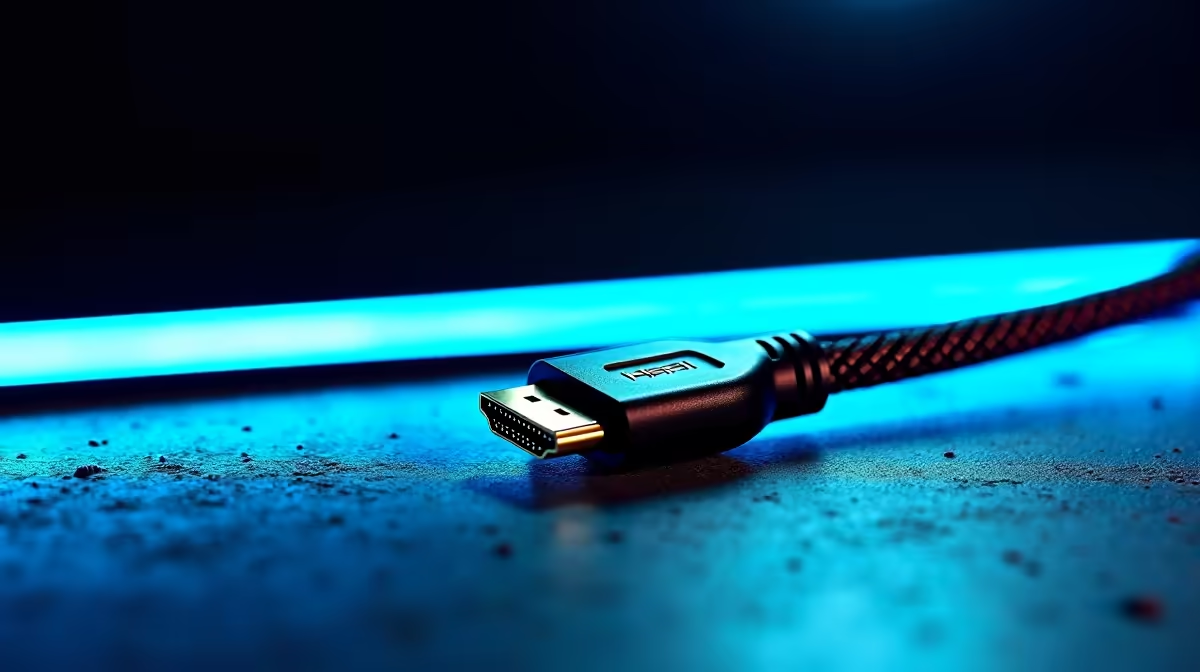
To confirm your HDMI cable supports 4K at 60Hz, look for the Premium Certified HDMI holographic label on the cable or its packaging (confirming 18 Gbps bandwidth), or connect it and verify in Windows Display Settings that your display runs at 3840 x 2160 at 60Hz. If the display only goes to 4K/30Hz, the cable is limited to HDMI 1.4 bandwidth (10.2 Gbps).
Reading the Cable Spec and Packaging 🔍
HDMI cables fall into three bandwidth tiers relevant to 4K: Standard Speed (4.95 Gbps, 1080p only), High Speed (10.2 Gbps, HDMI 1.4, 4K/30Hz), and Premium High Speed / HDMI 2.0 (18 Gbps, 4K/60Hz with HDR). The quickest check is the Premium Certified HDMI sticker: a silver holographic label on the packaging or cable itself confirms the cable has been independently tested to 18 Gbps. If there is no sticker, look at the spec text on the box. A cable that lists "18Gbps" explicitly is marketing the HDMI 2.0 capability. A cable that lists only "4K support" without a Gbps figure could be HDMI 1.4 (10.2 Gbps) dressed up with 4K marketing, which only supports 4K at 30Hz.
Checking Via Your Connected Device 🖥️
If you already have the cable connected, the fastest confirmation is within your operating system or display menu. On Windows 11: right-click the desktop, go to Display Settings, scroll to Advanced Display, and read the refresh rate shown next to 3840 x 2160. If it shows 60Hz, the cable is passing 18 Gbps. If only 30Hz is available, the cable or the display's input mode is limiting bandwidth. On your display, check whether the HDMI port connected is set to Enhanced or Enhanced Format in the display's own settings menu. Some Samsung, LG, and Sony panels require this setting to be enabled per-port before they will accept HDMI 2.0 signals. A Sony X90L or similar TV sold in South Africa defaults to Standard HDMI mode on some ports, capping output at 30Hz.
What to Do If Your Cable Is Only HDMI 1.4 💡
If your current cable is confirmed to be HDMI 1.4 (capped at 4K/30Hz), the solution is straightforward: replace it with a Premium Certified HDMI cable rated at 18 Gbps. A 1.8 metre certified HDMI 2.0 cable typically costs R180 to R280 at Evetech. You do not need to replace your GPU, monitor, or TV. The cable is the only variable. Note that if your GPU predates HDMI 2.0 support (very rare in GPUs from 2014 onwards), the port itself is the limitation, not the cable. All RTX 30, RTX 40, and RTX 50-series Nvidia cards include HDMI 2.1 ports as standard.
Use the HDMI Forum's Verification Tool Online ⚡
The HDMI Forum publishes a verification tool at hdmi.org that lets you enter a cable's product ID (if it has Premium Certified status) to confirm its certification. This is useful when buying a cable in a local market or second-hand, where the packaging may be missing. A genuine Premium Certified cable will appear in the database.
FAQ
Can a cheap HDMI cable work at 4K/60Hz even without Premium Certification?
Sometimes, at short cable lengths under 1.5 metres. At 1 metre, marginal cables occasionally maintain 18 Gbps. At 2 metres and above, uncertified cables are much more likely to drop to 30Hz or produce signal artefacts under the sustained 18 Gbps load of 4K/60Hz HDR content.
My TV shows 4K but the refresh rate shows 59.94Hz rather than 60Hz. Is this a cable problem?
No. 59.94Hz is the NTSC broadcast standard frame rate, functionally identical to 60Hz. This is a display standard setting, not a cable limitation. Your cable is fully passing the 18 Gbps required for 4K at 60Hz.
Does using an HDMI ARC port instead of a regular HDMI port affect 4K/60Hz capability?
Yes, on some TVs. The ARC or eARC port is designed primarily for audio return, and some manufacturers run it at HDMI 1.4 spec even on TVs with HDMI 2.0 elsewhere. Always use a standard HDMI input port for your 4K/60Hz source, not the ARC port.
Not sure if your HDMI cable is holding back your 4K display?
Evetech stocks Premium Certified HDMI 2.0 cables in multiple lengths. Upgrade to a verified 18 Gbps cable and unlock full 4K/60Hz HDR performance.