Quick Answer
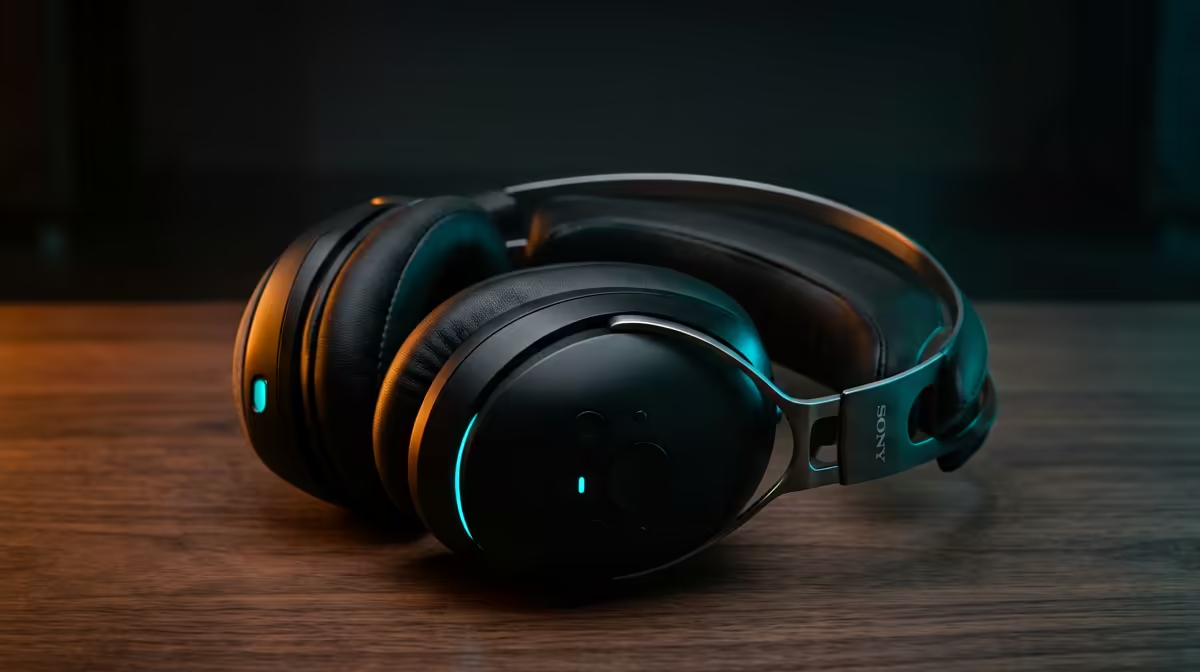
For a 40-hour battery wireless gaming headset, prioritise 2.4GHz wireless over Bluetooth for latency under 20ms, confirm the driver size is 40mm or larger for satisfying low-end response, check that the charging port is USB-C for convenience, and verify the virtual surround or spatial audio implementation is software-based so it works on PC without a separate external sound card.
Why Battery Life Rating Matters (and When It Does Not) 🔋
Manufacturers measure battery life with RGB lighting off, volume at around 50%, and no mic monitoring active. Real-world use with RGB enabled, volume pushed to 70%, and active noise cancellation running typically cuts claimed battery life by 20% to 35%. A headset rated at 40 hours in lab conditions delivers 26 to 32 hours in a typical South African gaming session with RGB on. That is still excellent, covering four to six gaming days without touching the charger. Where 40-hour headsets shine is the extended desk session common on weekends, or LAN party setups at venues in Johannesburg and Cape Town where charging access during play is inconvenient.
2.4GHz vs Bluetooth for Gaming 📡
The wireless protocol matters more than battery life alone. 2.4GHz USB dongle wireless maintains latency of 15ms to 20ms, which is imperceptible during gameplay. Bluetooth 5.0 and 5.2 deliver 50ms to 100ms typical latency, which introduces a subtle but noticeable delay during fast-paced titles. Some headsets offer simultaneous 2.4GHz and Bluetooth connections: 2.4GHz for the PC game audio and Bluetooth for the phone call or Discord on mobile at the same time. For South African gamers who switch between PC gaming and mobile, this dual-connectivity feature is genuinely useful.
Drivers, Mic Quality and Comfort for Long Sessions 🎧
A 40mm driver at minimum with neodymium magnets is standard in this battery-life class. Some flagship units use 50mm drivers for wider soundstage. For competitive FPS titles, a relatively flat frequency response with good upper-mid clarity (where footsteps and reload sounds live) matters more than heavy bass boost. The microphone on 40-hour headsets is typically a retractable or flip-to-mute boom, with noise rejection good enough for home use but not broadcast quality. Ear cup padding material affects long-session comfort: memory foam with leatherette retains heat, while fabric mesh breathes better during Joburg summer gaming marathons. Weight under 300g helps for four-hour-plus sessions.
Storage and Transport for LAN-Ready Headsets ⚡
Many wireless gaming headsets in the 40-hour class come without a carry case. A hard-shell glasses case or a dedicated headset bag keeps the boom mic and headband from bending during transport to a LAN venue. Store the USB dongle in the headset's cup storage slot if available, or keep it in a small zipper pouch attached to your gear bag.
FAQ
Does a 40-hour wireless headset need a base station or just the USB dongle?
Most 40-hour class wireless gaming headsets use a compact USB nano-dongle rather than a base station. A few premium models include a base station that also acts as a charging cradle.
Can I use a 40-hour wireless gaming headset with a PS5 as well as PC?
Some models support both via a USB dongle plugged into the PS5's USB ports and a PC simultaneously using profile switching, though true simultaneous multi-platform use requires the headset to explicitly support it. Check the spec sheet for PS5 compatibility before buying if cross-platform use is a requirement.
What should I expect to pay for a 40-hour wireless gaming headset in South Africa?
Entry-level 40-hour wireless headsets with acceptable 2.4GHz latency start around R1,800. Mid-range options with better drivers and USB-C charging sit at R2,500 to R3,000.
After a wireless headset that lasts the whole weekend?
Evetech stocks wireless gaming headsets across battery life classes and wireless protocol types. Check the full range at Evetech to find the right spec for your gaming setup and budget.