


PCIe 5.0 vs PCIe 4.0 for Video editing in 4k in SA
PCIe 5.0 vs PCIe 4.0 for video editing in 4k is mainly about fit, features, compatibility, cost, and upgrade path, not one automatic winner. SA buyers should match the choice to the setup.
Read moreTo configure Choose Between Standard Keypads and Analog Optical Keypads f, begin with analog optical actuation curve, pressure depth, and per-key mapping. Follow the setup order and you skip the common pitfalls.
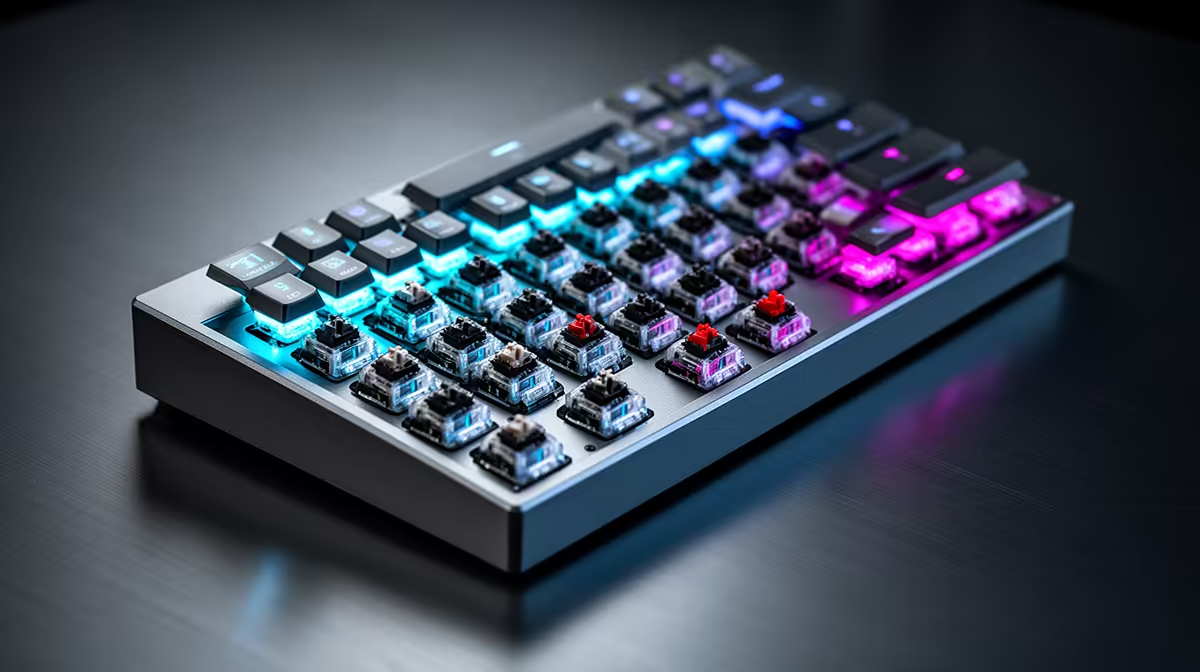
For serious racing sim play on titles like Assetto Corsa Competizione or iRacing, an analog optical keypad wins over a standard keypad because it delivers proportional throttle and brake control from key depth rather than on/off bursts. If you race casually or play simpler top-down racers, a standard keypad is perfectly adequate and costs significantly less.
A standard mechanical or membrane keypad sends a binary signal: full throttle or zero throttle. Skilled sim racers learn to tap the throttle key rapidly to simulate partial application, a technique called throttle tapping that works in lower-fidelity titles. In Assetto Corsa or Gran Turismo 7 on PC, however, binary throttle input produces noticeable wheel spin on corner exits and understeering from full-brake snap inputs, because the physics model expects gradual pressure curves. Standard keypads in South Africa are priced from R900 to R2,000 and offer excellent macro functionality, durability, and per-key lighting at that tier.
Analog optical keypads map key travel depth to a continuous throttle or brake axis, exactly as a pedal set does. Pressing a key 30 percent of the way applies 30 percent throttle, giving the game physics engine the gradual input it needs for realistic tyre behaviour. In Assetto Corsa Competizione at Spa-Francorchamps, the difference between binary and analog throttle on Raidillon is the difference between consistent exits and repeated spins. Razer's analog switch technology is the most widely available implementation in South Africa, found in keypads and keyboards that currently retail around R2,800 to R5,000 locally. The analog keypad also functions in full digital mode for non-racing game genres.
Ask yourself how seriously you sim race. If you log more than five hours per week in physics-heavy titles and do not own pedals, an analog optical keypad at R2,800 to R4,500 is the most cost-effective way to get proportional input before committing to a full wheel and pedal set that starts around R5,000 for entry-level kits. If you race occasionally in titles that support keyboard input without complex physics, spend R1,000 to R1,800 on a quality standard keypad and redirect the budget to other setup components.
After connecting an analog keypad to a racing sim, open the controller calibration or axis curve settings within the game rather than relying on defaults. Most racing sims default to a linear curve but allow you to add a slight S-curve that reduces throttle sensitivity at initial key travel and increases it near full press, matching real pedal feel more closely. This takes five minutes and meaningfully improves corner exit consistency.
Yes, if the keypad driver supports XInput emulation. In this mode the game detects the keypad as a gamepad and reads throttle and brake as analog axes. Without XInput emulation, the sim treats the keypad as a standard keyboard and ignores analog depth.
For casual to intermediate sim racing, yes. For highly competitive sim racing or league play, dedicated pedals with load-cell brake sensors provide superior feel and precision.
Yes. The same proportional input applies to flight simulators for thrust control, action-RPGs for movement speed, and creative software for parameter adjustment when XInput emulation is active.
Chasing faster lap times on PC? Evetech stocks both standard gaming keypads and analog optical keyboards for racing sim enthusiasts, with local warranty and shipping across South Africa. Browse the gaming peripherals range at Evetech.
PCIe 5.0 vs PCIe 4.0 for video editing in 4k is mainly about fit, features, compatibility, cost, and upgrade path, not one automatic winner. SA buyers should match the choice to the setup.
Read more
Wi-Fi 7 vs Wi-Fi 6e for competitive esports comes down to router support, latency goals, device compatibility, and coverage. SA buyers should match the choice to the real network setup.
Read more
ATX 3.1 vs ATX 3.0 for mMO and live-service games buyers - what changes is mostly about compatibility, budget, upgrade path, and setup fit. SA buyers should check device support and real needs before expecting a clear win from either option.
Read more
LGA 1851 vs LGA 1700 can affect Twitch and YouTube streaming when gaming and encoding share CPU resources. For SA creators, the real-world difference depends on encoder choice, memory support, motherboard cost, thermals, and upgrade plans.
Read more
X870E vs X670E for aaa single-player gaming is mainly about fit, features, compatibility, cost, and upgrade path, not one automatic winner. SA buyers should match the choice to the setup.
Read more
Hall Effect switches vs Mechanical switches for mMO and live-service games is mostly about compatibility, budget, upgrade path, and setup fit. SA buyers should check device support and real needs before expecting a clear win from either option.
Read more
A fake 113GB GTA VI ISO reportedly used empty padding around a small malware payload. SA gamers should delete unofficial builds, keep Windows security active and wait for official channels.
Wi-Fi 6E vs Wi-Fi 6 matters for 4K video editing when files move across a network. The real-world difference between Wi-Fi 6E and Wi-Fi 6 for video editing in 4K depends on NAS access, cloud uploads, router range, and SA creator workflows.

The difference between PCIe 5.0 and PCIe 4.0 for SA gamers is mostly bandwidth headroom. Compare GPU slot needs, NVMe speed, motherboard support, and upgrade timing before paying extra for a newer platform.

Gaming PC stuck pixel checks in South Africa should confirm the monitor fault first. Use colour tests, screenshot comparison, cable swaps, display menu checks, and clear photos before deciding on support.

Shokz OpenFit Air 2 earbuds weigh 7.2g each and use a redesigned dual-driver open-ear layout. SA buyers should choose them for comfort and awareness, not maximum isolation.

AMD's current driver now lists a Radeon RX 9050 4GB, while product coverage details a narrowed memory system. SA buyers should weigh the low VRAM ceiling against current local Radeon options.

Samsung Display has demonstrated a 16-inch 2.5K OLED laptop panel running at 300Hz. SA buyers should wait for a named notebook, full panel specifications and a local price before planning an upgrade.

Microsoft says some Windows 11 game crashes after recent updates are linked to RGB-related drivers. Affected SA gamers should confirm the update and driver before using the published registry workaround.

Minisforum's M2 Pro pairs Core Ultra X7, Arc B390 graphics and 32GB onboard memory in 1.8 litres. SA buyers should weigh its fixed memory and $1,439 launch offer against local mini PCs.

Smart monitors can add apps and convenience, but they also add privacy settings and unwanted-software risk. SA buyers should audit the operating system before paying for extras.
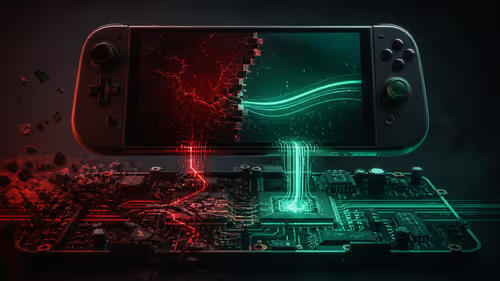
Lenovo says Legion Go failures linked to BIOS N3CN42WW are not user error. Affected SA owners should stop retrying the update, preserve proof and open a support case.
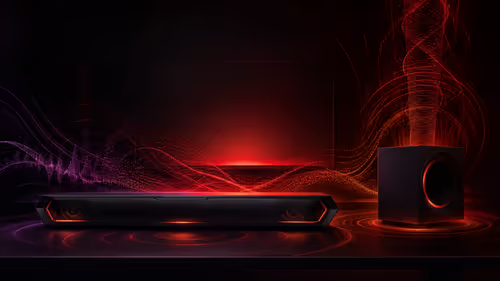
The ROG Gjallar gaming soundbar is now listed in the US at $599.99. SA buyers should compare its 2.1.2 audio, wireless bass and built-in chat controls with simpler local options.