Quick Answer
To get 4K at 60Hz on your monitor, your GPU must output DisplayPort 1.2 or HDMI 2.0 minimum, your cable must be rated for HBR2 (21.6Gbps) or higher, and your monitor must accept a 4K at 60Hz signal on its DisplayPort or HDMI 2.0 input. Once physically connected, set the refresh rate manually in display settings since Windows sometimes defaults to 30Hz after a new connection.
Checking Your Hardware Chain First 🖥️
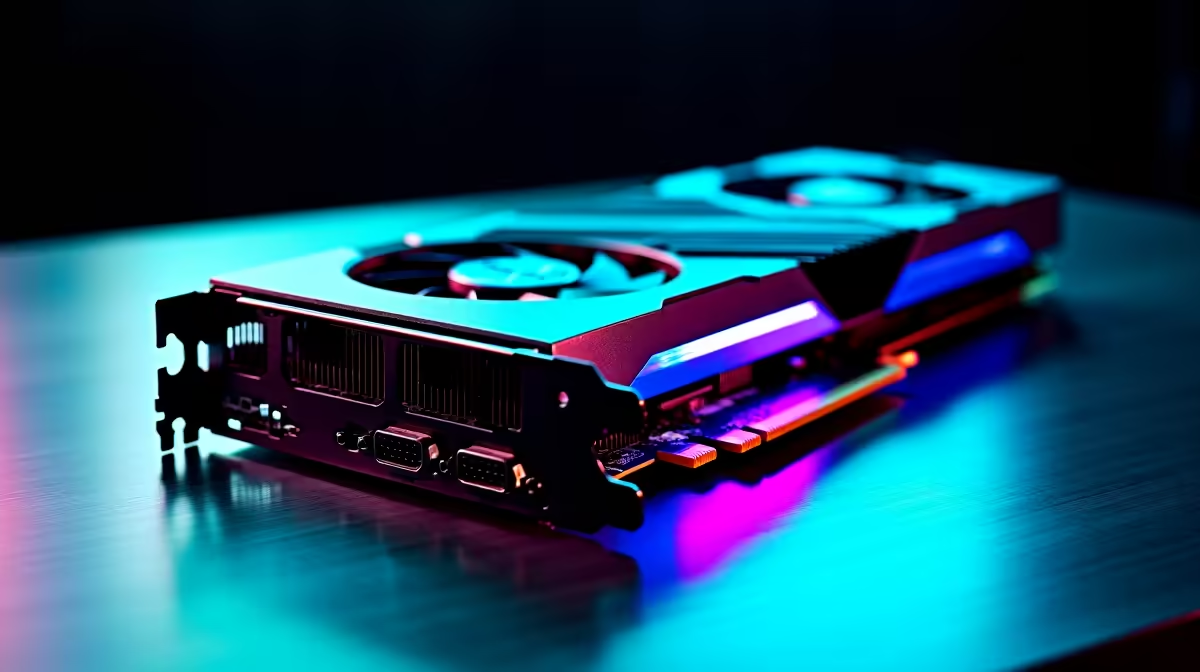
The most common reason for 4K playback running at 30Hz is that Windows has defaulted to a conservative rate after detecting the monitor. Before changing any settings, confirm your cable is HBR2-rated: an HDMI 1.4 cable or an unrated DisplayPort cable will cap at 4K at 30Hz regardless of software settings. Current-gen RTX 50-series and RX 9000-series GPUs drive 4K at 60Hz over native DisplayPort 1.4 or HDMI 2.1 without issue. Mid-range cards like the RTX 4060 and RX 7600 also support 4K at 60Hz for desktop and video playback, though gaming at 4K at 60Hz at maximum quality settings requires a more powerful card.
Windows Display Settings Configuration 🔧
Right-click the desktop and open Display Settings. Scroll to Advanced Display Settings and select the 4K monitor from the dropdown if multiple displays are connected. Under Refresh Rate, manually select 60 Hertz. If 60Hz does not appear, the cable, the port version, or the monitor input is limiting you. Check the monitor's OSD menu under the signal info section to confirm the current resolution and refresh rate received. On AMD GPUs, open AMD Software and verify the active resolution and refresh rate under Display. On Nvidia GPUs, open Nvidia Control Panel and navigate to Change Resolution to set 3840 x 2160 at 60Hz explicitly.
Professional Video Playback Considerations 🎬
For smooth 4K at 60Hz video playback, the GPU handles the decoding load. RTX 40-series and 50-series cards use AV1 hardware decoding for compressed 4K content, reducing CPU load substantially. For SA video professionals using DaVinci Resolve or Premiere for 4K project preview, enabling GPU-accelerated decode in the application settings alongside the 60Hz display configuration eliminates frame-drop stutters. DaVinci Resolve's optimised media workflow using H.264 proxies for the editing timeline is widely used in SA post-production studios to ensure fluid 4K preview without top-tier hardware.
Enable 10-Bit Output for HDR Monitors ⚡
If your 4K monitor supports HDR10 and your GPU is an RTX 40-series or newer, enable 10-bit colour depth alongside 60Hz in display settings. In Windows go to Display Settings > Windows HD Colour Settings and enable HDR. Ten-bit output reduces banding in gradients and is a meaningful improvement for any SA content creator doing professional review on a 4K panel.
FAQ
Why does my 4K monitor show 30Hz after I plug in a new cable?
Windows defaults to 30Hz for 4K when it cannot confirm the cable's bandwidth rating or when the HDMI port detected is HDMI 1.4. Check your cable spec and switch to DisplayPort or a verified HDMI 2.0 cable, then manually set 60Hz in Display Settings.
Does 4K at 60Hz require a powerful GPU for desktop use?
No. Desktop use and video playback at 4K at 60Hz require minimal GPU processing. Integrated graphics on a modern Intel Core Ultra or AMD Ryzen AI 300 can drive 4K at 60Hz for productivity tasks.
Is there a difference between 4K at 60Hz on DisplayPort vs HDMI for colour accuracy?
Both interfaces carry identical colour data at 60Hz. DisplayPort 1.4 offers more overhead than HDMI 2.0 for high bit-depth HDR, but for standard 8-bit 4K at 60Hz both are equivalent.
Looking for a 4K monitor or the cables to drive it at 60Hz?
Evetech stocks 4K displays and HBR2-rated cables to get your setup running at full resolution and refresh rate from day one.