Quick Answer
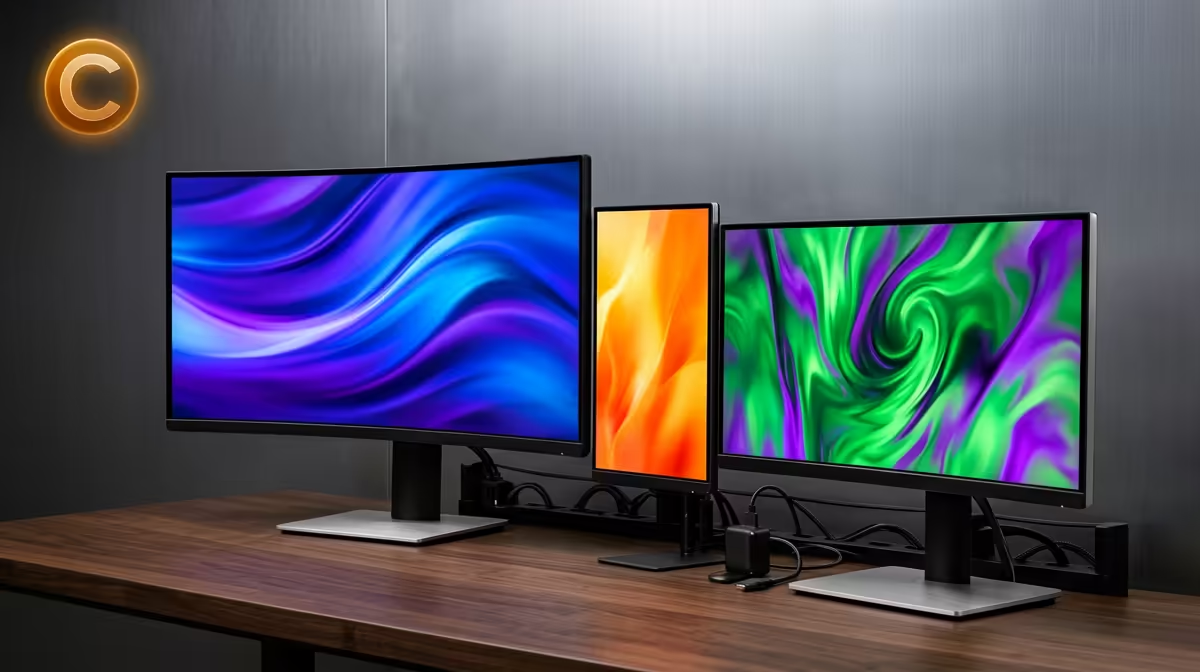
To connect multiple displays using HDMI 2.0 and DisplayPort 1.4, plug one monitor into your GPU's HDMI 2.0 port and a second into the DisplayPort 1.4 port. Both connections work simultaneously on any discrete GPU or Thunderbolt dock that exposes multiple video outputs.
Understanding Port Capabilities Before You Connect 🖥️
HDMI 2.0 supports 4K at 60Hz or 1440p at 144Hz, with a bandwidth of 18 Gbps. DisplayPort 1.4 carries 32.4 Gbps and supports 4K at 144Hz or 1440p at 240Hz, making it the stronger connection for high-refresh gaming. When running a dual-monitor setup, assign the higher-resolution or higher-refresh display to the DisplayPort connection and the secondary productivity monitor to HDMI. On an RTX 5070 Ti or RX 9070 XT, the GPU outputs enough bandwidth to drive both monitors at their native specs simultaneously without any shared bandwidth penalty. Confirm your monitor's input specs before purchasing cables: some budget 4K monitors only accept HDMI 2.0 signals at 60Hz regardless of the cable spec.
Physical Connection and Windows Display Settings 🔧
With both cables plugged in and monitors powered, Windows 11 detects the second display automatically within a few seconds. Press Win + P to choose between Duplicate, Extend, or Second screen only. For productivity, Extend is almost always correct. Right-click the desktop, open Display settings, and drag the monitor icons to match your physical desk layout so cursor movement between screens is intuitive. Assign the primary monitor (the one showing the taskbar and app launch points) to whichever screen you face most directly. Set each monitor's resolution and refresh rate individually in Display settings: a 1440p 165Hz gaming monitor on DisplayPort and a 1080p 60Hz secondary monitor on HDMI each need their correct refresh rate selected manually, as Windows sometimes defaults both to 60Hz.
Common Issues and Fixes ⚙️
If the second monitor shows no signal, swap the cable first since HDMI and DP cables are a frequent failure point. If the monitor flickers when connected via DisplayPort, disable Variable Refresh Rate (G-Sync or FreeSync) temporarily and retest. Some monitors enter DisplayPort 1.2 mode by default and need a menu setting changed to DP 1.4. If you are connecting through a docking station rather than directly from a GPU, confirm the dock supports dual independent video streams rather than MST daisy-chaining, which requires monitors with DisplayPort output pass-through. In South Africa, cable quality from reputable brands matters as generic cables sourced locally sometimes fail to meet HDMI 2.0 bandwidth specs under sustained 4K load.
Set Correct Colour Format per Display ⚡
In NVIDIA Control Panel or AMD Adrenalin, set the HDMI display to RGB Full or YCbCr444 depending on whether it's a monitor or TV. DisplayPort monitors should use RGB Full. Incorrect colour format causes washed-out colours or black crush that looks like a hardware fault but is purely a software setting.
FAQ
Can I use HDMI 2.0 and DisplayPort 1.4 at different refresh rates simultaneously?
Yes. Each port runs independently at whatever rate you set in Windows Display settings. One monitor at 60Hz and another at 165Hz work in parallel without any issue.
My laptop only has one HDMI port. How do I add a second display?
Use a USB-C to DisplayPort adapter or a Thunderbolt dock with a second video output port. Many modern SA laptops include at least one USB-C with DisplayPort Alt Mode, which enables a second monitor without a GPU dock.
Does running two monitors at high refresh rates affect gaming performance?
The game renders only to the primary display, so the second monitor's refresh rate has no direct GPU load impact during gaming. The slight overhead of driving a second panel is negligible on any mid-range discrete GPU like an RTX 5060 or RX 9060 XT.
Setting up a dual-monitor workstation or gaming desk?
Check the full monitor range at Evetech to find displays that match your GPU's HDMI and DisplayPort outputs.