Quick Answer
Choose air cooling for workstation builds where CPU TDP stays below 150W, budget is tight, and long-term maintenance-free reliability matters most. Choose a 420mm AIO when your CPU sustains above 200W, your case has excellent radiator mounting, and you need maximum sustained performance during extended professional workloads.
Where Air Cooling Still Wins for Workstations 🌬️
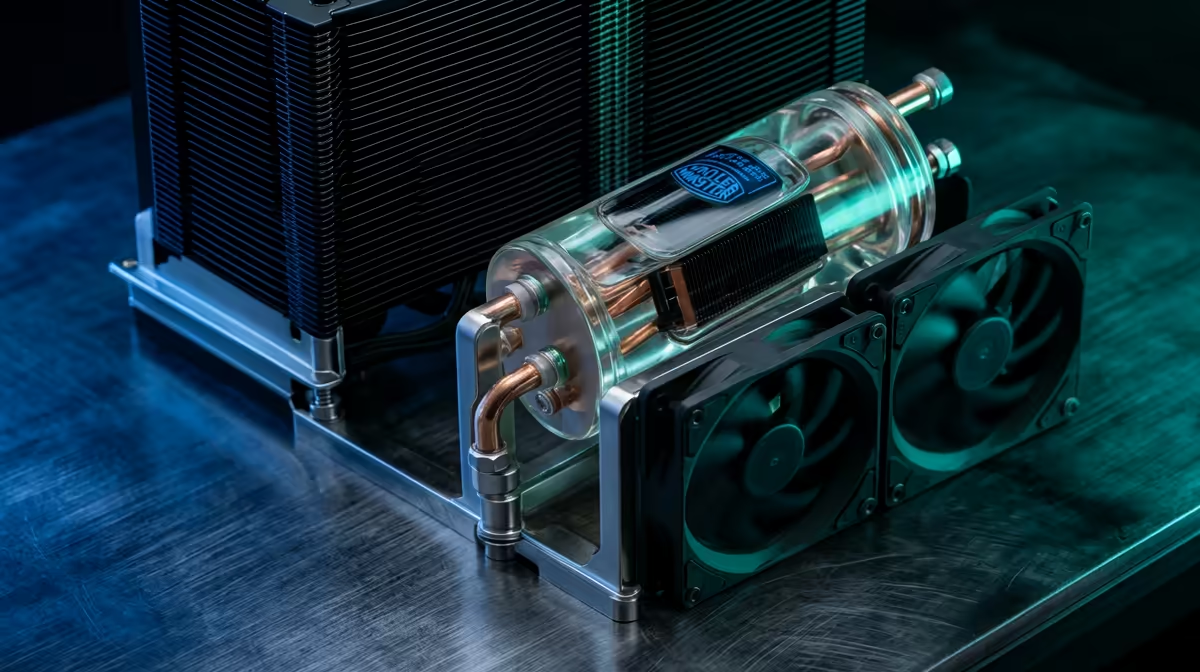
Premium dual-tower air coolers have improved significantly. The Noctua NH-D15 G2 and be quiet! Dark Rock Pro 5 both handle 170W sustained loads with CPU temperatures below 90 degrees Celsius while staying quieter than most AIO fans at high RPM. Air coolers have zero moving parts besides their fans, which are easily replaced if a bearing fails, and no risk of coolant leaks near expensive hardware. For South African workstation builders running Ryzen 9 9900X or Core Ultra 7 265K builds at sustained loads around 120W to 150W, a quality tower cooler in the R1,500 to R2,500 range does everything a 420mm AIO does thermally, costs R1,500 to R4,000 less, and will still be functioning in ten years with a simple fan replacement. The main limitation is RAM clearance: some dual-tower coolers overhang DDR5 slots on narrower ATX boards, so verify clearance specs before purchasing.
Where a 420mm AIO Becomes the Right Choice 💧
Once your CPU's sustained all-core TDP exceeds 180W to 200W, the thermal mass limitations of even the best air coolers become apparent during extended professional tasks. A Ryzen 9 9950X sustained at 200W for a 45-minute Blender animation render will climb past 95 degrees Celsius on a premium dual-tower cooler during the final 15 minutes of that render, triggering thermal throttling that slows frame completion. A 420mm AIO, priced from R3,500 at Evetech, maintains that same chip below 82 degrees Celsius throughout the full render duration, preserving all-core boost clocks and delivering measurably faster results.
Total Cost of Ownership Compared 💰
Air cooling wins on total cost of ownership over five to seven years. A R2,200 premium air cooler may need a R350 fan replacement after five years, bringing its seven-year cost to R2,550. A R5,000 420mm AIO that fails at the five-year mark requires a full replacement at R3,500 to R6,000 because the pump and radiator are a sealed unit. The gap widens further if you factor in that a quality air cooler works with any future CPU upgrade as long as socket brackets are available, while a failed AIO pump requires you to source a new unit entirely. If budget is a meaningful consideration and your CPU TDP allows it, the air cooling TCO advantage is real and should factor into your decision.
Test Thermals Before Finalising Your Choice ⚡
If you are building inside a compact or mid-tower case and are unsure whether an air cooler will suffice, install your chosen cooler and run Cinebench R24 nT for 30 minutes while monitoring CPU package temperature. If the chip stays below 90 degrees Celsius throughout, your cooling is adequate. If it climbs past 92 degrees and stays there, consider stepping up to a 360mm or 420mm AIO before running your real production workloads.
FAQ
Can air cooling compete with a 420mm AIO for Ryzen Threadripper builds?
Not reliably.
Does a 420mm AIO make more noise than a premium air cooler?
At equivalent thermal load, a quality air cooler with 140mm fans like the NH-D15 G2 is generally quieter than a 420mm AIO's three fans at moderate RPM.
Which lasts longer, an air cooler or a 420mm AIO?
Air coolers typically outlast AIOs because they have fewer failure points.
Torn between air and liquid cooling for your workstation?
Evetech stocks both premium tower air coolers and full 420mm AIO ranges, with local expertise to help you match the right solution to your CPU, case and professional workflow.