Quick Answer
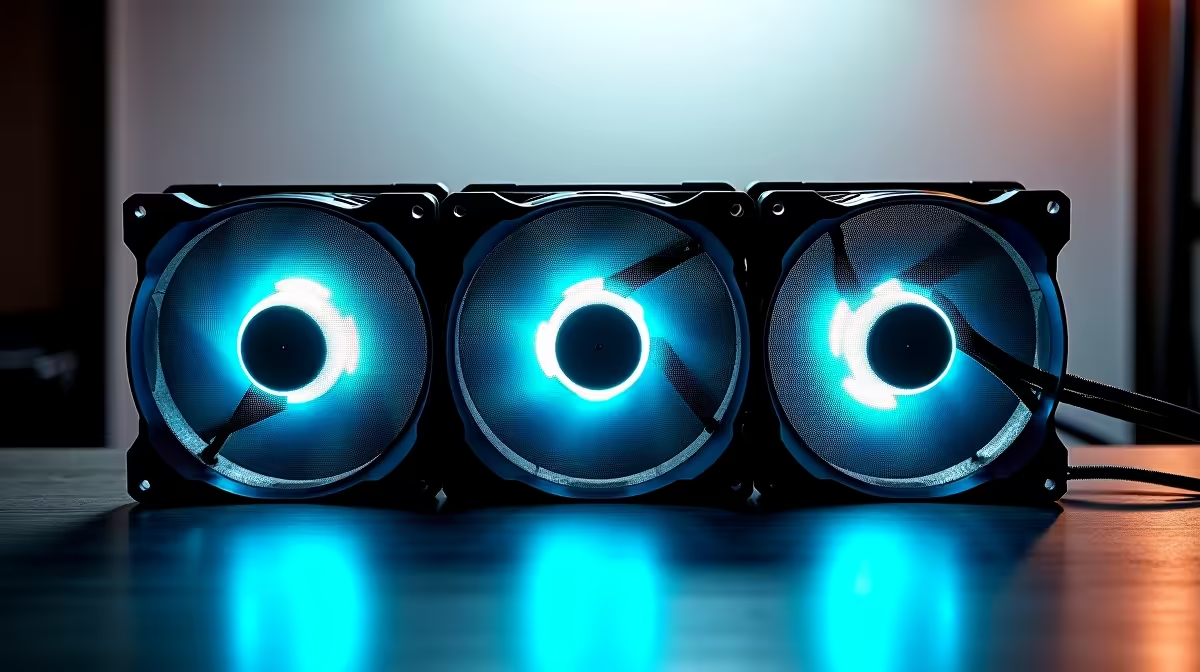
With two 200mm front intake fans and one 140mm rear exhaust fan, place the 200mm pair on front intake at 600 to 800 RPM and the 140mm on rear exhaust at 900 to 1,100 RPM. This creates a strong positive pressure bias that keeps dust out of unfiltered gaps while moving adequate air volume for mid-range gaming builds.
Understanding the Airflow Maths for These Fan Sizes 🌀
A 200mm fan typically moves 80 to 120 CFM at its rated RPM, which is roughly double what a 140mm fan achieves at equivalent speeds. Two 200mm front fans running at 700 RPM each contribute approximately 160 to 200 CFM of total intake. A single rear 140mm exhausting at 1,000 RPM moves around 60 to 75 CFM. The intake-to-exhaust imbalance of roughly 100 CFM creates positive pressure inside the case, which is intentional: it means air exits through case seams and dust filter gaps rather than entering through them. This significantly reduces dust accumulation on internal components.
Fan Curve Setup for This Configuration 📊
Because 200mm fans spin much slower than smaller fans at equivalent airflow, they can afford to ramp higher without becoming acoustically intrusive. A practical BIOS curve for the 200mm intake pair starts them at 40 percent duty cycle below 45C (around 550 RPM), ramps to 60 percent at 65C (around 800 RPM), and pushes to 80 percent above 80C. The 140mm rear exhaust can run a slightly tighter curve because it handles the heat expelled from the CPU cooler directly: 50 percent below 50C, 75 percent at 70C, 100 percent above 85C. If your BIOS allows independent header assignments, tie the rear exhaust curve to the CPU temperature sensor and the front intake curves to the motherboard ambient sensor for the most responsive setup.
Avoiding Dead Spots and Recirculation 🔧
Two 200mm front fans typically span the full height of a mid-tower front intake area, eliminating dead spots where stagnant air can accumulate around the GPU. The 140mm rear exhaust sits at the top-rear position standard in most cases, drawing hot air that has risen naturally from the CPU and GPU. If your case also has a top fan slot, adding a second 140mm exhaust on top converts the setup to a dual-exhaust configuration that can fully clear the hot air layer under the lid. Without it, the single rear 140mm is adequate for builds with CPU TDPs under 125W. For builds with RTX 5070 or RX 9070 XT class GPUs and a Ryzen 7000-series CPU, the single rear exhaust may not fully clear heat under sustained gaming; a top exhaust addition helps.
Speed Match Your Intake and Exhaust ⚡
Run HWiNFO64 and check that your rear exhaust fan RPM is at least 20 to 30 percent higher than each 200mm intake fan's RPM under load. The larger intake fans move more air per revolution, so the smaller exhaust needs to spin faster to come close to matching volume. This balance prevents pressure from building so high that the intake fans labour against their own back-pressure.
FAQ
Can I run 200mm fans on a standard 4-pin PWM header?
Yes, 200mm fans with 4-pin PWM connectors work on any PWM header. The header does not know the fan's size; it only controls duty cycle. Some large fans draw more current so confirm the header's amp rating against the fan spec.
Are 200mm fans quieter than 120mm fans at similar airflow?
Generally yes. Because 200mm fans achieve high CFM at lower RPM, they operate with less turbulence and blade noise than smaller fans spinning faster to match the same output.
Does positive pressure configuration require sealed case panels?
No, but it works best when all intake positions have dust filters. Unfiltered gaps still let some air in, slightly reducing the positive pressure effect, though the net result still favours cleaner internals than a balanced or negative pressure setup.
Upgrading your fan layout?
Evetech stocks case fans in 120mm, 140mm, and 200mm sizes for all mid-tower and full-tower configurations. Check the current range and pick the right size for your build.