Quick Answer
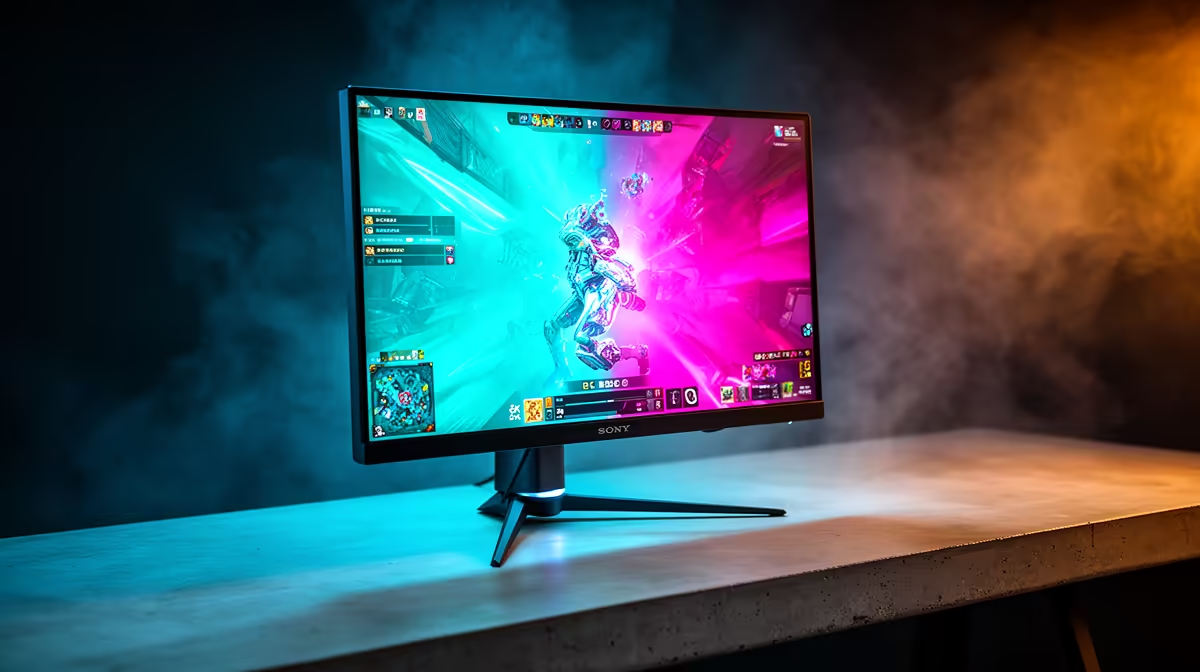
To optimise a 180Hz gaming monitor for competitive play without losing 5K visual quality: confirm 180Hz is active in Windows Display Settings (not defaulted to 60Hz), enable VRR to maintain smoothness below 180fps, use a gaming OSD preset, and keep native 5K resolution active rather than downscaling. Competitive titles run comfortably at 5K on an RTX 5070 or above, so there is no need to sacrifice resolution for performance.
Confirming 180Hz in Windows and GPU Settings 🔧
After connecting a high-refresh monitor, Windows commonly defaults to 60Hz. Open Settings, navigate to System, Display, Advanced Display and confirm the refresh rate reads 180Hz for the connected monitor. If 180Hz is not in the dropdown, the cable is the likely bottleneck: 5K at 180Hz requires DisplayPort 2.1. Once confirmed in Windows, open your GPU control panel and verify resolution and refresh rate match. NVIDIA users should also confirm G-Sync or G-Sync Compatible is enabled under the Display menu. AMD users should activate FreeSync in Adrenalin display settings. VRR is particularly valuable at 5K where frame rates may fluctuate between 90 and 180fps depending on scene complexity.
OSD Settings for Competitive Performance 🎮
Monitor OSD presets affect input lag, response time overdrive and colour rendering. For competitive gaming, select the Gaming or FPS preset rather than Standard or Creator modes. These enable maximum overdrive on pixel transitions, reducing ghosting behind fast-moving objects. At 180Hz, the frame window is 5.6ms per frame, meaning pixel response times above 4ms produce visible trailing on high-contrast edges. Set overdrive to medium rather than maximum to avoid inverse ghosting (bright coronas around moving objects). Reduce brightness to 150 to 180 nits for extended competitive sessions and set sharpness to the middle of its range, as extreme sharpness on 5K panels can make edges look artificially harsh.
Sustaining 5K Quality at 180fps in Competitive Titles 🖥️
Competitive titles with simpler rendering engines, such as Valorant, Apex Legends and CS2, run comfortably at 5K on an RTX 5070 or above, often sustaining 120 to 180fps at native resolution with High quality settings. The visual benefit of 5K over 4K in competitive games is real: fine textures on distant enemies are sharper, which can improve target acquisition at longer ranges. For titles that push GPU load harder at 5K, enable DLSS 4 Quality mode from a QHD base rather than dropping to native 4K, preserving sharpness while recovering frame rate headroom.
Use a Custom Resolution for Games That Skip 5K ⚡
Some competitive games do not natively list 5K as a resolution option in their settings menu. Add a custom resolution of 5120x2880 via NVIDIA Control Panel or AMD Adrenalin's Custom Resolutions tool, then select it within the game's video settings. This unlocks the full panel resolution in games that otherwise default to 4K or QHD on 5K displays.
FAQ
Do I need a specific GPU to run competitive games at 5K 180Hz?
For competitive titles like Valorant and CS2 at 5K 180Hz, an RTX 5070 is sufficient. For demanding titles at native 5K, an RTX 5080 provides comfortable headroom. The RX 9070 XT handles competitive 5K rasterisation well at a lower price point, currently stocked at Evetech.
Does 180Hz feel meaningfully different from 144Hz for competitive gaming?
Yes, particularly for players who have already adapted to 144Hz. The extra 36 frames per second reduces motion blur and improves mouse tracking on fast movements, most noticeable in FPS titles.
Will running 180Hz accelerate OLED panel wear faster?
No. Refresh rate does not accelerate OLED wear. Panel longevity is affected by static on-screen elements, not the refresh cycle speed.
Looking for a high-refresh monitor that handles competitive and creator work?
Evetech stocks gaming monitors from 144Hz to 480Hz across IPS, VA and OLED panel types. Browse the monitors category at Evetech to find models that match your GPU, resolution and competitive gaming requirements.