Quick Answer
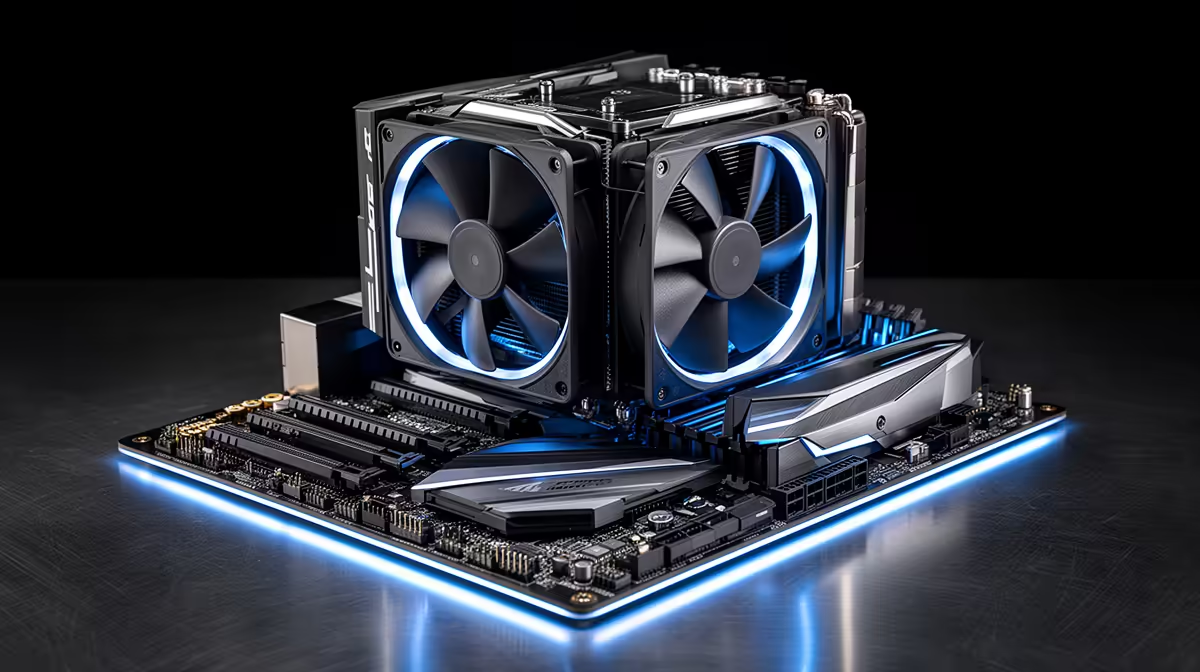
To plan an E-ATX workstation build with 420mm AIO support, start by selecting a full-tower case that explicitly lists E-ATX motherboard support and a 420mm top radiator mount, then verify the top panel has at least 60mm of clearance above the motherboard to fit the radiator without interfering with tall RAM or VRM heatsinks.
Selecting a Case That Handles Both Requirements 🖥️
Not all full-tower cases support both E-ATX motherboards and 420mm top radiators simultaneously. Some cases claiming 420mm top support were designed around standard ATX boards, and when you install a wider E-ATX board, the extra width pushes the RAM slots and VRM heatsink into the radiator clearance zone. Measure the distance from the CPU socket to the top of the RAM slots on your specific E-ATX board and compare it to the case clearance spec. E-ATX boards paired with AMD Threadripper Pro or Intel Xeon W platforms often have dual CPU power connectors near the top edge, which adds another routing challenge for the AIO pump head and tubing.
AIO Radiator Mounting Decisions 🔧
A 420mm AIO radiator uses three 140mm fans across a 420mm total length. The advantage over a 360mm AIO is meaningful for workstation CPUs: more surface area dissipates the high sustained TDPs of Threadripper and Xeon chips that can exceed 350W under AVX workloads. When mounting in the top panel, use push configuration with fans between radiator and roof rather than pull. Route the AIO tubing toward the front of the case to avoid conflicts with PCIe cables and GPU power connectors on large E-ATX boards. Budget R8,000 to R14,000 for a quality 420mm AIO from a brand with a local warranty given the investment level of a full workstation build.
Component Clearance and Build Order 📐
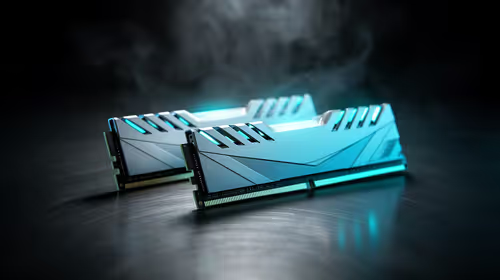
With an E-ATX board and a 420mm AIO in the same case, build order matters more than in a standard ATX build. Install the top radiator and fans before the motherboard, routing the pump head tubing through the case interior first. Seat the motherboard next, then install RAM after the radiator is in place so you can confirm clearance. E-ATX boards with eight DIMM slots have RAM extending further from the socket, and certain AIO pump head designs will physically contact RAM on slots A1 and A2 if the radiator is mounted too far toward the motherboard.
RAM Clearance Test ⚡
Before final assembly of your E-ATX workstation, dry-fit the pump head on the CPU socket with the radiator in position and RAM installed in all slots. If the pump head clears with 2mm or more on all sides, you are safe. Less than 2mm risks contact during thermal expansion under sustained workstation loads.
FAQ
Can I mount a 420mm AIO on the front of the case instead of the top?
Yes, and this is sometimes better in E-ATX full towers where top clearance is limited. A front-mounted 420mm AIO draws cool ambient air directly through the radiator. The downside is this fills your primary intake slots with radiator, leaving less room for additional case fans.
What PSU wattage is needed for an E-ATX workstation with a 420mm AIO?
For a Threadripper Pro or Xeon W workstation with a high-end GPU, plan for at least a 1200W PSU, and 1600W if you intend to add multiple GPUs or storage arrays.
How long does a 420mm AIO typically last in a workstation?
Quality AIOs carry a five to seven year warranty and typically last beyond that under normal use. For mission-critical workstations, some SA professionals keep a replacement AIO in storage as a spare given that replacing the unit mid-project is costly in lost productivity.
Building a serious E-ATX workstation?
Evetech stocks full-tower cases, 420mm AIOs, and E-ATX compatible hardware for professional workstation builds. Browse the full range to plan your build with confidence.