Quick Answer
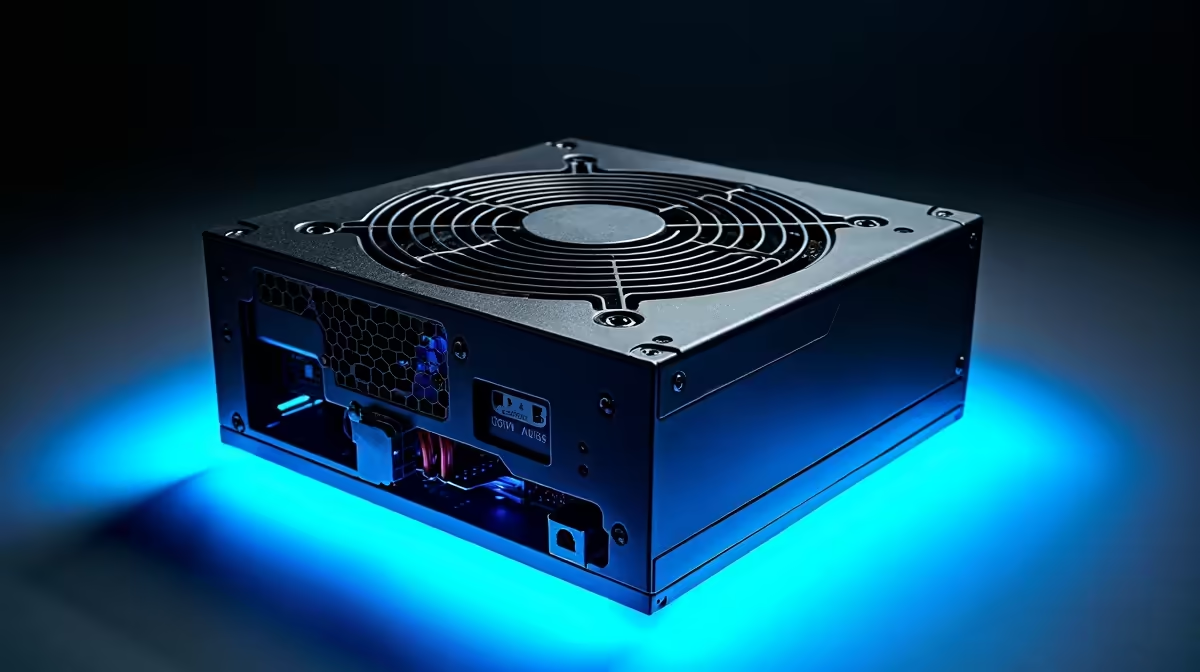
Switch to an 80 Plus Platinum or Titanium PSU, enable its semi-passive fan mode, and pair it with a well-ventilated case to cut PSU-generated heat by 20W to 40W at typical gaming loads. This also reduces the PSU fan from audible to inaudible during everyday gaming, since fan RPM is thermal-driven.
Why the PSU Is a Major Heat Source Inside Your Case 🌡️
A Gold-rated 850W PSU operating at 50% load converts mains power at roughly 87% efficiency. The missing 13% becomes heat: at 425W system draw, that is 55W of heat dissipated inside the PSU housing and blown into the case or exhausted directly. Upgrade to a Platinum unit at the same load, and efficiency rises to 92%, dropping waste heat to 37W: a saving of 18W continuously. At 60% load (510W draw from a Ryzen 7 9800X3D plus RTX 5080 gaming system), the saving grows to over 25W. That 25W of additional heat inside a closed ATX case raises the ambient air temperature around the GPU and CPU cooler, forcing their fans to spin faster to compensate. The noise you hear during an extended gaming session is partly PSU inefficiency amplified through the entire thermal chain.
Choosing a PSU with Semi-Passive Fan Mode 🔧
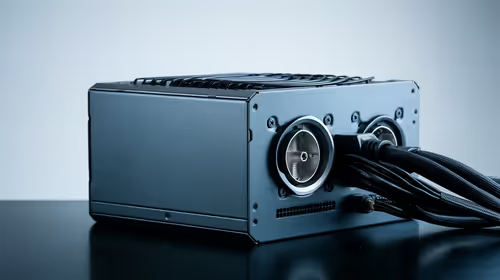
Most 80 Plus Platinum and Titanium units from Seasonic, Corsair, and be quiet! include a zero-RPM or semi-passive mode where the PSU fan remains fully stopped at under 40% to 50% of rated load. For a 1000W PSU powering a 450W gaming rig, the fan stays off during normal gameplay. It only spins during benchmarks, extended rendering, or heat-intensive tasks. The Seasonic Prime Platinum series, stocked at Evetech in the R4,500 to R7,000 range for 850W to 1000W, enables this by default. Be quiet! Dark Power 13 units take this further with a Silence Wings fan optimised for airflow at sub-600 RPM during light loads, which is acoustically imperceptible in a closed room.
Case Layout and Airflow That Complements PSU Efficiency 🖥️
Even the most efficient PSU benefits from proper case airflow. In South Africa, where summer ambient temperatures in Gauteng and Limpopo reach 32 to 36 degrees Celsius, passive convection alone is insufficient. The PSU should exhaust hot air directly out of the case, not recirculate it. Ensure: the PSU fan-down orientation is matched with a clear mesh bottom intake, or fan-up if your case recommends it; at least two case exhaust fans at the rear and top to prevent hot air pooling; and cable management that avoids blocking airflow paths. Aftermarket fully modular cable kits reduce cable bulk by 30% to 50% compared to non-modular PSU bundles, which visibly improves airflow routes in mid-tower cases.
Clean Dust Filters Every Three Months ⚡
South African urban and suburban areas can have higher ambient dust levels than European environments, particularly near construction zones or unpaved roads. A clogged PSU dust filter reduces airflow and forces the PSU fan to spin faster and hotter. Clean mesh filters on the PSU intake and case bottom intake with compressed air every three months to maintain rated thermal performance.
FAQ
Does a quieter PSU mean it's running too cool?
No.
Can replacing just the PSU noticeably reduce overall system noise?
Yes, especially in mid-range builds where the PSU fan is audible under load. Switching from a Gold semi-modular to a Platinum fully-modular unit with zero-RPM mode can drop system noise floor by 2 to 5 dB during light to moderate gaming, which is a perceptible difference in a quiet room.
Should I add a PSU intake fan mod to a hot system?
Not necessary and potentially counterproductive. PSUs are designed to move air in one direction. Adding an external fan that pushes air into the PSU intake helps only if the unit itself is thermally constrained, which a properly sized Platinum unit should not be under normal gaming loads.
Want a cooler, quieter gaming rig?
Evetech stocks Platinum and Titanium rated PSUs with zero-RPM fan modes from Seasonic, Corsair, and be quiet!, sized from 650W to 1200W.