Quick Answer
Enable ELMB Sync in the monitor OSD, confirm your GPU supports G-Sync Compatible or FreeSync, and set your in-game frame rate target to at least 100fps so the strobing backlight stays consistent. At 160Hz with ELMB Sync active, moving targets that would appear as a smeared streak at 60Hz resolve into a sharp, clearly defined image.
What ELMB Sync Does to the Backlight 🔧
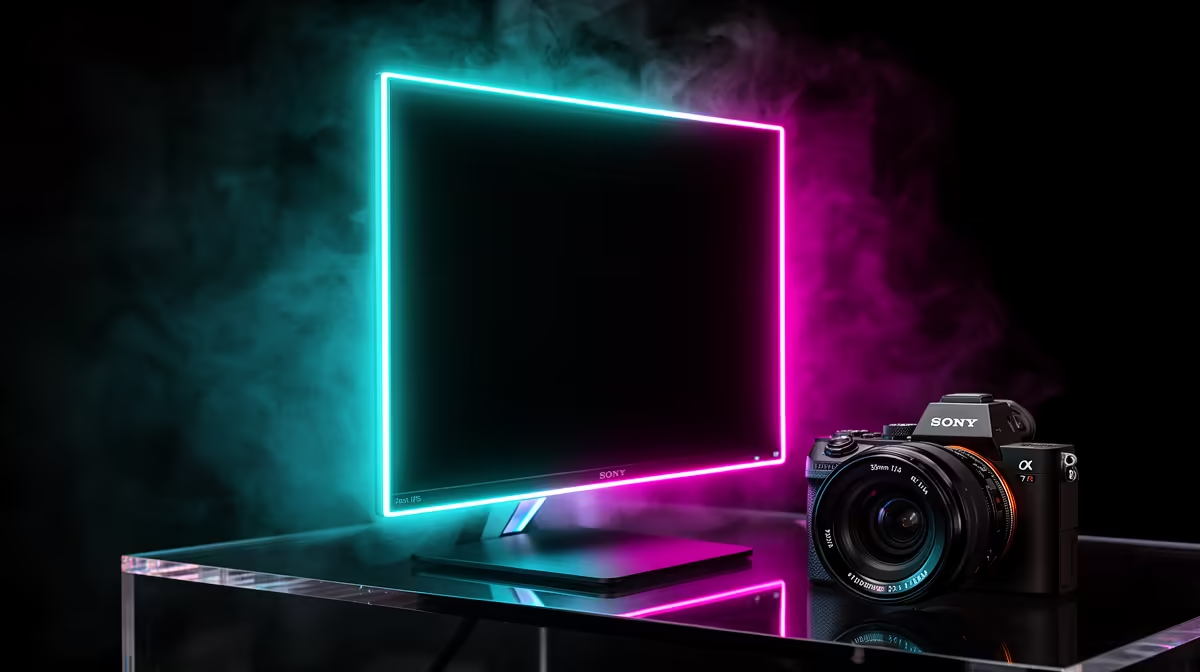
ELMB stands for Extreme Low Motion Blur. In standard operation a monitor holds each frame illuminated for the full frame period, and the eye perceives blur as it tracks a moving object across persistent pixels. ELMB Sync replaces constant illumination with brief flashes: the backlight fires once per frame at the exact moment the panel finishes its pixel transition, then cuts to black until the next frame. The result is closer to a CRT-style strobed snapshot. On a Fast IPS panel with 0.3ms GTG, the pixel transition completes before the strobe fires, giving you the sharpest possible image. The trade-off is brightness, which drops by 30 to 50%, so raise backlight intensity to compensate.
Setting Up ELMB Sync Correctly 🖥️
Enter the OSD, navigate to the gaming or image quality section, and enable ELMB, Motion Blur Reduction, or Backlight Strobing. Confirm G-Sync Compatible or FreeSync is also on; ELMB Sync supports running both simultaneously. In NVIDIA Control Panel, enable G-Sync under Display, Set Up G-Sync. Cap your frame rate just below the panel maximum using RTSS or an in-game limiter; 155fps on a 160Hz panel is more stable for strobing than uncapped frames. If flickering appears at a specific frame rate, raise the cap until it disappears.
When to Use It and When to Skip It ✨
ELMB Sync delivers the clearest benefit in first-person shooters, racing sims, and fighting games. In strategy games, turn-based RPGs, or productivity, the backlight strobing adds no value and costs brightness. Most SA gamers who run a mixed library should bind ELMB to a monitor hot-key. If your GPU delivers below 100fps consistently, disable ELMB Sync; strobing at low frame rates creates flicker that causes eye fatigue over long sessions.
Brightness Offset for Strobing ⚡
When ELMB Sync is on, bump your backlight setting 20 to 30% above your normal preference. The strobe duty cycle cuts perceived brightness significantly and can cause eye strain during long gaming sessions if the image is too dark.
FAQ
Can I use ELMB Sync with any GPU?
ELMB Sync works with both NVIDIA (G-Sync Compatible) and AMD (FreeSync) GPUs. An RTX 5060 Ti or RX 9070 both benefit. Older cards without VRR support can still use ELMB in fixed-frequency mode, though the experience is less stable.
Does ELMB Sync reduce input lag?
ELMB Sync does not directly reduce input lag, but by eliminating perceived blur it makes fast-moving targets easier to track, which functionally improves aiming accuracy. Actual input lag is determined by the monitor's processing pipeline and your frame rate.
Is ELMB Sync worth using for console gaming?
Consoles output at a fixed frame rate of 60 or 120fps. ELMB Sync functions at those rates but the improvement is less dramatic than at 144Hz or above. At a stable 120fps via HDMI 2.1, enabling motion blur reduction is still worthwhile for fast action titles.
Want a monitor where ELMB Sync actually makes a difference?
Evetech carries Fast IPS gaming monitors with built-in motion blur reduction, locally stocked with South African warranty coverage.