Quick Answer
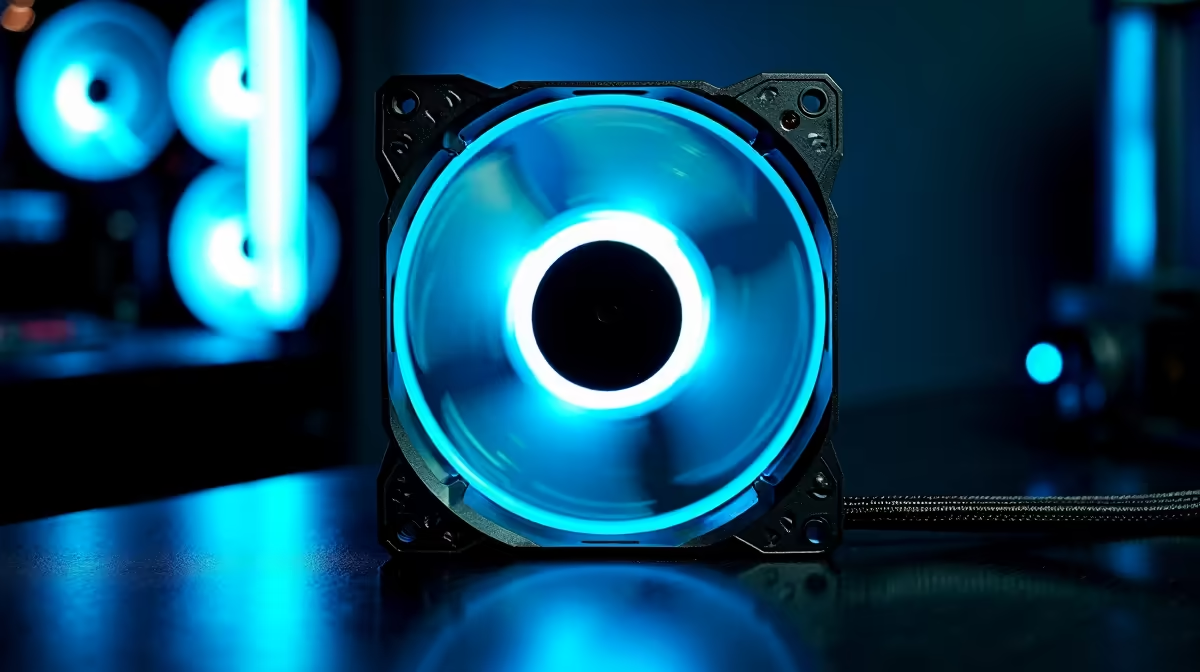
Connect 120mm PWM fans to the motherboard's PWM-capable 4-pin headers, set a custom fan curve in BIOS or software that keeps fans below 800 RPM at idle and ramps to 1,200 RPM at 70 degrees Celsius. This combination delivers effective cooling in silence during light tasks and adequate airflow under load.
Wiring and Header Configuration for 120mm PWM Fans 🔧
PWM control requires a 4-pin connection: pin 1 is ground, pin 2 is 12V power, pin 3 is RPM signal (tachometer), and pin 4 is the PWM control signal from the motherboard. Plugging a PWM fan into a 3-pin header removes the PWM control; the fan then runs at a fixed voltage, typically 100 percent. For full PWM control, use headers labelled CHA_FAN, SYS_FAN, or CPU_OPT on your motherboard and confirm they are 4-pin in the manual. If your case has more 120mm fan positions than motherboard headers, use a PWM fan hub that takes one 4-pin PWM signal from the motherboard and distributes it to multiple fans simultaneously. Fan hubs suitable for four to six fans are stocked at Evetech from around R250 to R450.
Setting a Fan Curve for Balanced Cooling and Quiet Operation 🔇
Most motherboard BIOS interfaces include a fan curve editor under a Hardware Monitor or Smart Fan section. Set reference points: below 40 degrees Celsius, run fans at 20 to 30 percent duty cycle (400 to 600 RPM). At 60 degrees, ramp to 50 to 60 percent (1,000 to 1,200 RPM). At 70 degrees, push to 75 to 80 percent (1,500 to 1,600 RPM). Above 80 degrees, allow 100 percent. Human hearing detects fan noise around 800 RPM; staying below that at idle produces a virtually silent desktop. Software alternatives include Argus Monitor and Fan Control.
Intake and Exhaust Placement for 120mm Fans in SA Cases 💨
Positive pressure (more intake than exhaust) is recommended for dusty SA homes. Two front intakes and one rear exhaust pushes dust toward filters rather than drawing it through unfiltered gaps. Three front intakes with two top exhausts suits mid-tower builds using an RTX 5060 Ti or Ryzen 7 9700X. Ensure intake fans face inward and exhaust fans face outward; an arrow on the fan frame indicates airflow direction.
Use the CPU Temperature, Not Case Temperature, as the Fan Curve Source ⚡
motherboards offer a choice of temperature source for the fan curve: CPU, motherboard, or water cooling header. Use CPU temperature as the primary trigger for all chassis fans. Case temperature sensors respond too slowly and often sit in cooler parts of the case, causing fans to ramp up too late during sudden CPU load spikes in gaming sessions. Setting CPU temp as the source gives more responsive, protective cooling.
FAQ
How do I know if my 120mm fans are actually running at PWM speed and not fixed voltage?
Open your monitoring software (HWiNFO64, Argus Monitor) and note the RPM readout while adjusting the duty cycle in BIOS. If the RPM changes proportionally (lower duty cycle, lower RPM), PWM control is working. If the RPM stays fixed at maximum, the fan is wired to a 3-pin header or the header is not PWM-capable.
What fan RPM should I target for silent operation in South Africa's warm climate?
Above 30 degrees Celsius ambient (common in Gauteng and KwaZulu-Natal summers), set your idle RPM floor to around 600 to 700 RPM rather than the absolute minimum. This pre-compensates for higher ambient temperatures and prevents unexpected thermal spikes during light tasks in a warm room.
Can I mix PWM and non-PWM 120mm fans in the same build?
Yes. PWM fans connect to 4-pin headers for speed control; non-PWM (DC) fans connect to 3-pin headers and are voltage-controlled or run at fixed speed. Mixing them in a build is fine; just accept that the DC fans will not be governed by your custom PWM curve.
Building a quiet, thermally balanced gaming PC?
Evetech stocks 120mm PWM fans and fan hubs suited to SA gaming and workstation builds, available for delivery across South Africa.