Quick Answer
For gaming: enable 4K 144Hz via DisplayPort 2.1 or HDMI 2.1, turn on G-Sync Compatible or FreeSync Premium Pro, and set SDR brightness between 150 and 200 nits to protect the OLED panel. For streaming: set OBS capture to 4K 60Hz for source and encode at 1080p 60Hz for upload. For creative work: calibrate to D65 white point with 2.2 gamma and run an ICC profile for accurate colour reproduction across your editing software.
Gaming Setup on a 32-Inch 4K OLED 🎮
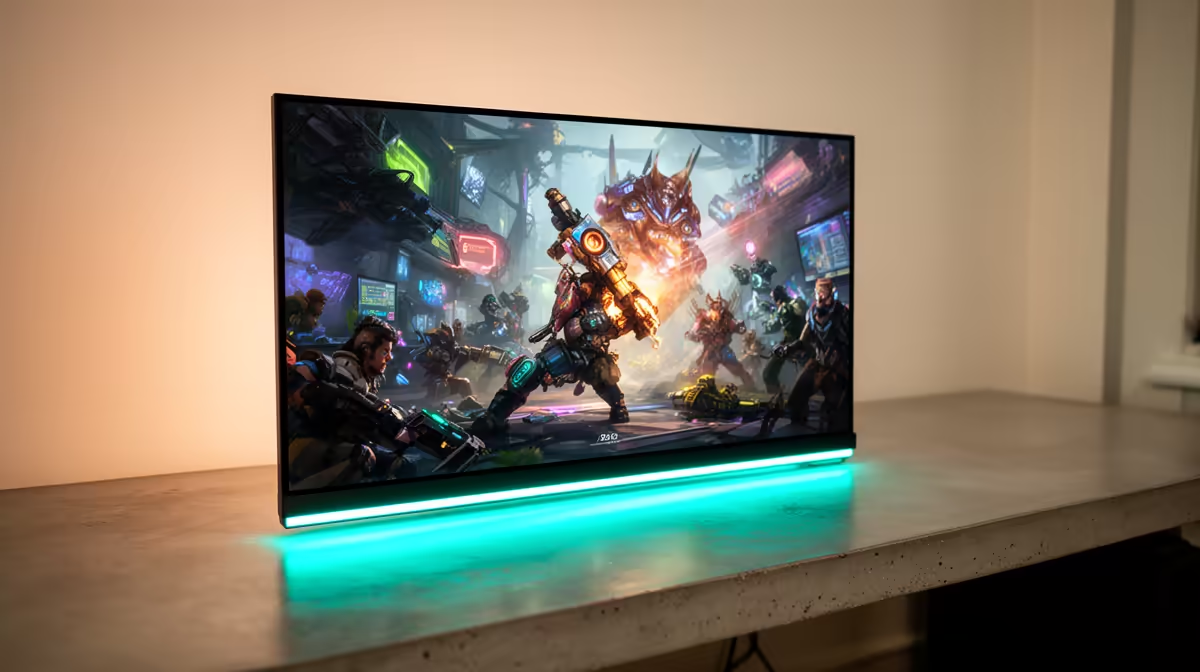
Start by confirming the cable and port. HDMI 2.1 and DisplayPort 2.1 both support 4K at 144Hz uncompressed on current OLED monitors. For Nvidia GPUs like the RTX 4080 or RTX 5080, use the DisplayPort 2.1 port and enable G-Sync Compatible in Nvidia Control Panel under Display. For AMD GPUs like the RX 9070 XT, use DisplayPort 2.1 and enable FreeSync Premium Pro in AMD Software. Set in-game resolution to 3840x2160 and confirm the Windows display resolution matches. Enable the monitor's built-in low-latency mode (sometimes called Game Mode or Response Time Override) to minimise processing delay below 1 ms GtG. 32-inch 4K OLED gaming monitors currently start from around R16,000 to R24,000 at Evetech.
Streaming Configuration for 4K OLED 📡
For streaming, use OBS Studio with a 4K canvas set at 3840x2160 and output scaled to 1920x1080 for upload, since most South African fibre connections at 100 Mbps upload have headroom for 1080p60 streaming but not reliable 4K streaming. Enable hardware encoding using NVENC (Nvidia) or AV1 (for RTX 4000-series or later) in OBS encoder settings for low-CPU overhead. The OLED's HDMI 2.1 port can simultaneously output to a capture card at 4K 60Hz while your primary game runs on the DisplayPort connection, keeping capture and play on separate outputs for cleaner signal quality.
Creative Work Calibration and Colour Profile 🎨
For photo and video work on a 32-inch 4K OLED, the panel's near-infinite contrast ratio and wide DCI-P3 coverage (typically 98% to 99% on current models) make it genuinely suited to colour-critical work. Calibrate using the monitor's OSD: set colour temperature to D65 (6500K), gamma to 2.2, and brightness to 120 nits for indoor creative work. Load an ICC profile generated by a hardware colorimeter into Windows Colour Management for precise application-level colour matching in Lightroom, Premiere, or DaVinci Resolve. Enable the monitor's Creator or Cinema preset as a starting point before hardware calibration.
OLED Brightness Limit for Longevity ⚡
On an OLED gaming monitor, avoid running full-screen static white content above 150 nits for extended periods. For creative work with large white document backgrounds, lower SDR brightness to 150 to 200 nits in the OSD. This preserves panel longevity without affecting image quality during editing sessions.
FAQ
Does a 32-inch 4K OLED need a very powerful GPU to run at 4K 144Hz?
Yes. Achieving 4K 144Hz in demanding games requires an RTX 5080, RTX 4090, or RX 9070 XT class GPU. For less demanding titles or with DLSS 4 or FSR 4 upscaling, an RTX 4080 manages 4K 100Hz to 120Hz in most games at high settings.
Is OLED burn-in a real concern for a 32-inch gaming monitor used daily?
OLED gaming monitors include pixel-shift, logo-dimming, and automatic screen-refresh features that significantly reduce burn-in risk under normal gaming use. Avoiding static HUD elements at full brightness for hours daily is the main precaution. Modern OLED panels are substantially more burn-in resistant than earlier TV OLED technology.
Can I use a 32-inch 4K OLED with a PS5 for both gaming and streaming?
Yes, via HDMI 2.1. The PS5 outputs 4K 60Hz or 4K 120Hz on supported games. Enable the monitor's game mode for HDMI and set the PS5 HDR calibration to match your OLED panel's peak brightness specification for the best HDR result.
Ready to set up a 32-inch 4K OLED for your gaming and creative workflow?
Browse the 4K OLED gaming monitors at Evetech alongside the RTX and RX GPUs that power them at full resolution and refresh.