Quick Answer
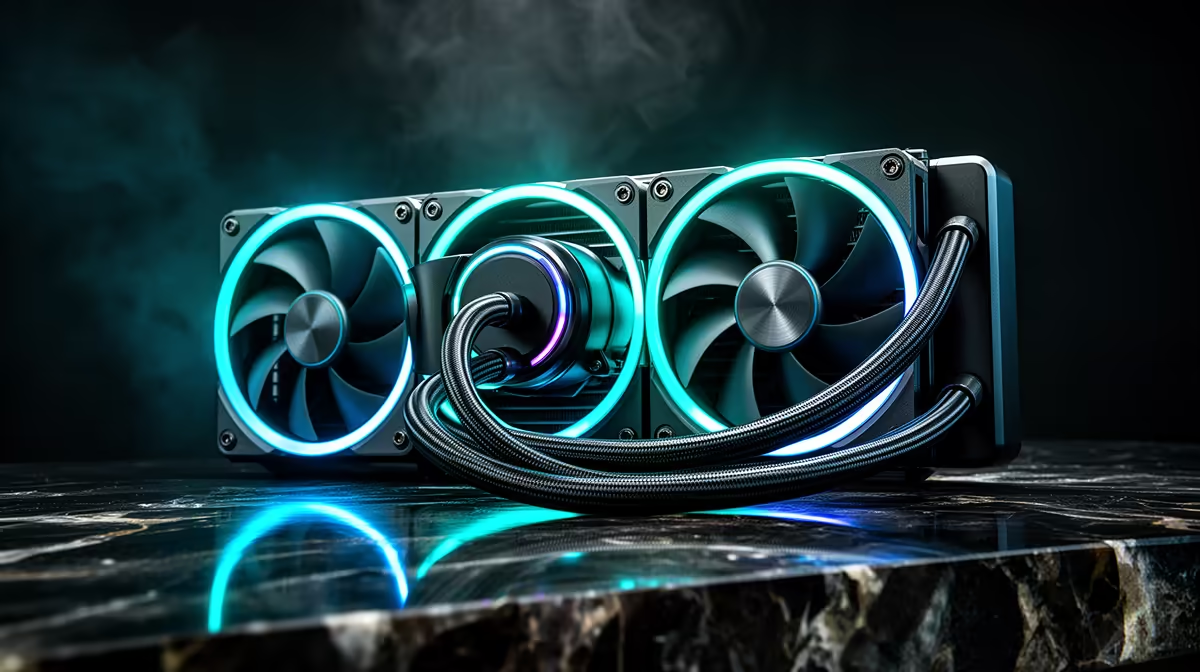
To set up a 360mm AIO for stable gaming and overclocking, mount the radiator at the top of the case as exhaust with tubes at the rear, apply a pea-sized dot of quality thermal paste, tighten the cold plate using a diagonal pattern, and configure a custom fan curve in BIOS with fans at 800 RPM below 50 degrees Celsius and ramping to 1,600 RPM above 75 degrees. After mounting, verify temps under a 10-minute stress test before gaming.
Physical Installation: Getting the Mount Right 🔧
The cold plate mount is the most performance-critical step. Before mounting, wipe the CPU IHS with isopropyl alcohol and a lint-free cloth to remove any factory residue or previous paste. Apply a pea-sized dot of thermal paste to the centre of the IHS; for AM5 CPUs like the Ryzen 7 9800X3D with their slightly raised chiplet die, a small cross pattern can improve coverage. Seat the cold plate directly without twisting it into position, then tighten the backplate screws or standoffs in a diagonal sequence to ensure even pressure. Never use more than finger-tight plus a quarter-turn. An uneven mount can add 10 to 20 degrees Celsius to peak temps. Connect the pump head to the CPU_OPT or AIO_PUMP header on your motherboard, not a standard fan header, as the pump needs consistent 12V power.
Radiator Placement and Airflow Direction 💨
For a top-mounted 360mm radiator used as exhaust, orient the fans so they push air upward through the radiator and out of the case. This means the fan frames face downward inside the case and the radiator sits on top. Tubing position matters too: tubing routed to the bottom-rear keeps air bubbles away from the pump inlet, which is generally at the top of the pump head. Do not mount the radiator as a front intake in high-ambient SA conditions; top exhaust consistently delivers better coolant temperatures because it removes the hottest air directly from the case rather than recirculating it. Check that radiator screws are torqued evenly, as a warped or unevenly mounted radiator loses thermal contact at the fin edges.
Fan Curve Setup and Overclocking Temperature Targets 🎮
After physical installation, configure your fan curve in BIOS. Use coolant temperature as the source sensor if supported. A safe gaming curve: 700 RPM at 35 degrees, 1,000 RPM at 55 degrees, 1,400 RPM at 70 degrees, 1,800 RPM at 80 degrees or above. For overclocking a Ryzen 7 9800X3D or Core i9-14900K, target junction temps below 85 degrees Celsius under sustained loads. If temps breach 88 degrees at 1,800 RPM, reduce the all-core overclock offset by 25MHz to 50MHz increments until stable. South African summer ambient temps above 30 degrees Celsius may require slightly more conservative overclocks than international benchmarks suggest.
Stress Test Before You Overclock ⚡
Run Cinebench R23 for 10 minutes at stock CPU settings after AIO installation to confirm baseline thermals. Only start overclocking once the cooler is verified within spec, isolating mount or paste issues before adding clock speed stress.
FAQ
Should pump speed be set to Performance or Quiet mode for overclocking?
Always set the pump to Performance or Extreme mode when overclocking. Pump speed directly affects how quickly hot coolant moves from the CPU cold plate to the radiator. A slower pump increases coolant dwell time near the hot CPU, raising temperatures.
Can I reuse factory-applied thermal paste from a new AIO?
Yes, on first installation. Factory paste on premium AIOs is usually adequate. If you have already mounted and unmounted the cooler, clean and reapply fresh paste before remounting; disturbing the original layer creates air voids that raise temps.
How often should I replace the thermal paste on an AIO installation?
Every two to three years suits most systems. In hot SA environments with daily wide temperature swings, annual reapplication during a cleaning session is worthwhile.
Ready to set up or upgrade your 360mm AIO?
Browse the full range of AIO coolers and thermal accessories stocked at Evetech.