Quick Answer
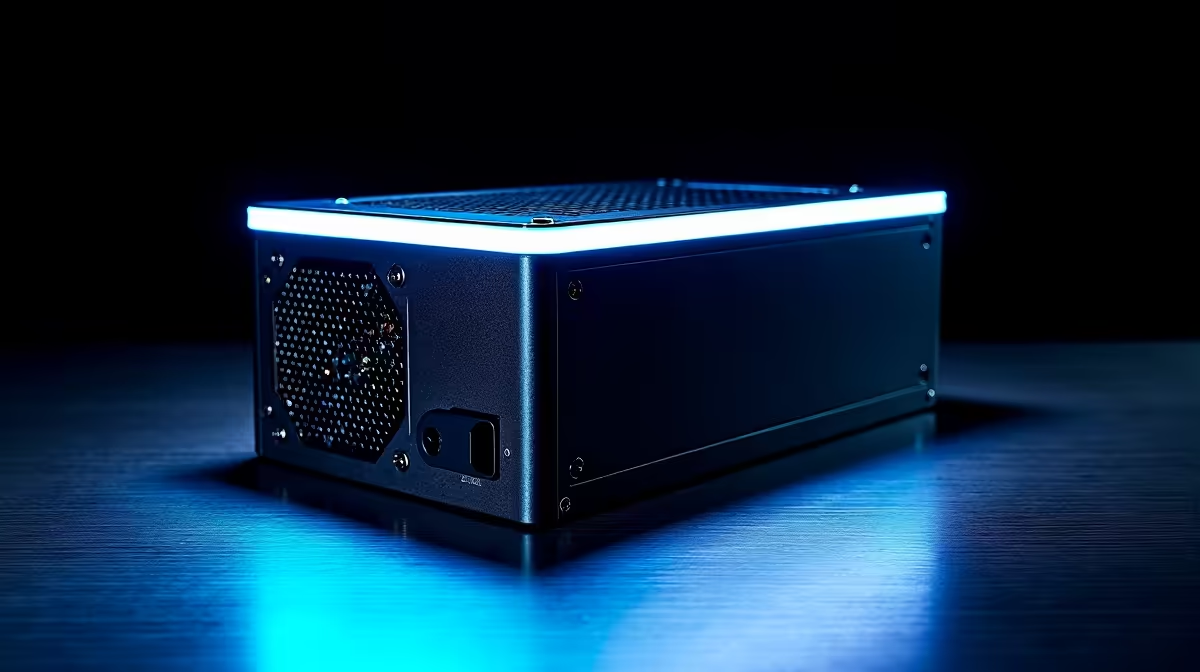
Start by running a PSU diagnostic: monitor 12V rail voltage under load using HWiNFO64 or OCCT. If the rail drops below 11.4V or spikes above 12.6V during GPU load, the PSU is failing or under-specced. Secondary causes include a wall outlet with loose wiring, a surge protector past its protective life, or a GPU drawing transient current beyond the PSU's rated excursion handling.
Diagnosing the Root Cause 🔧
Voltage instability in a PC shows up as random crashes during GPU-heavy tasks, POST failures after sleep, memory errors that disappear on retest, and USB devices disconnecting under load. To isolate the PSU, run OCCT's PSU test for 30 minutes while logging voltages. A healthy PSU keeps the 12V rail between 11.52V and 12.48V (the ATX specification tolerance is plus or minus 4%). If the rail droops below 11.4V during a stress peak, the PSU is either at the end of its service life, under-rated for your components, or the capacitors are degrading. South African mains at 220V to 230V should not introduce instability in a PSU with active PFC, but a faulty surge strip or an extension cord can add resistance and cause brownout-like conditions.
Fixing PSU-Side Instability 🖥️
If the PSU is the culprit, the fix is replacement. Capacitor wear accelerates after 50,000 hours of operation or when a PSU has run near its rated wattage ceiling for extended periods. Replacing an older 650W Gold unit with a modern 1,000W Platinum or Titanium unit typically resolves instability immediately: the larger headroom means the unit never struggles under transient loads. If the system uses a single-rail design but the PSU is multi-rail, a rail imbalance where one GPU connector saturates a rail while another runs light can also trip overcurrent protection incorrectly. Switch to a reputable single-rail ATX 3.1 unit for RTX 50-series GPUs.
Mains and Wiring Causes 💡
In South African homes, especially older properties built before 2000, wiring may not be earthed to modern code. A poor earth connection allows ground-referenced noise onto the PSU secondary rails, causing intermittent errors that look like RAM or motherboard faults. Test with a socket tester (available at hardware stores) to confirm live, neutral, and earth are correctly wired. If the socket checks out, replace the surge protector: standard surge strips degrade silently after absorbing large transient spikes and offer no protection once the MOV (metal oxide varistor) is depleted. An uninterruptible power supply with true online double conversion provides the cleanest power to sensitive components.
OCCT Stress Test First ⚡
Before replacing any component, run OCCT's PSU stress test for 20 minutes with voltage and temperature logging enabled. Download the free version, set the GPU and CPU to maximum load simultaneously, and watch the 12V rail in the graph overlay. A drop below 11.5V confirms the PSU, not the motherboard or GPU, is the source of instability.
FAQ
Can a failing PSU damage my GPU or CPU?
Yes. Sustained undervoltage stresses voltage regulators on the GPU and CPU, and a catastrophic PSU failure can send a voltage spike through multiple components. A quality PSU with over-voltage and over-current protection limits the damage radius.
My PC crashes only during gaming but not during benchmarks. Is that a PSU issue?
Gaming loads are often more sustained than short benchmark runs and can expose marginal headroom. Monitor voltages during gaming specifically using HWiNFO64 to see if the 12V rail drops during the crashes.
How long do PSU capacitors typically last?
Japanese brand capacitors (105 degree C rated) in quality PSUs last 50,000 hours or more under normal conditions. Budget PSUs with 85 degree C capacitors can degrade noticeably within 20,000 hours of use.
Dealing with random crashes or shutdowns?
Evetech stocks reliable replacement power supplies with proper overcurrent and overvoltage protection. Upgrading to a quality unit is often the single fix that ends months of frustrating instability.