Mining leaves clues, but it rarely leaves a confession. A seller can clean the cooler and reset software. Your job is to build a picture from wear, thermal behaviour and the way the card performs under load. Spotting an ex-mining GPU takes several small checks working together.
Quick Answer
Look for fan wear, heat-aged pads, corrosion and signs that the cooler has been opened, then run a sustained benchmark while watching memory errors, temperature and clock stability. Some cards or tools expose useful operating history, but there is no universal GPU hour counter you can trust. The July 2026 Evetech price for the Infinity 2 OC RTX 5060 8GB from Palit was R6,999, which gives you a clean local marker.
🧹 A clean card can still show its working life
Mining rigs often run cards for long periods at a steady load. Many operators reduce core power and tune memory, which can be gentler on the core than gaming. The constant runtime still wears fans and keeps thermal materials hot for months.
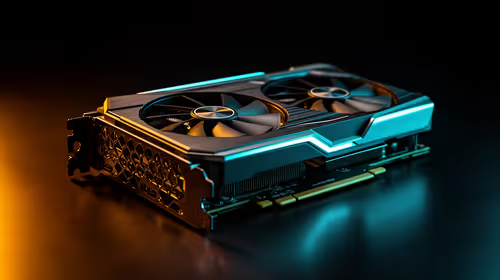
Start with the fan hubs. Hold the card level and spin each fan. Rough bearings, wobble or a dry clicking sound point to long service. Replacement fans can be a good repair, though a mismatched set tells you the card has a history worth asking about.
Look through the heatsink fins. Dust packed deep inside after the outer surfaces were wiped suggests a quick cosmetic clean. Corrosion or sticky residue can come from a damp or dirty environment. Mining is one possible cause; poor storage is another.
Check the screws around the backplate and cooler. Tool marks show that someone opened it. Ask whether they replaced thermal paste or pads. A careful service can improve the card, while torn pads or uneven pad thickness can leave memory running hot.
Yellowed, compressed or oily thermal pads show age and heat exposure. They cannot prove mining on their own. Combine that clue with fan wear and test behaviour.
The Evetech NVIDIA graphics card range gives you current local alternatives. Keep the R6,999 Palit RTX 5060 price beside the seller's number as you assess the risk.
🧪 Memory behaviour matters more than the seller's story
Run a benchmark and a workload that exercises VRAM. Watch for coloured blocks, flashing textures, driver resets or a sudden black screen. Mining overclocks often pushed memory harder than the core, so memory instability deserves attention.
Use a hardware monitor to record core temperature, hotspot where available, fan speed, power and clocks. The gap between core and hotspot can reveal poor cooler contact, though acceptable values vary by model. A card that holds steady clocks with a stable temperature trend is giving you useful evidence.
Let the test run for at least fifteen minutes. A quick launch proves almost nothing. Heat-soaked pads and fans show their behaviour after the cooler settles.
Compare the performance with results for the exact model and power setting. A card running a low power limit or unusual BIOS may score below expectations. Ask the seller to restore normal settings before testing. Avoid flashing firmware during a meetup because one mistake can leave you with a card unable to boot.
⏱️ Treat hour counters as supporting evidence
Consumer graphics cards lack a shared reliable lifetime-hours counter. A tool may show fan hours, application history or data exposed by a particular board, while another card exposes nothing useful. Software can also be reinstalled.
If you find a credible counter showing thousands of hours at a steady load, place it beside the physical clues. It strengthens the mining case. A low number cannot clear the card because the relevant counter may have reset or measured only one component.
Ask to see the PC where the card ran. Multiple identical cards, open frames, risers and high-capacity power distribution can reveal a mining setup. A single gaming PC with normal wear supports a different story, though it still needs the same test.
The seller's answer matters most when it is specific. Someone who can explain the power limit, temperatures and maintenance gives you more to verify. A flat denial carries little value without a stable test.
💵 Price the card for its remaining uncertainty
An ex-mining card can work well in games. Constant operation at controlled temperature may leave the silicon healthy. Fans and thermal materials are replaceable. The purchase becomes sensible when the price covers that service risk.
Check the GPU best sellers for the local new market. If the used card sits close to a new R6,999 RTX 5060, choose the new support route. A large discount can fund fan replacement and still leave value.
Ask whether the seller will let you test the card and record the serial on a sale note. Refusal to test is a bigger warning than mining history. You are buying today's condition; last year's job matters only where it left damage.
Walk away from repeatable artifacts, unstable memory or a seller pushing you to skip the load test. Those are present faults. Mining history is only the question that led you to look for them.
Frequently Asked Questions
How can you check a GPU's total run hours?
Some board tools or system records expose partial history, but there is no universal trustworthy lifetime counter. Use any hour figure with the physical inspection and load test.
What fan condition suggests heavy mining use?
Wobble, grinding and mismatched replacement fans point to long runtime. They show wear, though the workload remains unknown.
Does thermal paste condition reveal mining history?
Dried paste or compressed pads show age and heat. They can come from gaming, mining or storage, so combine them with other clues.
Is a very low price always a mining red flag?
No. Urgent sales and older models can be cheap. A low price should buy you enough margin for the unknown history.
Do mining cards perform worse in games afterward?
A healthy card should perform near the expected result for its model and settings. Wear or memory damage can lower stability, which is why you test.
Should you ask sellers directly if a card was mined on?
Yes. Ask how it was powered, cooled and maintained. Verify the answer against the card and benchmark.
Are all ex-mining GPUs a bad buy?
No. A stable card at the right price can be useful. Buy the tested condition and leave room for fan or thermal servicing.
Want to know what the used discount must beat?
Compare Evetech's new graphics cards before meeting the seller. Take a dated new price, your test tools and enough time to let the card warm up.