Quick Answer
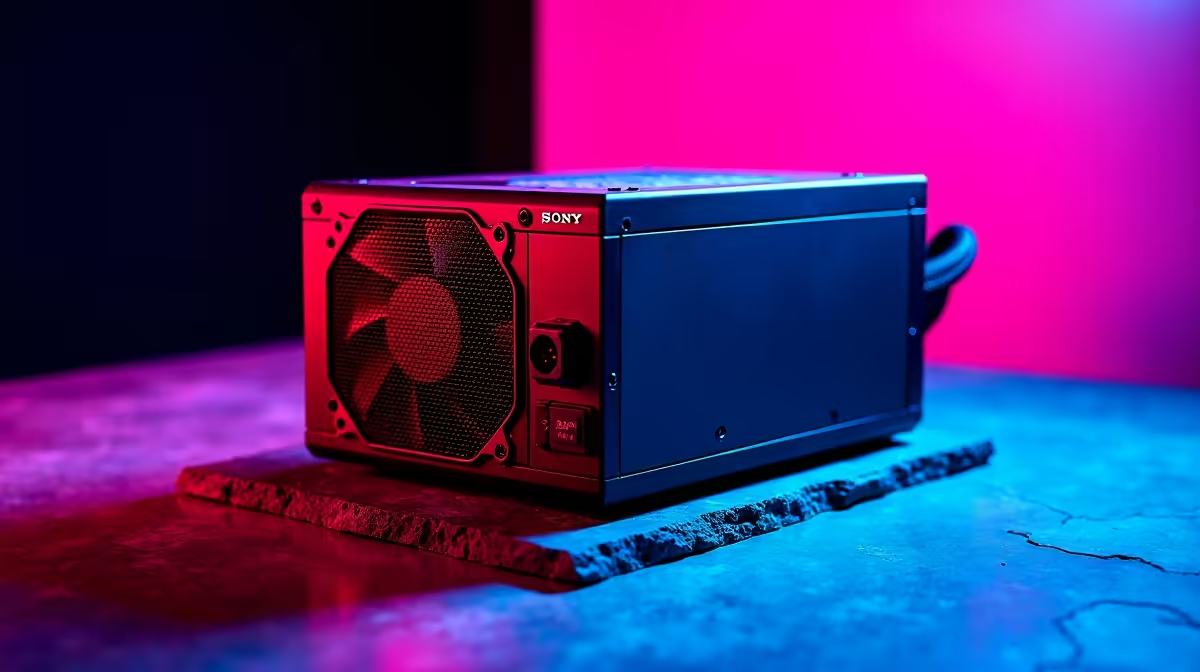
PSU RGB lighting syncs through the motherboard's ARGB or RGB header and the corresponding software ecosystem: ASUS Aura Sync for ROG boards, Corsair iCUE for Corsair PSUs, or MSI Mystic Light. Most premium PSU OLED displays sync separately via USB to the manufacturer's companion app. For South African gaming rooms, this same software can coordinate PSU lighting with case fans, GPU shroud LEDs, and RAM sticks into a single colour theme.
Understanding PSU RGB and OLED Display Connectivity 🎮
Power supply RGB lighting takes two forms. The first is addressable RGB (ARGB) LED strips or halos on the PSU's external housing, connected to the motherboard via a 3-pin ARGB header. These integrate into any ARGB software ecosystem regardless of PSU brand. The second is a dedicated display module like the ASUS ROG Thor III's OLED screen, which connects via USB directly to a header on the motherboard and communicates with Armoury Crate software. The OLED display can be configured to show system stats such as wattage draw, efficiency, and temperature, or custom animations that react to in-game events via Armoury Crate's Aura Sync integration. For SA gamers running an ASUS-dominant build, the entire lighting ecosystem from PSU to motherboard to GPU to RAM can be synchronised through a single software panel.
Cross-Brand Sync Options for Mixed Builds 💡
Many SA builders mix brands: an ASUS motherboard with a Corsair PSU and MSI GPU. Cross-brand sync is achievable through OpenRGB, a free open-source tool that communicates with ARGB hardware from multiple manufacturers simultaneously. OpenRGB supports most Corsair, ASUS, MSI, Gigabyte, and Deepcool RGB components and can push unified colour profiles across all devices. The limitation is that some proprietary features, like the ROG Thor III's real-time wattage animation or Corsair's iCUE FPS-reactive lighting, require the brand's own software. For basic colour synchronisation across brands, OpenRGB works well and runs as a system tray service with minimal performance impact.
Setting Up a Gaming Room Aesthetic in SA 🎨
South African gaming rooms in smaller apartments in Cape Town or Johannesburg often rely on PC RGB as the primary ambient lighting, replacing overhead bulbs with Govee or Nanoleaf smart lighting panels that can also be synchronised to gaming events. The practical setup for PSU-centred lighting: mount the system in a glass-panel mid-tower visible from the gaming chair, ensure the PSU face or OLED display is visible through the panel by checking case orientation first, run ARGB cables neatly to the motherboard header, and install Armoury Crate or iCUE. Budget roughly R150 to R400 extra for cable extensions if the case's included ARGB header cables do not reach the PSU position. Total additional setup cost for PSU lighting integration is negligible when the PSU itself is already an OLED-equipped premium unit.
Set RGB to Auto-Off During Long Sessions ⚡
Persistent high-brightness RGB adds a small continuous power draw, typically 3W to 8W for a full ARGB setup, and contributes minor heat. Setting Armoury Crate or iCUE to dim or disable RGB after 30 minutes of gaming keeps the PSU's OLED display from burning in at maximum brightness during long sessions and saves a marginal but real amount of electricity at SA tariff rates.
FAQ
Do all PSUs have RGB lighting?
No.
Will RGB on the PSU affect its efficiency or reliability?
Minimally.
Can the OLED display on a PSU show custom images or logos?
Yes on certain models. The ROG Thor III allows custom image upload via Armoury Crate, including team logos or personalised graphics. The display resolution is limited to approximately 128x128 pixels but is clearly visible through a glass panel case from gaming chair distance.
Want a gaming room setup where even the PSU lights up with the theme?
Evetech stocks RGB and OLED-display power supplies from ASUS ROG and Corsair, with sync support for Aura, iCUE, and OpenRGB ecosystems.