Quick Answer
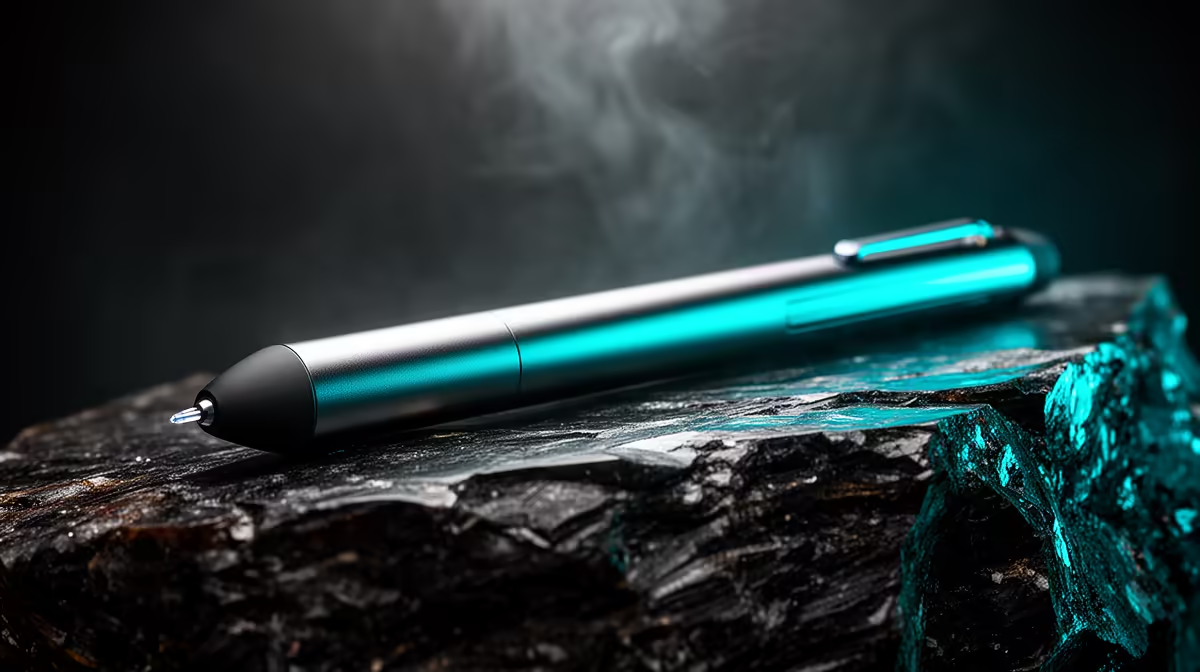
4,096 pressure levels let you produce line weights and shading gradients that respond to the force you apply to the stylus tip, from a hairline at barely-there pressure to a thick stroke at full force. To use them effectively, configure the pressure curve in your tablet driver and in your drawing app, then practise building shading transitions using only hand pressure without lifting the pen.
Understanding the 4,096-Level Pressure Scale 🎨
A stylus with 4,096 pressure levels divides your pen force from feather-light to full press into 4,096 discrete steps. In practice, this means smooth gradient transitions in brush strokes that look organic rather than stepped. The earlier standard was 1,024 levels (10-bit); 4,096 levels (12-bit) provides four times the resolution, which is visible in cross-hatching and airbrushed shading. Professional artists working in Clip Studio Paint, Procreate, Krita, or Photoshop will see the most benefit because these apps have pressure-sensitive brush engines that map all 4,096 levels to opacity, size, or both simultaneously.
Configuring the Pressure Curve for Your Drawing Style 🔧
Open your tablet's driver (Wacom, XP-Pen, or Huion) and locate the pressure curve editor. The curve is a graph with input pressure on the X-axis and output force on the Y-axis. For illustrators doing detailed linework, a softer curve (bowed upward) makes light strokes register more easily so you aren't pressing hard for thin lines. For painters doing heavy texture work, a harder curve (bowed downward) prevents accidental thick strokes. Most drawing apps also have their own pressure sensitivity sliders inside the brush settings, separate from the driver curve; combining both gives you fine-grained control. Test with a long diagonal stroke going from feather to full pressure to check the transition is smooth.
Applying 4,096 Levels to Shading Techniques ✏️
For hatching and cross-hatching: keep the pressure curve soft and focus on consistent, controlled stroke pressure. The 4,096-level resolution means each pass of a hatch line can be fractionally heavier or lighter, creating a natural depth illusion. For airbrushing or blending: work in circular motions with very light, consistent pressure, increasing force toward the darkest areas. A 4,096-level stylus separates these zones clearly without banding. For value studies: practise a single stroke from white to dark using one unbroken pen movement; the pressure scale should render a smooth gradient if your curve is correctly configured. South African illustration students using tablets starting from around R800 to R2,500 will have access to full 4,096-level support on most current-gen XP-Pen and Wacom models.
Per-Brush Pressure Mapping ⚡
In Krita and Clip Studio Paint you can set pressure curves per individual brush preset, not just globally. This means your inking brush can have a hard curve for crisp lines while your blending brush uses a soft curve for seamless shading, all without changing driver settings between strokes.
FAQ
Can I actually see a difference between 2,048 and 4,096 pressure levels?
Yes, especially in smooth shading and gradient brushwork. The transition between light and dark is noticeably smoother at 4,096 levels, particularly with low-opacity brush strokes layered over each other.
Does my drawing software need to support 4,096 levels to use them?
Yes. The software must have a pressure-sensitive brush engine to interpret the signal from the driver. Clip Studio Paint, Photoshop, Krita, Procreate, and Affinity Designer all support 4,096 levels; basic apps may cap at 1,024 or even 256.
Do I need a special computer to run 4,096-level pressure sensitivity?
No. Pressure level data is processed by the tablet driver, not the GPU or CPU. Any modern PC or laptop handles it with no performance penalty.
Looking to unlock smoother shading and more expressive linework?
Evetech stocks drawing tablets and stylus pens with full 4,096-level pressure support, ready for illustrators, students, and digital artists in South Africa.