Quick Answer
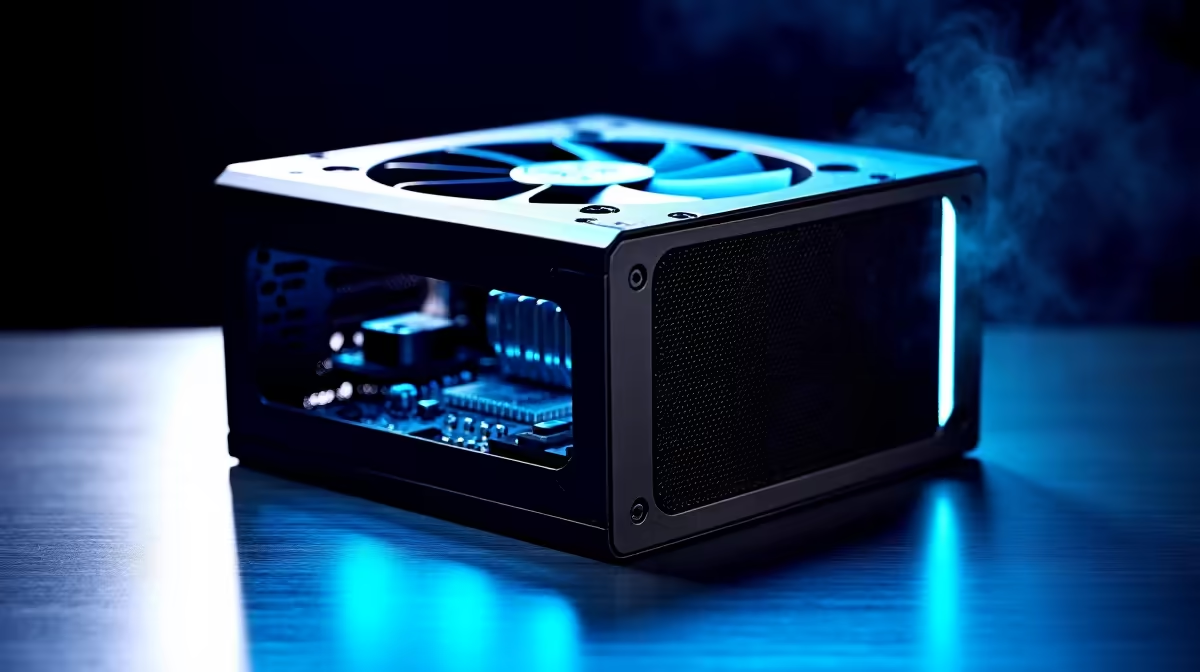
GaN (gallium nitride) MOSFET technology replaces traditional silicon transistors in PSU switching stages, cutting switching losses by up to 50 percent. The result is a smaller, cooler-running power supply that achieves 80 Plus Titanium efficiency ratings and can operate passively at loads under 40 percent. For South African builders in hot climates, GaN PSUs run noticeably cooler and quieter than equivalent silicon-based units.
How GaN MOSFETs Differ From Silicon In Practice 🔬
In a conventional silicon MOSFET PSU, the transistors switch the primary AC waveform at around 65 to 100 kHz. At these frequencies, silicon's relatively slow switching speed introduces dead-time losses, where both the high-side and low-side transistors briefly conduct at the same time, wasting energy as heat. GaN switches at 300 kHz to 1 MHz with near-zero dead time, slashing those losses dramatically. The switching stage in a GaN PSU runs so much cooler that manufacturers can downsize the heatsinks considerably, freeing space for a larger transformer or simply making the unit shorter.
Efficiency and Thermal Benefits for SA Environments 🌡️
A GaN-based 850W PSU commonly achieves 94 percent or higher efficiency at 50 percent load, versus 88 to 90 percent for a typical Gold-rated silicon unit. At Johannesburg summer ambient temperatures of 30 to 36 degrees Celsius, that difference translates to roughly 30 to 50W less heat radiated inside the chassis. For compact mid-tower or mATX builds where internal airflow is restricted, that thermal reduction directly lowers CPU and GPU temperatures by 2 to 4 degrees Celsius at idle. The fan on a GaN unit often stays off entirely during web browsing or light streaming loads, making the system near-silent outside gaming sessions.
Installation Considerations and Cable Compatibility 🔧
GaN PSUs frequently ship with ATX 3.1 compliance and native 12V-2x6 connectors, making them ideal partners for RTX 5000-series and RX 9000-series cards. Check that the modular cable set includes the PCIe cable count your GPU requires; some GaN units target ITX or mATX form factors and supply fewer cables than a full ATX build might need. The standard ATX24-pin and EPS12V connectors are identical to conventional PSUs, so installation is no different from any other unit. GaN PSUs do not require special grounding or wiring beyond what a standard South African three-pin plug and surge-protected power strip already provides.
Passive Mode Saves Noise and Wear ⚡
Many GaN PSUs feature a hybrid fan mode that spins the fan only when internal temperature exceeds a set threshold, typically around 40 degrees Celsius. In a well-cooled South African mid-tower, the fan may never spin during a desktop session, extending fan bearing life significantly and keeping your work-from-home environment quiet.
FAQ
Are GaN PSUs reliable enough for a daily-use gaming PC?
Yes. GaN MOSFET technology is mature in consumer electronics and is now proven in desktop PSUs from established brands. The lower operating temperature of the switching stage typically extends MOSFET lifespan well beyond that of comparable silicon units.
Do GaN power supplies work with any motherboard or are there compatibility requirements?
GaN PSUs use standard ATX connectors and are fully compatible with any ATX, mATX, or ITX motherboard. The only compatibility point to verify is that the unit's cables include the connectors your specific GPU needs, particularly the 16-pin 12V-2x6 for current NVIDIA cards.
Is the price premium for a GaN PSU justified over a standard Platinum unit?
For builders who value silence, compact sizing, and long-term reliability in South Africa's warm climate, yes. If budget is tight, a conventional 80 Plus Platinum unit from a reputable brand is still an excellent choice; GaN adds incremental benefits rather than being a fundamental requirement.
Want a cooler, quieter PC build?
Evetech stocks GaN-based and 80 Plus Platinum power supplies across multiple wattage classes, ready for next-gen GPU pairings.