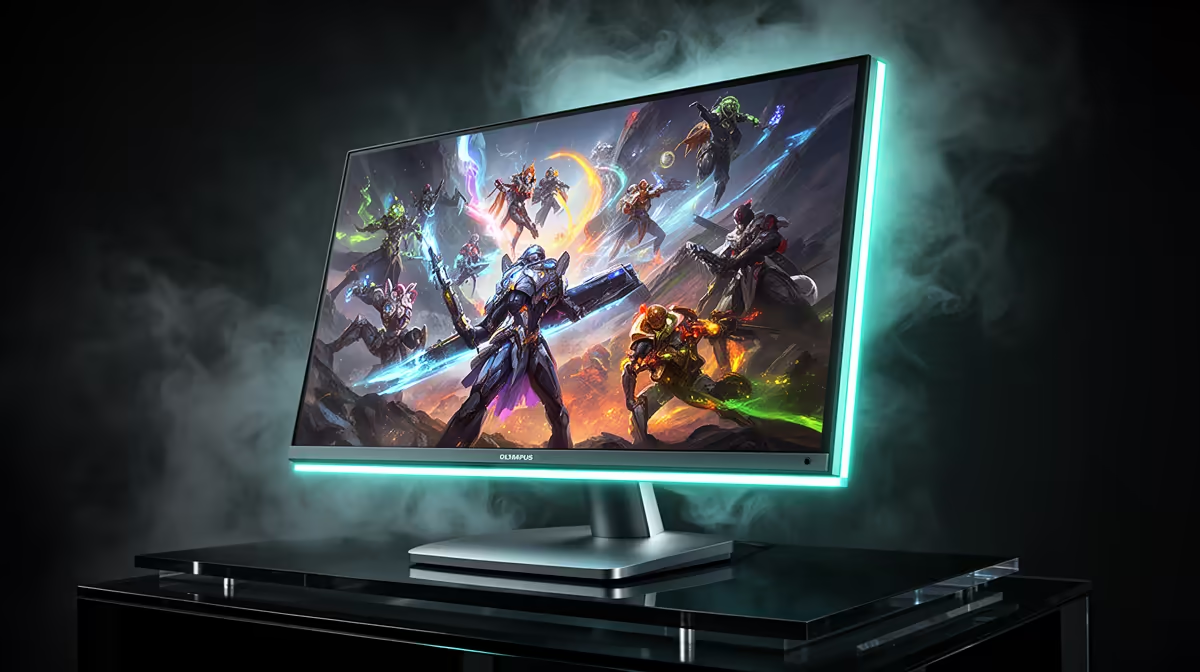
Most monitor specs come with an asterisk. Brightness figures are measured from the front. Contrast numbers are taken straight-on. Only IPS panel technology holds up when you tilt the screen, hand a colleague the keyboard, or simply glance over from a slightly odd angle. That consistency is not marketing copy; it is physics, and understanding how IPS achieves it tells you exactly why it costs what it does and whether it is the right pick for your setup.
Quick Answer
IPS keeps colour and tone steady across a full 178-degree field because its liquid crystals shift in a flat plane rather than twisting upright. That geometry stops the colour wash-out you get on TN and the contrast crush you can see off-angle on VA. For colour-critical work, IPS is the safe starting point.
🔆 Why the Crystal Orientation Changes Everything
Every LCD panel works by arranging liquid crystals between two glass layers, then shining a backlight through them. The crystals rotate to block or pass that light, which is how the image forms. The difference between panel types comes down to the direction in which those crystals move.
In a TN cell the crystals twist like a coiled spring. Viewed straight on, the image looks fine. Tilt the screen even modestly and the twist geometry distorts, shifting colours and washing out shadows. The viewing cone is narrow enough that a person sitting half a metre to the side of you can see a noticeably different image from what you see.
IPS solves this by lying the crystals flat and rotating them within the same plane as the panel surface. Because the rotation stays horizontal, the optical path from backlight to your eye changes very little across a wide arc. Tone and saturation hold to within a degree or two of their calibrated value whether you are sitting directly in front or viewing from the far edge of the screen. That stability is the core promise of the technology.
The 178-Degree Spec in Practice
178 degrees sounds like a conference-room figure. At a typical desk you rarely exceed 50 degrees off-centre, so the number matters for a different reason: a panel that holds colour out to 178 degrees shows almost no variation across the central 60 degrees where you actually sit. A panel rated to 160 degrees is already drifting measurably before you reach that limit. The extreme headroom is what guarantees accuracy at normal angles.
🎨 Colour Coverage and Why 99 Percent sRGB Is the Benchmark
Colour gamut describes the range of colours a panel can reproduce. The sRGB space covers what standard images, websites, and video content are mastered to. A display at 99 percent sRGB renders essentially that entire space at the correct hue and saturation. Some IPS panels extend further into DCI-P3 territory for cinema and photo editing work, but for general gaming and productivity, 99 percent sRGB is where the meaningful threshold sits.
TN panels, even modern ones, often cover 70 to 75 percent of sRGB. Colours that should be a vivid red can read as a duller, slightly shifted tone. For gaming that might be tolerable, but for anyone editing photos or checking design files it introduces errors that compound through a workflow.
Pro Tip ⚡
If you are calibrating for photo or video work, run a free software calibration profile on any IPS monitor before your first serious editing session. Most IPS panels ship with a small factory delta but respond well to profiling, and the improvement in accuracy is immediately visible in skin tones and sky gradients.
⚡ How IPS Compares to VA and TN
Placing IPS against the other two common technologies reveals genuine trade-offs rather than a clear hierarchy.
VA panels lead IPS on contrast. A mid-range VA can achieve 2,500 to 3,000 to 1 native contrast, while IPS typically sits between 800 to 1 and 1,200 to 1. In a dark room that gap is visible; black letterboxes on a VA look genuinely dark, while the same scene on an IPS shows a faint grey lift, often called IPS glow, at the corners or edges. For pure cinematic dark-room viewing, VA has the edge.
Where VA struggles is in fast motion and off-angle consistency. Many VA panels show a dark smearing trail behind moving objects in low-contrast scenes, such as a grey ship on a dark sea. The phenomenon is a response time artefact caused by the crystals moving more slowly between mid-tone states. It is rare to the point of being irrelevant on brightly lit game environments, but noticeable in cinematic or dark-themed titles.
TN panels were the speed benchmark for a long time. Sub-1ms response times gave competitive players a real advantage when IPS was still slowing through 4 to 5ms transitions. Modern Fast IPS technology has closed most of that gap, reaching 0.5 to 1ms response with full colour accuracy intact. The practical case for TN at the same price point has narrowed significantly.
🖥️ When IPS Glow Becomes a Real Issue
IPS glow is the faint brightening visible near the corners and edges of an IPS panel in dark scenes, caused by backlight scatter around the crystal structure. It is not a defect; every IPS monitor exhibits it to some degree, and it only matters in specific situations.
In a bright office or under daylight-adjacent desk lighting it is invisible. In a moderately lit room with a dark game or movie on screen, it can be a minor distraction at the edges of your peripheral vision. In a completely dark room, watching dark cinema content at close range, it is the most obvious limitation of the technology.
Mitigation is simple. A soft LED bias light behind the monitor at around 6,500 Kelvin raises the room's ambient black level, shrinking the perceived glow contrast and reducing eye strain across long sessions. Under normal desk lighting, IPS glow is a footnote rather than a reason to choose differently.
Frequently Asked Questions
Why does IPS keep colour steady when viewed from the side?
The crystals rotate within the flat plane of the panel rather than twisting upward, keeping the light path geometrically similar across a wide arc. Colour and brightness at 60 degrees off-centre stay close to the calibrated straight-on values, rather than washing out or shifting hue the way a TN crystal structure does.
How does a 99 percent sRGB figure affect everyday use?
It means the panel can produce virtually every colour that standard images, games, and video are authored in. Below about 90 percent sRGB you start seeing colours that should appear vivid rendered as muted or slightly wrong in hue. At 99 percent those errors disappear for standard content, which matters most for photo editing, design review, and any game with rich environmental colour.
Is the IPS glow problem bad enough to avoid the technology?
For most South African setups under normal desk lighting, no. IPS glow is only clearly visible in a very dark room against dark content at close range. Running a soft bias light behind the screen removes most of the perceived effect. It is worth understanding before you buy, but it does not override the colour and angle advantages for the majority of users.
How does VA panel contrast compare to IPS in a real gaming session?
In brightly lit or colourful game environments the contrast difference between VA and IPS is negligible. The VA advantage becomes visible in dark, cinematic scenes where the deeper blacks read as genuinely richer. The trade-off is that some VA panels show smearing behind moving objects in those same dark scenes, which can feel worse than the IPS glow it was meant to replace.
Can modern IPS match TN panels for competitive gaming speed?
Yes. Fast IPS and Nano IPS variants reach 0.5 to 1ms grey-to-grey, matching what was once exclusive to TN. The practical gap in competitive play is now within the margin of error for most players, while TN retains none of the colour or angle benefits IPS carries.
Ready to see what a properly calibrated IPS panel looks like in action?
Browse the IPS gaming monitor range and find a screen that holds its colour honestly, from any angle and across every hour of a long session.