


PCIe 5.0 vs PCIe 4.0 for Video editing in 4k in SA
PCIe 5.0 vs PCIe 4.0 for video editing in 4k is mainly about fit, features, compatibility, cost, and upgrade path, not one automatic winner. SA buyers should match the choice to the setup.
Read moreA 144Hz refresh rate is high enough for competitive esports for nearly all South African players, delivering a 6.9ms frame time that feels vastly sharper than 60Hz. Only top pros gain much from 240Hz, which most local GPUs cannot fully feed anyway.
The question South African players ask most often when speccing a gaming display is not which resolution to pick. It is whether to stop at 144Hz or keep spending toward 240Hz or beyond. 144Hz refresh rate represents the point where diminishing returns start to appear for most players, but the honest answer about whether it is competitive enough depends on what game you play, at what level, and what your GPU can actually sustain.
For the vast majority of competitive players, 144Hz is genuinely sufficient. The jump from 60Hz to 144Hz cuts frame time from 16.7ms to 6.9ms, a difference every player notices immediately. The step to 240Hz saves only another 2.7ms, which trained professionals can detect but most players cannot exploit.
Refresh rate converts directly into frame time: the interval between each displayed image. At 60Hz that interval is 16.7 milliseconds. At 144Hz it drops to 6.9ms. At 240Hz it reaches 4.2ms. The human perceptual benefit is not linear across those steps.
The gap between 60Hz and 144Hz is enormous in practice. Cursor movement, aim tracking, and the snap of a flick all feel fundamentally different at 144Hz because the visual system has nearly 10ms of extra information per second to work with. Players switching from 60Hz describe the difference as immediate and obvious, and it shows up in aim consistency within the first few sessions.
The gap between 144Hz and 240Hz is a 2.7ms reduction in frame time. This is measurable in controlled lab conditions and perceptible to professional players who have spent years training at 144Hz before stepping up. For players who have not built that level of motor-visual precision, the difference is real but difficult to translate into better outcomes.
The competitive benefit of a high-refresh display depends entirely on the GPU actually sustaining matching frame rates. A 144Hz display where the GPU delivers 80 to 100 FPS shows none of the full 144Hz advantage. The monitor shows the most recently rendered frame, and if new frames arrive slowly, the display refresh simply repeats frames rather than showing new ones.
For 144Hz to be meaningful, the GPU needs to consistently sustain frame rates at or above 144 FPS in the specific titles you play. In esports-oriented games like Valorant, Counter-Strike 2, Apex Legends, and League of Legends, this is achievable with mid-range hardware. An RTX 4060 handles these titles well past 144 FPS at medium-to-high settings, making 144Hz practical for a broad range of South African gaming setups.
Not all competitive games benefit equally from refresh rate. The advantage scales with how fast and how precisely aim or reaction input translates into outcome.
In tactical shooters and battle royales, where a single frame of information advantage can determine whether a player peeks or is peeked, 144Hz delivers a clear benefit. The smoother motion at 144Hz makes tracking moving targets genuinely easier, and the tighter frame time reduces the window in which the game's state has changed but your display has not yet shown it.
In real-time strategy games, MOBAs, and card-based competitive titles, the refresh rate advantage shrinks. Interface responsiveness and cursor smoothness are better at 144Hz, but the action pace rarely involves the kind of rapid aim movement where 60Hz creates a visible disadvantage. Players in those genres may find a QHD panel at 144Hz a better investment than a 240Hz panel at 1080p.
Enable your game's FPS counter and confirm you are actually reaching 144 FPS before buying a 240Hz display. If your GPU regularly dips below 144 FPS in your main titles, the display refresh rate ceiling is not your bottleneck. Address the GPU first.
240Hz monitors carry a premium that, in rand terms, often sits R2,000 to R4,000 above a quality 144Hz panel in the same size and panel type. For that difference, you receive the 2.7ms frame-time reduction described above, plus a sharper sampling window for the backlight strobing that drives MPRT response time claims.
At a recreational or club competitive level, this premium is difficult to justify unless budget permits. The players who unambiguously benefit from 240Hz are those competing at LAN events or national ranking tournaments where opponents are also at 240Hz and where the tiny timing windows are actively exploited. At those levels, every marginal gain matters. Below that tier, the R2,000 to R4,000 separating 144Hz from 240Hz almost always does more good applied toward a better GPU, a higher-quality 144Hz panel, or a chair and desk setup that improves posture and reduces fatigue over long sessions.
Yes. Moving from 60Hz to 144Hz halves the frame time from 16.7ms to 6.9ms, and almost every competitive player notices this improvement immediately in how aim feels and how motion resolves. The remaining step to 240Hz is a 2.7ms gain that has diminishing perceptual impact for the majority of players below professional competition level.
Measurably real but practically small for most players. The 2.7ms reduction in frame time is detectable under controlled testing and felt by high-level professionals. Recreational and amateur competitive players switching directly from 144Hz to 240Hz often report a subtle rather than dramatic improvement, unlike the stark shift from 60Hz to 144Hz.
Yes, in practice. The display's 144Hz capability only delivers its full benefit when the GPU feeds it at least 144 frames per second. Below that, the monitor cycles through available frames without the full timing advantage. Adaptive Sync helps by eliminating tearing when FPS dips below the ceiling, but the refresh rate ceiling is only meaningfully used when the GPU sustains matching output.
Partly. Interface and cursor movement feel smoother at 144Hz than 60Hz, which is noticeable in any fast-scrolling RTS. The primary competitive advantage of high refresh rate comes from tracking aim and reacting to fast movement, which matters less in slower genres. For those titles, panel quality, QHD resolution, and colour accuracy often represent better value than chasing maximum refresh rate.
Stop at 144Hz unless you are competing at a serious national or LAN event level. The R2,000 to R4,000 premium for 240Hz over a quality 144Hz panel buys a 2.7ms frame-time improvement that most players cannot exploit. That budget spent on a better GPU to consistently sustain 144 FPS, or on a higher-quality 144Hz IPS panel, typically improves the overall experience more meaningfully.
Immediately and clearly different. Motion tracking is smoother, aiming feels more connected to mouse input, and the display's response to fast movement stops looking like a series of frames and starts feeling fluid. Most players describe the transition as one of the largest perceptible improvements they have made to their gaming setup.
Ready to experience the difference 144Hz makes? Browse the 144Hz gaming monitor range at Evetech and find a panel that matches your GPU and competitive ambitions.
Yes. Moving from 60Hz to 144Hz halves the frame time from 16.7ms to 6.9ms, and almost every competitive player notices this improvement immediately in how aim feels and how motion resolves. The remaining step to 240Hz is a 2.7ms gain that has diminishing perceptual impact for the majority of players below professional competition level.
Measurably real but practically small for most players. The 2.7ms reduction in frame time is detectable under controlled testing and felt by high-level professionals. Recreational and amateur competitive players switching directly from 144Hz to 240Hz often report a subtle rather than dramatic improvement, unlike the stark shift from 60Hz to 144Hz.
Yes, in practice. The display's 144Hz capability only delivers its full benefit when the GPU feeds it at least 144 frames per second. Below that, the monitor cycles through available frames without the full timing advantage. Adaptive Sync helps by eliminating tearing when FPS dips below the ceiling, but the refresh rate ceiling is only meaningfully used when the GPU sustains matching output.
Partly. Interface and cursor movement feel smoother at 144Hz than 60Hz, which is noticeable in any fast-scrolling RTS. The primary competitive advantage of high refresh rate comes from tracking aim and reacting to fast movement, which matters less in slower genres. For those titles, panel quality, QHD resolution, and colour accuracy often represent better value than chasing maximum refresh rate.
Stop at 144Hz unless you are competing at a serious national or LAN event level. The R2,000 to R4,000 premium for 240Hz over a quality 144Hz panel buys a 2.7ms frame-time improvement that most players cannot exploit. That budget spent on a better GPU to consistently sustain 144 FPS, or on a higher-quality 144Hz IPS panel, typically improves the overall experience more meaningfully.
Immediately and clearly different. Motion tracking is smoother, aiming feels more connected to mouse input, and the display's response to fast movement stops looking like a series of frames and starts feeling fluid. Most players describe the transition as one of the largest perceptible improvements they have made to their gaming setup.
PCIe 5.0 vs PCIe 4.0 for video editing in 4k is mainly about fit, features, compatibility, cost, and upgrade path, not one automatic winner. SA buyers should match the choice to the setup.
Read more
Wi-Fi 7 vs Wi-Fi 6e for competitive esports comes down to router support, latency goals, device compatibility, and coverage. SA buyers should match the choice to the real network setup.
Read more
ATX 3.1 vs ATX 3.0 for mMO and live-service games buyers - what changes is mostly about compatibility, budget, upgrade path, and setup fit. SA buyers should check device support and real needs before expecting a clear win from either option.
Read more
LGA 1851 vs LGA 1700 can affect Twitch and YouTube streaming when gaming and encoding share CPU resources. For SA creators, the real-world difference depends on encoder choice, memory support, motherboard cost, thermals, and upgrade plans.
Read more
X870E vs X670E for aaa single-player gaming is mainly about fit, features, compatibility, cost, and upgrade path, not one automatic winner. SA buyers should match the choice to the setup.
Read more
Hall Effect switches vs Mechanical switches for mMO and live-service games is mostly about compatibility, budget, upgrade path, and setup fit. SA buyers should check device support and real needs before expecting a clear win from either option.
Read more
A fake 113GB GTA VI ISO reportedly used empty padding around a small malware payload. SA gamers should delete unofficial builds, keep Windows security active and wait for official channels.

Wi-Fi 6E vs Wi-Fi 6 matters for 4K video editing when files move across a network. The real-world difference between Wi-Fi 6E and Wi-Fi 6 for video editing in 4K depends on NAS access, cloud uploads, router range, and SA creator workflows.

The difference between PCIe 5.0 and PCIe 4.0 for SA gamers is mostly bandwidth headroom. Compare GPU slot needs, NVMe speed, motherboard support, and upgrade timing before paying extra for a newer platform.

Gaming PC stuck pixel checks in South Africa should confirm the monitor fault first. Use colour tests, screenshot comparison, cable swaps, display menu checks, and clear photos before deciding on support.

Shokz OpenFit Air 2 earbuds weigh 7.2g each and use a redesigned dual-driver open-ear layout. SA buyers should choose them for comfort and awareness, not maximum isolation.

AMD's current driver now lists a Radeon RX 9050 4GB, while product coverage details a narrowed memory system. SA buyers should weigh the low VRAM ceiling against current local Radeon options.

Samsung Display has demonstrated a 16-inch 2.5K OLED laptop panel running at 300Hz. SA buyers should wait for a named notebook, full panel specifications and a local price before planning an upgrade.

Microsoft says some Windows 11 game crashes after recent updates are linked to RGB-related drivers. Affected SA gamers should confirm the update and driver before using the published registry workaround.
RTX 5090 on a 650W PSU is a tight pairing with very limited headroom. For SA gaming PCs, focus on total system draw, PSU quality, connector support, CPU choice, and avoid OC plans unless the full build is carefully power-limited.
PCIe 5.0 vs PCIe 4.0 for video editing in 4k is mainly about fit, features, compatibility, cost, and upgrade path, not one automatic winner. SA buyers should match the choice to the setup.
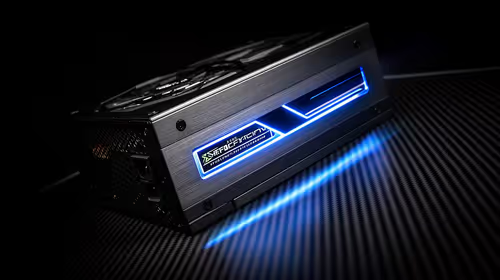
850W PSU safety for RTX 5090 is plausible with a quality unit and balanced parts. In SA, confirm connector support, CPU power draw, case airflow, PSU age, and spare capacity before building around 850W.
Wi-Fi 7 vs Wi-Fi 6e for competitive esports comes down to router support, latency goals, device compatibility, and coverage. SA buyers should match the choice to the real network setup.