Quick Answer
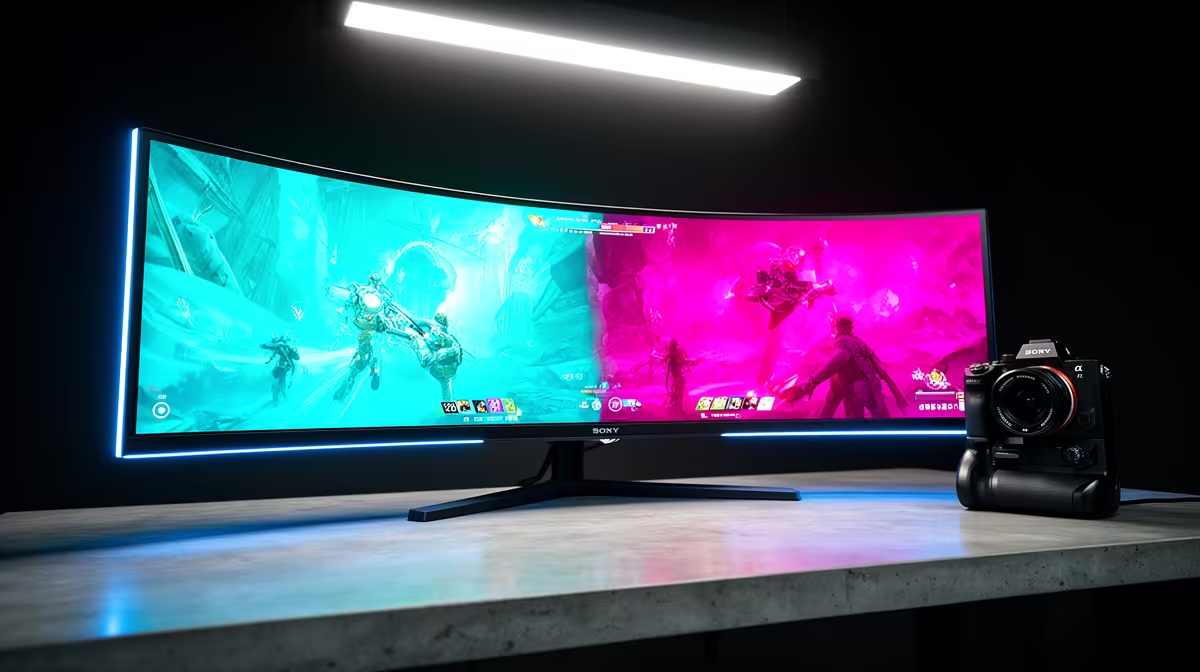
Yes, 3840x1080 DFHD is enough for most gamers at 49 inches because pixel density lands at about 81 ppi, which looks sharp from the recommended 90 to 110 cm viewing distance. It is not sharp enough for close-up reading of small desktop text, but for gaming and media it is perfectly adequate. Buyers who sit very close or do detailed design work may prefer the 5120x1440 DQHD format instead.
Pixel Density Reality at 49 Inches 🖥️
3840x1080 across 49 inches gives a pixel pitch of roughly 0.31 mm and a density of about 81 ppi. For comparison, a 1080p 27-inch monitor sits around 81 ppi too, so the sharpness is equivalent to what most gamers already accept on a standard gaming display. The wide panel means you are never looking at the centre and the edges simultaneously up close, so the density feels acceptable in practice. Where the limit shows is in fine-detail work like reading 8-point text in a spreadsheet, where individual characters can look slightly soft at 81 ppi compared to a 4K display at 27 inches.
DFHD vs DQHD: The Alternative Worth Knowing 🔍
5120x1440 DQHD monitors offer 109 ppi at 49 inches, noticeably sharper for text and close-up content. These panels currently start around R14,000 to R22,000 at Evetech, representing a meaningful premium. The GPU cost increases proportionally: driving 5120x1440 at 120Hz in demanding titles requires at minimum an RTX 4080 or RX 7900 XTX to achieve smooth gameplay. DFHD at 3840x1080 is far more accessible for a mid-range system. Most South African gamers building around R10,000 to R16,000 in GPU budget will find DFHD a more realistic pairing.
Game Compatibility and Rendering Considerations 🎮
All games that run at 1080p can technically run at 3840x1080 if they support 32:9. Some games do not scale natively and render at 2560x1080 (21:9) with pillarboxing. Game engines that render at 3840x1080 benefit from the ultrawide width without needing higher vertical resolution, since 1080p vertical resolution is the standard for most GPU benchmark targets. The lower pixel count vs DQHD also means your GPU delivers higher frame rates at equivalent settings, making 144Hz ultrawide gaming more achievable on current mid-range hardware like the RTX 4070 or RX 7800 XT.
Scaling Fix for Non-Ultrawide Games ⚡
that do not natively support 32:9 will render a 16:9 image with black bars on the sides at DFHD. In most cases you can force the game to fill the screen via the OSD stretch mode, but this distorts the image. A better approach is to use the monitor's built-in PBP mode to display a different source on the unused sides, or simply accept pillarboxing for non-supported titles.
FAQ
Is 3840x1080 too blurry for desktop use in Windows?
It depends on how close you sit and your font sensitivity. At 90 cm to 110 cm viewing distance most users find text legible, especially with Windows ClearType enabled. Sitting closer than 70 cm makes the pixel grid visible and text looks soft.
Can I use a 3840x1080 monitor with a mid-range GPU like an RTX 4060?
Yes. The RTX 4060 handles 3840x1080 at medium-to-high settings in most games at 75Hz to 100Hz. It may struggle to hold 144 fps in demanding titles like Cyberpunk 2077 at high settings, but optimised settings get you well above 100 fps in most cases.
How does 3840x1080 compare to a 4K 27-inch monitor for productivity?
A 4K 27-inch has roughly 163 ppi and is sharper for text-heavy work. The ultrawide wins on horizontal screen real estate, fitting more application windows side by side. The two formats serve different primary use cases.
Considering a DFHD ultrawide for your gaming setup?
Browse Evetech's range of 3840x1080 ultrawide monitors paired with the GPUs that drive them smoothly at 144Hz.