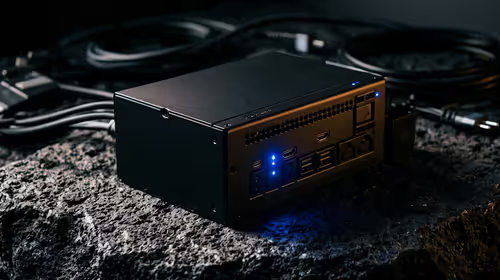
A plug-in router that gives you home internet in the time it takes to make coffee sounds too good to be true, and for some South African homes it genuinely is the right answer. For others, it is a step down from what a fibre line already at the kerb would deliver. 5G home internet is now a real alternative to fibre across SA metros, but whether it suits you comes down to your exact address, what you do online, and how much latency matters to your household.
Quick Answer
5G fixed-wireless access suits homes where fibre is unavailable or where you want a fast install with no trenching, it sets up in minutes with a SIM-based router and can deliver 100 to 500-plus Mbps. If your suburb has fibre coverage, fibre's lower, steadier latency makes it the stronger long-term choice, especially for gaming and heavy work-from-home use. Check fibre availability at your exact address first, then decide.
How 5G home internet actually works
5G fixed-wireless access, often shortened to FWA, delivers broadband over the same mobile network towers that serve phones, but to a fixed router in your home rather than a handset. You receive a customer-premises router with a SIM, plug it in, and it connects to the nearest 5G mast. There is no cable run to your home, no trench across the pavement, and no technician appointment beyond placing the router where signal is strongest.
That is the headline advantage. A fibre installation depends on a physical line being run to your property, which can mean weeks of waiting and digging if your area is not already connected. A 5G router is something you can have working the same day. Providers including Rain, Vodacom, and MTN have built out 5G coverage across South African metros, and FWA subscriber numbers have grown sharply as that coverage has widened.
How fibre compares
Fibre delivers internet over a dedicated optical line run directly to your home. Because that line is yours and is not shared over the airwaves, it tends to offer more consistent speeds and, crucially, lower and steadier latency, the delay between your action and the network's response.
Why latency is the deciding factor for some
Raw download speed is where 5G competes well, and for streaming and browsing the difference is often invisible. Latency is where fibre usually pulls ahead. A wired fibre connection typically holds a lower, more stable ping than a wireless link that shares tower capacity with every other device in the area. For online gaming, video calls, and remote-desktop work, that steadiness matters more than peak speed, which is why fibre remains the safer pick for households that live online for work and competitive play.
Why fibre is the steadier long-term bet
Fibre performance does not degrade when the neighbourhood gets busy in the evening in the same way a shared wireless cell can. For a household that needs uninterrupted work, school, and streaming all at once, fibre is still widely regarded as the most reliable option once it is available at your address.
The South African decision: how to choose
The honest answer is that the better technology depends entirely on your circumstances. Work through these four questions.
Is fibre available at your exact address?
This is the first and most decisive check. Fibre coverage in South Africa is patchy street by street, an estate may have it while the road behind does not. If fibre is not at your address and is not coming soon, 5G FWA is the obvious way to get fast internet now without waiting on infrastructure. If fibre is available, weigh it seriously against 5G on the points below.
How sensitive is your household to latency?
If your home revolves around competitive online gaming, frequent video meetings, or remote work into office systems, fibre's steadier latency is worth prioritising. If your use is mostly streaming, browsing, social media, and the occasional call, 5G's latency is perfectly comfortable and the difference will rarely surface.
How does the pricing stack up?
5G home packages from the major SA providers are often priced competitively, with some unlimited 5G plans undercutting comparable fibre packages on monthly cost. Fibre pricing varies by provider and speed tier. Compare the real monthly figure for the speed you actually need rather than the headline maximum, and factor in that 5G usually has no installation or trenching cost.
How quickly do you need it, and how often will you move?
5G wins on speed of setup and on flexibility, the router can move with you within a coverage area, which suits renters and anyone in a temporary home. Fibre is the better fit for a settled household that values long-term stability over portability.
Getting the most from whichever you choose
The connection into your home is only half the equation, the equipment inside it decides how much of that speed actually reaches your devices. A 5G router placed near a window facing the nearest mast will hold a stronger, faster link than one tucked into a cupboard. On a fibre line, an ageing router can bottleneck a fast plan, so the in-home Wi-Fi gear matters either way. A capable router or a mesh system that covers the whole home is the upgrade that most often unlocks the speed people are paying for, and you can compare options across the networking range at Evetech. For the smaller pieces, cables, adapters, and signal accessories that round out a setup, the accessories best sellers are a quick place to fill the gaps.
Frequently Asked Questions
Is 5G home internet good enough for gaming?
For casual gaming, yes, 5G delivers strong download speeds. For competitive online gaming, fibre's lower and steadier latency gives a more consistent connection, so if ranked play matters to you and fibre is available, it is the safer choice.
How fast is 5G home internet in South Africa?
5G fixed-wireless from the major SA providers can deliver roughly 100 to 500-plus Mbps depending on your distance from the mast and network congestion. Real-world speeds vary with signal strength and how busy the local cell is.
Can I move my 5G router to a new home?
Within the same provider's coverage area, yes. A SIM-based 5G router can be unplugged and set up at a new address without an installation, which makes it well suited to renters and anyone who moves often.
Why is fibre still recommended where it is available?
Fibre offers a dedicated, wired line that is not shared over the air, giving more consistent speeds and lower, steadier latency. For households needing reliable simultaneous work, school, and streaming, that stability is why fibre remains the default recommendation when it reaches your address.
What should I check before signing up for either?
Check fibre availability at your exact address, the real monthly price for the speed you need, and how latency-sensitive your usage is. Then make sure your in-home router or mesh system can actually carry the speed you are paying for.
The connection is only as good as the gear behind it. Browse the networking range at Evetech to find a router or mesh system that delivers your full 5G or fibre speed to every room in the house.