Quick Answer
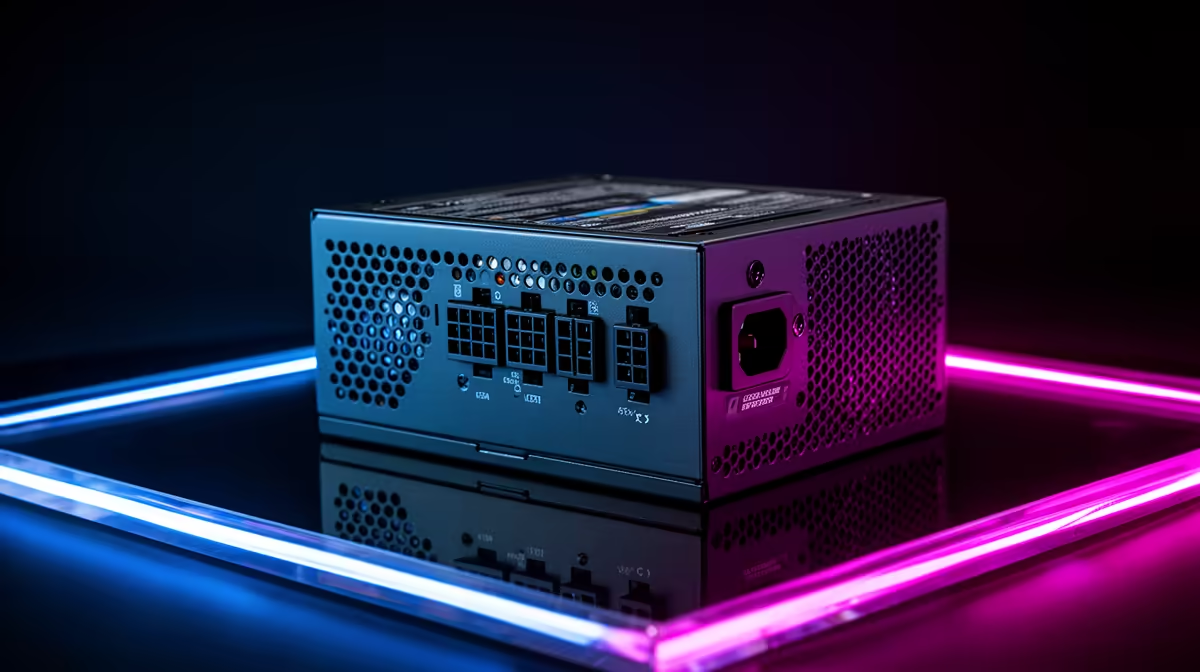
For most single-GPU high-end gaming builds in South Africa, no: an 850 W to 1,000 W 80 Plus Gold ATX 3.1 PSU handles RTX 5080 or RX 9070 XT builds with headroom. A 1,200 W unit is justified for RTX 5090 builds, heavy overclocking, or multi-GPU or multi-device workstations.
What High-End Builds Actually Draw at the Wall 🔢
A system with a Core Ultra 9 285K and RTX 5080 at stock settings draws around 700 W to 750 W peak under combined CPU and GPU stress tests. A 1,000 W 80 Plus Gold PSU runs that load at roughly 70% to 75% of capacity, its most efficient operating zone. Stepping up to an RTX 5090, which can burst past 600 W GPU draw alone, pushes the same CPU system to 850 W to 950 W peak. A 1,000 W unit handles this with 5% to 15% headroom; a 1,200 W unit gives 20% to 30% headroom, which is more comfortable for long-term reliability and future upgrades.
When 1,200 W Becomes the Right Choice 🔌
Three scenarios push a build into 1,200 W territory: pairing an RTX 5090 with a Ryzen 9 9950X and running both at sustained overclocked loads; running a workstation with two high-TDP cards for AI or professional rendering; or planning an upgrade path that adds a second NVMe array, extra drives, and multiple USB-C devices. South African content creators and AI developers building workstations locally often spec 1,200 W for this reason. Current 1,200 W 80 Plus Gold fully modular ATX 3.1 units from brands stocked at Evetech are priced at approximately R4,500 to R6,500.
Efficiency at High Wattage in SA Conditions 💡
A 1,200 W 80 Plus Gold PSU running a 750 W load (62% capacity) operates near peak efficiency. A 1,000 W unit running the same load (75% capacity) is also in the efficient zone. Both are sensible; the 1,200 W gives more upgrade headroom but costs R700 to R1,200 more. In South Africa, the electricity cost difference at R3.00 per kWh between these two units is small: the 1,200 W PSU may waste marginally more at light loads due to its larger transformer, but the difference is under R50 annually at typical gaming sessions.
Do Not Undersize for an RTX 5090 Build ⚡
The RTX 5090 can demand up to 600 W during transient spikes under ATX 3.1. Pairing it with a Core Ultra 9 or Ryzen 9 9950X and a full drive and peripheral setup brings the total burst demand close to 950 W. For this combination specifically, a 1,200 W 80 Plus Gold ATX 3.1 unit is the safer choice to avoid over-current protection trips during intense gaming sessions.
FAQ
Can a 850 W PSU run an RTX 5090 in South Africa?
Marginally. The RTX 5090 alone can burst past 600 W, and with a high-TDP CPU the combined peak may exceed 850 W transiently. Nvidia's own guidance recommends a 1,000 W PSU minimum for the RTX 5090; 1,200 W is safer.
Does a higher wattage PSU waste more electricity at idle?
Slightly. A 1,200 W PSU at 50 W idle load runs below 20% capacity, outside its peak efficiency zone. The difference versus a 1,000 W unit at the same idle is small (1 W to 3 W extra waste), insignificant in practice.
Are 1,200 W PSUs available locally in South Africa with warranty support?
Yes. Brands like Corsair (HX1200i), Seasonic (Prime TX-1200), and be quiet! (Dark Power 13 1200W) are stocked at Evetech with local SA warranty backing.
Building an RTX 5090 or flagship gaming rig?
Browse 1,000 W and 1,200 W ATX 3.1 power supplies at Evetech, all with local SA warranty support.