Quick Answer
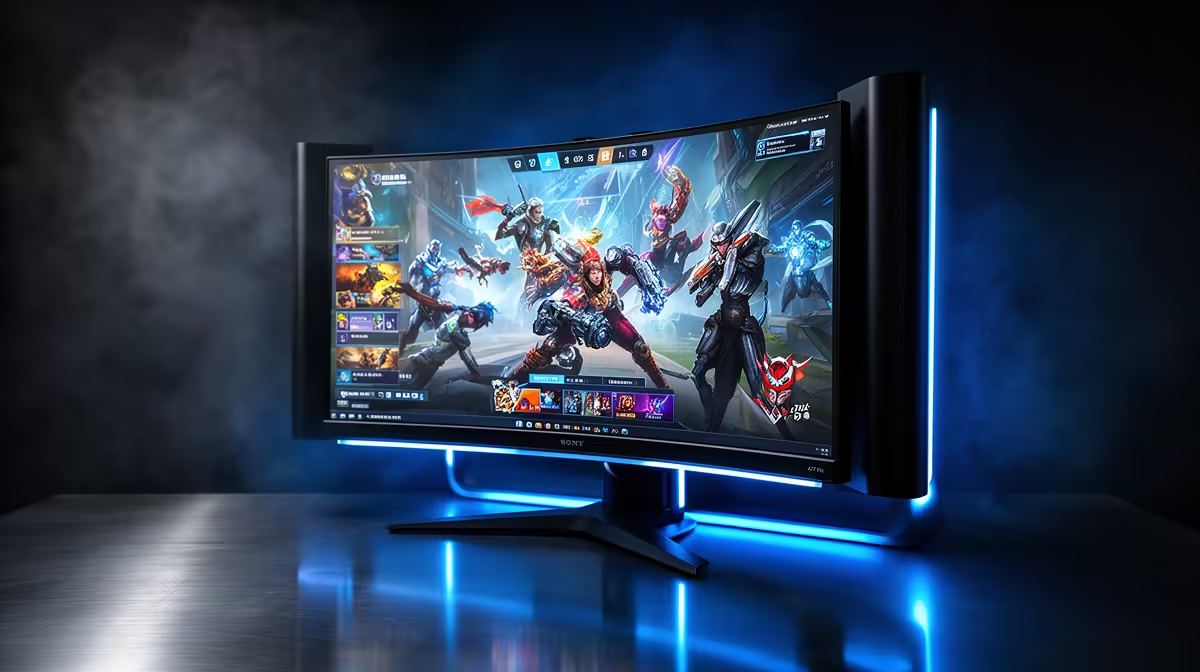
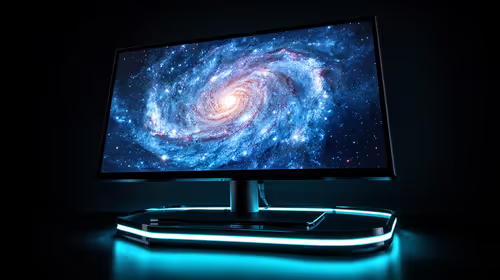
For casual and mid-level esports players in SA, yes, a 31.5-inch FHD curved gaming monitor is worth it if the panel is a fast-VA or IPS type with a refresh rate of at least 165 Hz. Competitive professionals at the top tier typically prefer 24 to 27-inch QHD or 1080p screens for pixel density and peripheral-vision clarity.
What 31.5 Inches and FHD Actually Mean for Gaming 🖥️
A 31.5-inch panel at FHD (1920 x 1080) produces a pixel density of roughly 70 ppi. For comparison, a 27-inch FHD screen gives about 82 ppi. This lower pixel density is the main trade-off: text and fine detail appear slightly softer at normal viewing distances. For gaming, where you sit 60 to 80 cm from the screen, this is visible in fine textures and small UI elements, but in motion during fast-paced titles like CS2, Valorant, or Apex Legends the difference is rarely distracting.
How the Curve Affects Competitive Play 🎮
The curvature on 31.5-inch gaming monitors is typically 1500R or 1800R. At 1500R the screen curves more aggressively, placing the edges closer to the eye plane and reducing the angular difference between the screen centre and edges. For a 31.5-inch panel this means the corners sit about 5 to 8 degrees closer to your natural gaze compared to a flat screen of the same size. In practice this reduces head turning during long sessions and minimises the distortion that appears on flat screens when you look at the extreme corners. For esports the benefit is subtle but real: enemies moving along the edge of the frame appear slightly less distorted and at a more natural viewing angle.
FHD at 31.5 Inches: GPU Demands and Frame Rates 💻
FHD at 31.5 inches is GPU-friendly. Even an entry-level dedicated GPU like the RX 7600 or RTX 4060 can push 200-plus frames per second in competitive titles at this resolution, which fully utilises a 165 Hz or 250 Hz panel. This is the practical advantage of FHD over QHD on a large screen for SA gamers: you do not need to spend R8,000 to R12,000 on a GPU to hit high frame rates. A mid-range GPU at R5,000 to R7,000 paired with a 31.5-inch FHD curved monitor at R5,000 to R6,000 gives a competitive esports setup for under R13,000 total for the display and GPU portion.
Set Your Viewing Distance Before Calibrating ⚡
For a 31.5-inch monitor, the optimal viewing distance is 70 to 90 cm. Sit closer and the pixel grid becomes visible; sit further and the immersive benefit of the large panel diminishes. Measure your actual desk depth before buying a 31.5-inch screen to confirm it fits your workspace and leaves your eyes at the right distance from the panel surface.
FAQ
Is 1080p good enough at 31.5 inches for competitive gaming?
For fast-paced competitive play where frame rate matters more than visual fidelity, yes. The pixel density trade-off versus a smaller 1080p screen is visible but does not affect competitiveness in titles like Valorant or CS2 where enemy models are large relative to the screen.
Does a curved monitor give a real advantage in esports?
The curvature reduces eye travel and screen distortion at the panel edges, which is a genuine ergonomic benefit in long sessions. It does not provide an unfair mechanical advantage, but it does reduce fatigue over multi-hour play sessions compared to equivalently sized flat panels.
What GPU do I need for a 31.5-inch FHD 165 Hz monitor in SA?
An RX 7600 or RTX 4060 handles most competitive titles at high frame rates on FHD resolution. For graphically demanding AAA titles you may need to reduce quality settings to maintain 165-plus fps, but in esports-category games these GPUs run freely at that threshold.
Looking for the right curved gaming monitor for your SA esports setup?
Evetech stocks 31.5-inch FHD curved gaming monitors with high refresh rates and fast panel technology. Browse current stock to find the right screen for your rig.