Quick Answer
For high-core-count CPUs like the Ryzen 9 9950X (16 cores, 170W TDP) or Core Ultra 9 285K (24 cores, 250W TDP), a quality 360mm AIO typically holds temperatures 6°C to 14°C lower under sustained all-core load compared to a premium dual-tower air cooler. For gaming loads, the advantage narrows; for sustained rendering, the AIO is clearly better.
Performance Under Sustained All-Core Load 🌡️
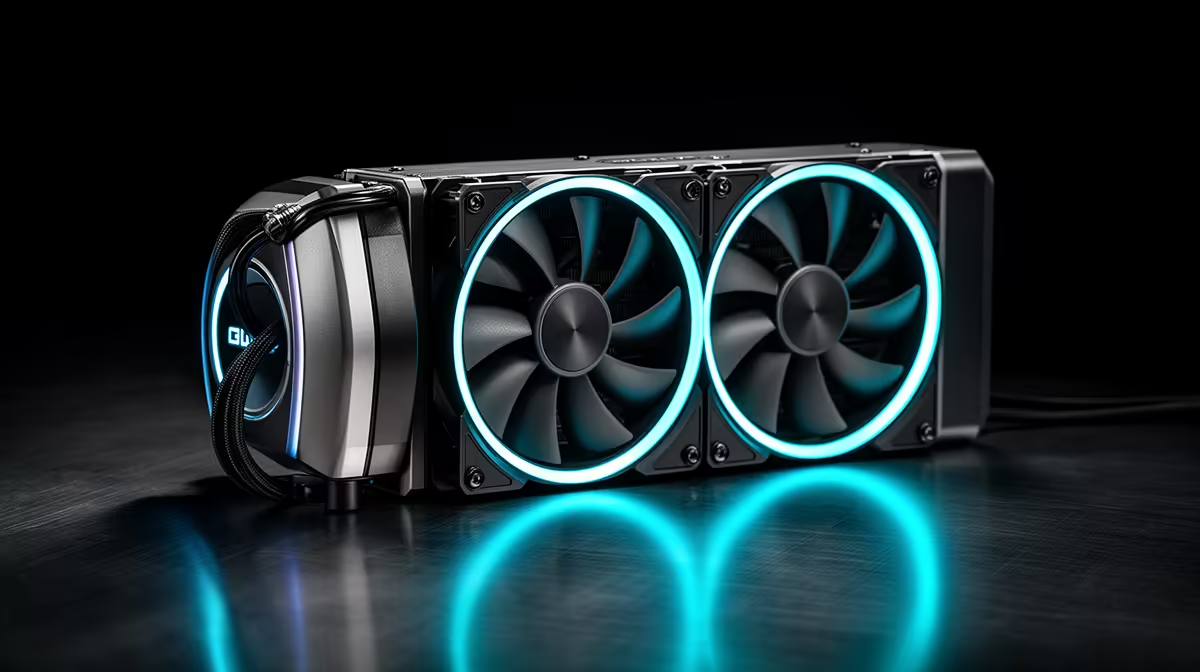
The core advantage of a 360mm AIO over a large air cooler is sustained thermal capacity. Premium air coolers like the Noctua NH-D15 handle TDPs up to 250W adequately in a well-ventilated case, but under sustained all-core loads on a 16-core or 24-core CPU for extended periods, heat builds faster than ambient airflow can dissipate. A 360mm AIO's radiator surface area is roughly triple that of a dual-tower air cooler, allowing it to shed heat more rapidly into the case's exhaust airflow. Under a one-hour Cinebench multi-core loop on a Ryzen 9 9950X, a quality 360mm AIO typically holds package temperature 8°C to 12°C below a comparable premium air cooler, translating to the CPU sustaining boost clocks longer and throttling less frequently.
Gaming Loads: The Air Cooler Case 🎮
In gaming workloads, high-core-count CPUs rarely sustain all-core full power draw. Games utilise a subset of cores at high frequency rather than stressing every core simultaneously. Under gaming loads, a Ryzen 7 9800X3D draws roughly 80W to 120W in typical scenarios, and a quality dual-tower air cooler handles this comfortably with CPU temperatures below 75°C at 25°C ambient. The 360mm AIO advantage narrows to 3°C to 6°C in this scenario. If gaming is the primary use case and the CPU is a gaming-optimised chip, the air cooler is a genuinely competitive option and costs R400 to R1,200 less than a 360mm AIO in the South African market.
Practical SA Considerations: Case Clearance and Ambient Heat ☀️
In South Africa's warmer climate, ambient room temperatures during summer regularly reach 28°C to 35°C. A premium air cooler that manages a Ryzen 9 9950X at 80°C in a 22°C Joburg autumn may hit 92°C or throttle in a 34°C summer afternoon in the same build. The AIO provides a larger thermal buffer in summer conditions. Physical fit is another factor: large dual-tower air coolers can conflict with RAM height and case side-panel clearance in compact mid-towers. A 360mm AIO eliminates the RAM and clearance conflict at the cost of requiring a case that accommodates a 360mm radiator.
Choose a 360mm AIO for Workstation CPUs, Air for Gaming-Only Builds ⚡
If your CPU is a Ryzen 9 9950X or Core Ultra 9 285K running sustained rendering or compilation workloads, the 360mm AIO is worth the premium. If your CPU is a gaming-optimised chip like the Ryzen 7 9800X3D and your workload is predominantly gaming, a quality premium air cooler keeps temperatures safely within range for R600 to R1,500 less.
FAQ
Do 360mm AIOs require maintenance that air coolers do not?
Closed-loop AIOs are sealed and require no coolant top-ups. The only moving parts beyond the fans are the pump, which averages five to seven years of operational life. Air coolers have no moving parts beyond the fans. The AIO adds a slight long-term reliability consideration that air coolers do not share.
What does a quality 360mm AIO cost in South Africa compared to a premium air cooler?
Premium dual-tower air coolers range from R1,200 to R2,200 locally. Quality 360mm AIOs start at around R1,800 to R2,500 for mainstream models, rising to R3,500 to R5,000 for premium display models.
Can a 360mm AIO fit in a standard mid-tower ATX case?
Most mid-tower ATX cases support either top or front 360mm radiator mounts. Verify the case's supported radiator sizes in its specification sheet. Some compact mid-towers cap at 280mm or 240mm due to VRM heatsink clearance on the motherboard.
Cooling a high-core-count CPU and not sure which route to take?
Browse Evetech's 360mm AIO coolers and premium air coolers side by side, with options for AM5 and LGA1851 sockets stocked locally.