Quick Answer
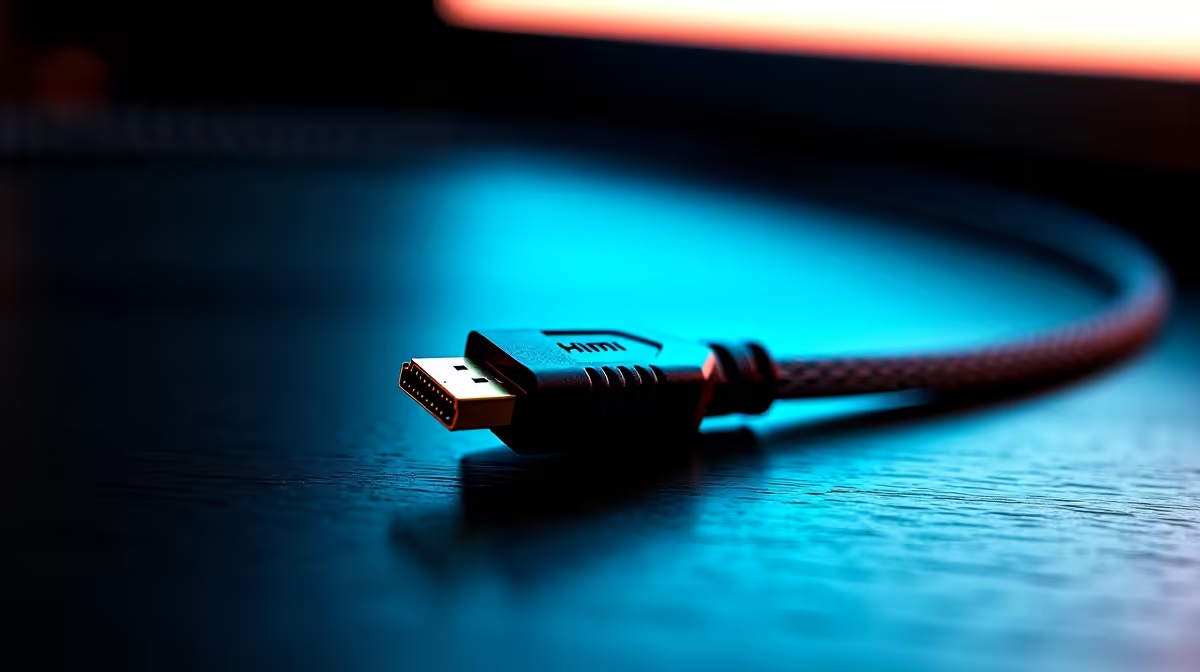
Yes, a 5m HDMI 2.0 cable is enough for 4K 60Hz gaming and streaming. HDMI 2.0 carries 18Gbps, which is the minimum bandwidth required to run 4K at 60Hz with full HDR, and passive copper cables hold that spec reliably up to 5m without signal loss.
The Bandwidth Maths Behind 4K 60Hz 🖥️
A raw 4K 60Hz signal with 4:4:4 chroma and 8-bit colour depth demands around 17.8Gbps. HDMI 2.0's 18Gbps ceiling clears this by a narrow but sufficient margin. Add HDR10 metadata and the cable is still within spec at 5m, provided the conductor gauge is 28AWG or better. Streaming services like Netflix and Showmax South Africa output HDR10 at up to 4K, and a 5m HDMI 2.0 cable carries that signal from a streaming stick, smart TV box, or PC without chroma subsampling or frame-rate reduction. Gamers using a PS5 or an Nvidia RTX 5070-powered rig benefit equally: 4K 60Hz is the sweet spot these consoles and mid-range GPUs target, and 5m gives enough slack to route cables neatly behind furniture.
Why 5m Is the Practical Sweet Spot for SA Living Rooms 🏠
Most South African lounge setups place the TV on a wall-mounted bracket or entertainment unit between 2m and 4m from the media cabinet or gaming corner. A 5m cable covers those distances with enough surplus to route along skirting boards or through cable conduit without pulling tight. Going shorter saves a little money but risks a taut run that stresses the connector; going longer than 5m with a passive cable risks signal attenuation at 4K 60Hz and may require an active HDMI 2.0 cable (typically 30 to 50 percent pricier). At around R180 to R300 for a certified 5m HDMI 2.0 unit locally, the length-to-price ratio is hard to fault.
Streaming vs Gaming: Does the Cable Behave Differently? 🎮
The cable itself has no awareness of what it is carrying. Whether the source is a streaming app pushing a Dolby Vision encode from a DStv decoder or a PS5 outputting 4K 60Hz HDR10 gameplay, the electrical requirements are identical. The one nuance is that some 4K 120Hz gaming modes (available on PS5 and Xbox Series consoles) require HDMI 2.1's 48Gbps bandwidth, which HDMI 2.0 at any length cannot deliver. If you only game at 4K 60Hz, HDMI 2.0 remains the correct and cost-effective cable choice. If you want 4K 120Hz, you need an HDMI 2.1 cable and a display with an HDMI 2.1 port.
Enable Enhanced HDMI Mode on Your TV ⚡
After connecting your 5m HDMI 2.0 cable, navigate to your TV's settings and enable 'Enhanced' or 'HDMI 2.0' mode on the specific port you are using. Without this step, many SA-market TVs default to HDMI 1.4 mode and cap the output at 4K 30Hz even with a capable cable. The option is usually labelled 'HDMI Signal Format' or 'Input Signal Plus'.
FAQ
Will I notice any input lag from a 5m cable compared to a 1m cable?
No. HDMI signals travel at close to the speed of light through the cable. The propagation delay added by 5m versus 1m is measured in nanoseconds, which is completely imperceptible in gaming or streaming.
Can I use the same cable for both a gaming PC and a streaming device?
Absolutely. HDMI 2.0 is a universal spec, and the cable works identically regardless of source. Simply unplug from one device and plug into the other.
Does a 5m cable need to be a specific brand to maintain 4K 60Hz?
Brand matters less than certification. Look for cables that explicitly state HDMI 2.0 or 18Gbps on the packaging. Evetech stocks certified HDMI 2.0 cables; if the spec is printed, the cable has been tested to meet it.
Setting up a 4K gaming or streaming space?
Evetech carries certified 5m HDMI 2.0 cables suited to PS5, Xbox, and PC builds, available for delivery across South Africa.