Quick Answer
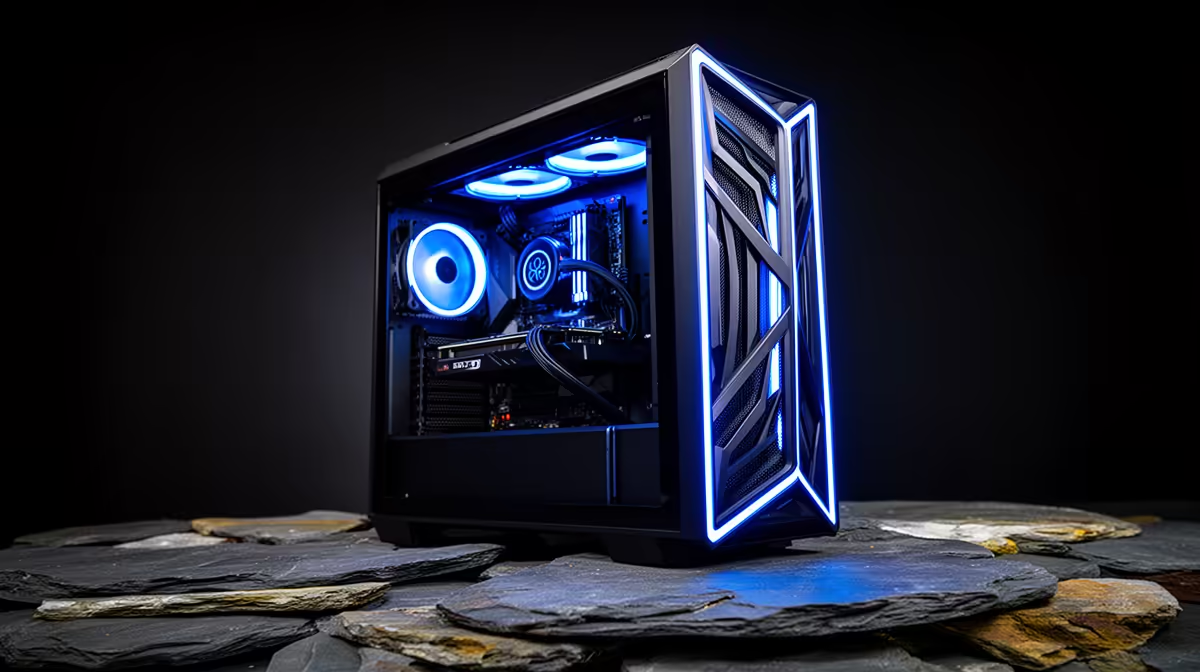
Yes, a dual-chamber case is better for high-performance gaming builds. When combined CPU and GPU TDP exceeds 350W, isolating the PSU and cable mass from the main airflow path reduces CPU temps by 4 to 10 degrees Celsius and GPU junction temps by 4 to 8 degrees Celsius compared to equivalent hardware in a traditional single-chamber mid-tower.
Why High-Performance Builds Specifically Benefit 🚀
At mid-range TDP levels, a well-ventilated traditional case is adequate. The dual-chamber advantage becomes decisive when the thermal load is high enough that even a small increase in intake air temperature causes noticeable performance loss. An RTX 5080 at 320W sustained load and a Ryzen 9 9950X at 170W together produce 490W of heat that the case must remove. In a shared airflow design, the interior temperature rises significantly above ambient before the rear and top exhaust can clear it, and some pre-heated air re-enters the front intake as turbulence. A dual-chamber case eliminates the PSU heat contribution from the main chamber, typically 80 to 150W in an 80+ Gold or Platinum unit at load, and removes the cable turbulence that disrupts smooth front-to-back airflow.
Thermal Data That Supports the Dual-Chamber Choice 🌡️
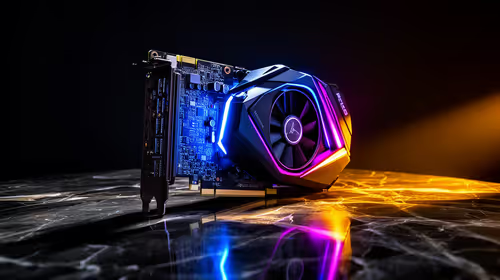
Builds using the RTX 5080 in a dual-chamber case paired with front 360mm AIO cooling show GPU hotspot temps of 78 to 83 degrees Celsius at full load in a 24-degree room, versus 86 to 91 degrees Celsius in a comparably equipped traditional mid-tower. At 83 degrees Celsius hotspot, the RTX 5080 sustains its full boost clock. At 91 degrees Celsius, the thermal throttle engages periodically, dropping GPU frequency by 50 to 100MHz and reducing average frame rates by 2 to 4 percent. South African gamers in Pretoria or Kimberley where summer ambient temps hit 35 degrees Celsius see this thermal advantage expand further.
Is the Premium Worth It for Different Build Tiers? 💰
For builds with an RTX 5070 Ti and above, or any GPU drawing over 250W sustained, the dual-chamber premium is worth it. The step from a quality traditional mid-tower at R2,000 to a quality dual-chamber case at R4,500 is R2,500. On a build spending R18,000 to R22,000 on the GPU alone, R2,500 on a thermally superior case represents an 11 to 14 percent incremental cost that delivers sustained performance preservation. For builds with an RTX 5060 Ti or below drawing under 170W, the traditional case is adequate.
Pair a Dual-Chamber Case With a 360mm AIO for Best Results ⚡
The dual-chamber layout works best when CPU cooling is handled by a liquid cooler mounted at the front or top, completely removing CPU heat from the main airflow path. With an AIO handling CPU temps and the dual-chamber isolating PSU heat, the remaining case air manages only GPU exhaust, giving the most thermally clean high-performance environment possible.
FAQ
Does the GPU brand or cooler design change how much the dual-chamber helps?
GPU cooler design affects baseline temps but the dual-chamber benefit is consistent regardless of GPU brand. All axial-fan GPUs benefit from receiving cooler intake air from an uncontaminated main chamber. Blower-style GPUs exhaust heat directly out the rear of the case and see less benefit from improved intake conditions.
Will a dual-chamber case make my system louder or quieter?
Generally quieter under load. Because components run cooler, fan curves stay at lower RPM levels throughout a gaming session. PSU fans in the secondary chamber are audibly isolated from the main listening position, further reducing perceived noise.
Are there dual-chamber ITX or mATX cases for smaller builds?
Dual-chamber ITX cases exist but are rare, with most examples in the R3,500 to R6,000 SA price range. mATX dual-chamber options are more available. The feature is most commonly found in ATX and E-ATX form factors.
Building a high-performance gaming PC in South Africa?
Evetech stocks dual-chamber gaming cases suited to flagship builds, with options supporting 360mm AIOs, full-length GPUs, and E-ATX boards. Browse the range at Evetech.